Taiwan-U.S. Trade Deal
Taiwan signed a tariff-reducing trade deal, the Agreement on Reciprocal Trade, or ART, with the U.S. on February 12. The deal cut U.S. tariffs on Taiwanese exports to 15%, and will bring Taiwan into more regulatory alignment with the U.S. and increase cooperation on economic and national security. Taiwan also committed to purchasing $85 billion in U.S. goods, including energy and aircraft.
Writing for Global Taiwan Institute, Riley Walters described the ART as “most significant trade agreement between the United States and Taiwan in decades, and perhaps the closest thing the two countries will ever have to a bilateral trade agreement.”
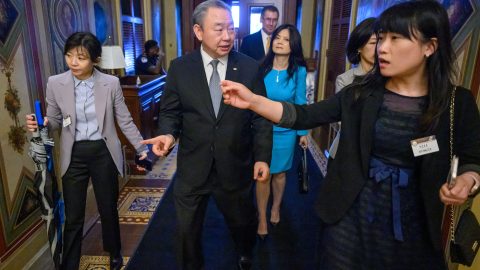
Taiwan’s vice premier, Cheng Li-chiun (鄭麗君), signed the deal in Washington with U.S. Trade Representative Jamieson Greer and Commerce Secretary Howard Lutnick.
The deal is not yet in force. On the Taiwanese side it will need to be approved by parliament, potentially a sticking point. Just a week after the deal was signed, the U.S. Supreme Court ruled that President Donald Trump did not have the authority to impose the tariffs that he had implemented in 2025, throwing many of the U.S.’s negotiating partners into subtle confusion as they attempted to work out what the new state of affairs was.
2026 U.S.-Taiwan Economic Prosperity Partnership Dialogue
The trade deal followed the 2026 U.S.-Taiwan Economic Prosperity Partnership Dialogue, which took place on January 27. Taiwan’s minister of economic affairs, Kung Ming-hsin (龔明鑫), met with Jacob Helberg, the U.S. under secretary for economic affairs. They witnessed the signing of a joint statement on the Pax Silica Declaration and U.S.-Taiwan Cooperation on Economic Security by the American Institute in Taiwan (AIT) and the Taipei Economic and Cultural Representative Office in the United States (TECRO).
“Therefore, we, through our designated representatives, hereby endorse the principles of the Pax Silica Declaration,” the joint statement reads. “We, through our designated representatives, intend to work together to further deepen our economic cooperation, in close coordination with the Pax Silica signatories.”
Taiwan, somewhat incongruously as the leading manufacturer of cutting edge semiconductors, is not a directly a signatory of the Pax Silica, a U.S. effort on AI and supply chain security pact. It is now the only “Non-signatory Participant.”
Delegations
The steady drumbeat of parliamentary visitors to Taiwan from other democracies continues.
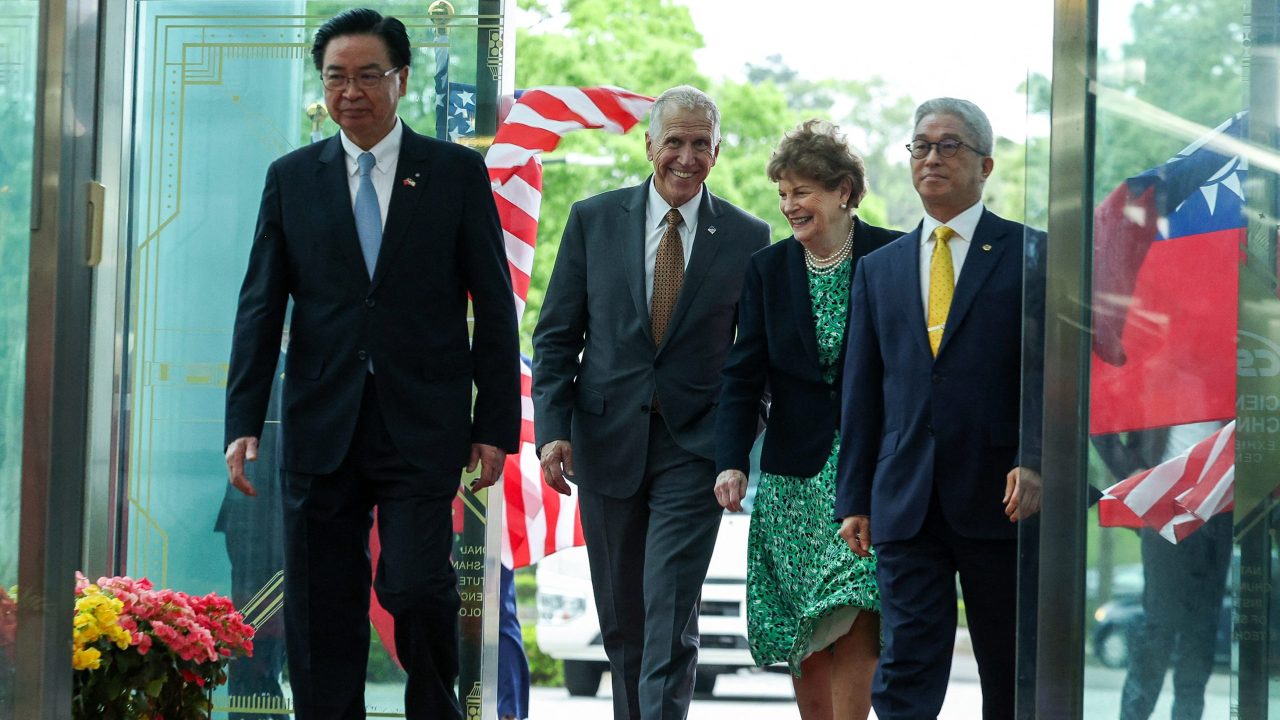
Four members of the U.S. Senate Foreign Relations Committee met with Taiwanese President Lai Ching-te (賴清德) on March 30. The delegation was composed of Jeanne Shaheen, John Curtis, Thom Tillis and Jacky Rosen. The senators urged Taiwan to increase its defense spending, which is still mired in a partisan battle in the legislature.
In April, Lai met with two further U.S. delegations. One was led by Zach Nunn, chairman of the National Security Task Force of the United States House Republican Study Committee, and including Scott Fitzgerald, Julie Fedorchak and Jefferson Shreve. The other was led by Jim Banks, who sits on the Senate Armed Forces Committee and was one of 37 congressional signatories of a letter urging Taiwanese lawmakers to pass a stalled special budget to increase defense spending.
On March 16, Lai met with Furuya Keiji, a member of the Japanese House of Representatives and a longtime leader of the Japan-ROC Diet Members’ Consultative Council. Furuya emphasized the current situation of Chinese pressure on Japan, saying that to prevent a Taiwan contingency from occurring, Japan will steadily strengthen its cooperation with countries that share common values to safeguard Taiwan and its democracy.
It was the turn of a delegation from the European Parliament’s Committee on Security and Defence on March 31. Lai met with Chair Marie-Agnes Strack-Zimmermann, as well as Nicolas Pascual le la Parte, Jose Cepeda, Urmas Paet, Martins Stakis and Nikolas Farantouris, all members of the European Parliament. Strack-Zimmermann said that the purpose of the trip was to deepen their understanding, listen carefully and strengthen their cooperation with Taiwan.
World Trade Organization
Taiwan withdrew from a WTO meeting that was hosted in Cameroon at the end of March. Taiwan’s Ministry of Foreign Affairs initially said that the nationality of Taiwan’s delegation was listed as “Taiwan, Province of China.”
There was then an apparent offer to exempt the delegation from the visa requirement, but the foreign ministry said the new documentation was riddled with errors, creating “an even greater risk of being obstructed or humiliated upon arrival.”
The WTO is one of the few international organizations where Taiwan is a full member. Foreign Minister Lin Chia-lung (林佳龍) subsequently claimed that Taiwan’s nonattendance had no direct impact on its interests.
Take Cho Out to the Ball Game
Taiwanese Premier Cho Jung-tai (卓榮泰) made a surprise appearance at a World Baseball Classic game in Tokyo on March 7, where Taiwan was playing Czechia. Cho attended the game with the Taiwanese representative to Japan, Lee Yi-yang (李逸洋), Sports Minister Lee Yang (李洋) and Chinese Professional Baseball League (Taiwan’s domestic league) commissioner Tsai Chi-chang (蔡其昌).
Cho claims that the trip was undertaken in a private capacity. Think China reported that it was the first visit to Japan by a sitting premier in 54 years, apart from an unplanned diverted flight that landed in Okinawa carrying You Si-kun (游錫堃) in 2004. But Ocean Affairs Council Minister Kuan Bi-ling (管碧玲) suggested that Cho must have met with Japanese officials, according to local media reports. Japanese Chief Cabinet Secretary Minoru Kihara denied such meetings took place.
Rather predictably, the opposition parties have fired off several fastballs at Cho, alleging that the trip was a waste of public funds. Cho claims he paid for the trip, including privately chartering a China Airlines passenger jet.
More recent reports suggest that Japan isn’t too happy about the media furore.


Leave a Reply