
At the Taipei Aerospace & Defense Technology Exhibition, there was an abundance of counter-uncrewed air systems, or counter-UAS. Many different vendors were hawking their wares, especially hard-kill solutions that physically damage the target. But there is one place, seemingly, where hard-kill counter-UAS is absent. None of the companies have yet persuaded Taiwan’s defense ministry to buy their weapons.
The key problem counter-UAS seeks to solve is that drones can be fielded cheaply and in large numbers, so counter-UAS has to be correspondingly low-cost, otherwise the defender will be priced out of defending themselves. Traditional air defense systems are more expensive, in part because they have to be capable of handling much larger missiles and planes.
There are various solutions. Instead of expensive surface-to-air missiles, counter-UAS can use electronic warfare, or jamming, to disrupt the communications between a drone and its controller, meaning that it either misses or even lands itself. This is known as a soft kill. Alternatively, guns, lasers, microwave weapons or drone interceptors, effectively anti-drone drones, can be used to knock drones out of the sky, the aforementioned hard kill.
Counter-UAS has received renewed interest in the past two weeks because of Russian drone incursions into Poland. Nineteen drones flew into Polish airspace on September 10; Polish president Donald Tusk said that Poland had shot down three or four. Europe is now looking again at how it lacks the capabilities to handle this kind of threat effectively.
The proliferation of drones on the battlefield in Ukraine and beyond has meant that militaries everywhere are scrambling to acquire cheap counter-UAS. China, and specifically one company DJI, is far and away the largest manufacturer of commercial drones and their components. The Center for a New American Security recently published a report saying that “the United States could lose a war over Taiwan,” unless it invests in counter-UAS.
Taiwan has implemented jamming systems since 2022, when Chinese drones flew over the outlying island of Kinmen unimpeded. However, on the frontline in Ukraine electronic warfare is now so intense that radio-controlled drones effectively have no chance — this has led to the widespread adoption of systems that are impervious to jamming, like fiber optic controls.
It was reported in January that Taiwan had purchased counter-UAS systems to protect its airbases, which would be deployed in 2025 and 2026. The company providing these systems is Tron Future, a domestic manufacturer. Delivery of all 26 systems will be complete by April of 2026, according to Misha Lu (呂亦塵), a staff specialist at the company.
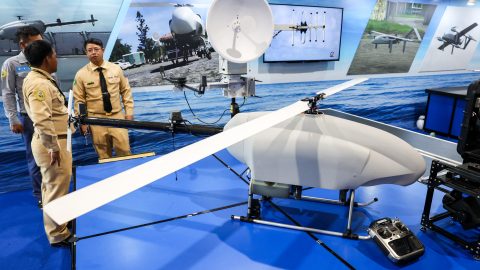
The reporting on Tron Future’s system frequently mentions that it includes both jammers and interceptors. However, the company confirmed to Domino Theory this week that Taiwan’s military has not purchased interceptors from them. And to be clear, Tron Future is not shying away from this. Tron’s booth at Taipei Aerospace & Defense Technology Exhibition featured a fiber optic-controlled drone that Tron’s own jammers would not be able to stop, as well as numerous models of the interceptors they would like to sell to Taiwan.
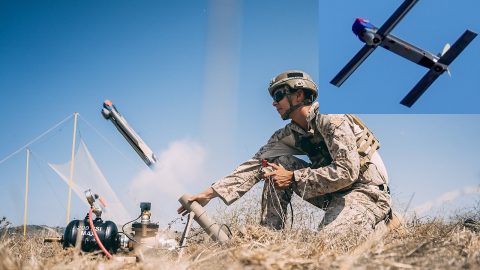
The T. Interceptor CS, one of two different interceptors Tron Future was promoting, is a single-use drone that is intended to take out between three to five enemy drones. Tron Assistant Manager Chai Chun-yu (柴俊瑜) explained to Domino Theory that the CS targets the propellers of enemy vehicles, knocking them out of the sky and moving on to another enemy. Itself much smaller than one meter across, the CS should be effective against drones with a wingspan of up to two meters. Chai said that the CS is six months away from production.
The second interceptor was called T. Interceptor MP and is a reusable drone that can shoot nets at smaller enemy drones, especially quad-copters whose rotors are vulnerable to fouling.
Tron Future would appear to have a leg up on the competition trying to sell interceptors to Taiwan’s military because its systems will already be in place on air fields. But there were a multitude of competitors showing off their solutions nonetheless.
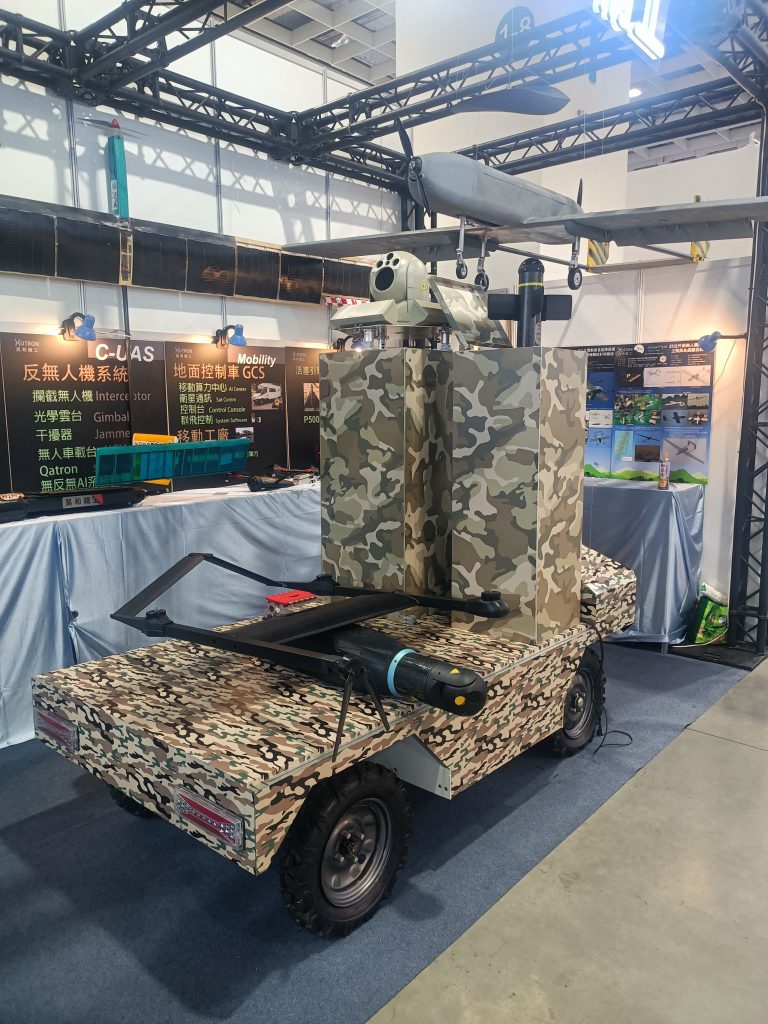
Hutron is offering an integrated counter-UAS package, with the entire system fitted on an uncrewed ground vehicle, or UGV. It mounts an optical sensor, with radar an optional extra. The UGV is fitted with two jammers and a vertical launch system, or VLS, for interceptors. Each VLS cell can hold one large interceptor or four small ones, General Manager Frank Fan (樊毓漢) explained. He said that the sensor, the jammers and the large interceptor would be effective out to 10 kilometers, although they are testing at 5 kilometers now.
Perhaps most intriguing is that Fan said the cost to produce their interceptors is $2,000 to $3,000 for the large one and $1,000 for the small, and that they can ship right now, in volumes in the hundreds.
Hutron is also working on making its own drones as well as shooting others’ down. Fan explained that they are skipping fiber optic-controlled drones and moving straight to autonomous AI-controlled ones because they believe that technology will mature within a year. On investigation, this turned out to be a commonly held view at the Taipei Aerospace & Defense Technology Exhibition.
Interceptors aren’t the only game in town. Several companies were showing off laser-based counter-UAS, including government defense contractor Aerospace Industrial Development Corporation, whose counter-UAS laser is intended to be integrated into a system containing radar, guns and microwave weapons. It needs a large 800-kilowatt battery, but this is still vehicle portable.
Aerospace Industrial Development Corporation’s laser has an effective range of two to three kilometers. However, business manager Lee Chi-Lin (李奇霖) explained to Domino Theory that development is ongoing, with achieving this range being the issue. He said that development should finish at the end of 2025, with production in 2026. Asked if he hopes or expects that the laser will be ordered, he said both.

The picture that emerged from the Taipei Aerospace & Defense Technology Exhibition was of companies keen to sell systems to Taiwan’s military, with those systems perhaps not quite being ready for service, and Taiwan not being quite ready to buy.
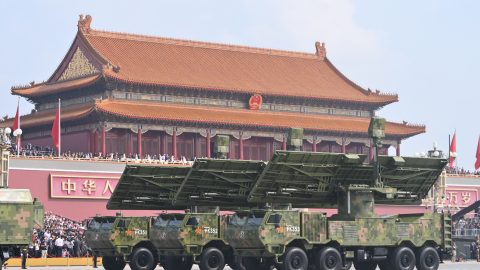
Taiwan is falling behind China in counter-UAS. Beijing showed off gun and missile-, laser- and microwave-based counter-UAS at its September 3 military parade, although it’s unclear whether all of these systems are in service. “A parade is a spectacle. It’s not a demonstration of capability,” according to Mark Montgomery, a retired U.S. Navy rear admiral and senior fellow at the Foundation for Defense of Democracies.
UAS and counter-UAS are evolving rapidly, in part driven by the innovation that is taking place in Ukraine. The jammers that Taiwan has already bought will still have their place. But for the increasing threat of autonomous drones, as well as the current fiber optic-controlled generation, hard-kill solutions are imperative.
Montgomery put it quite simply: “If there’s an effective interceptor out there, and it’s cost-effective, I’d buy it.”


Leave a Reply