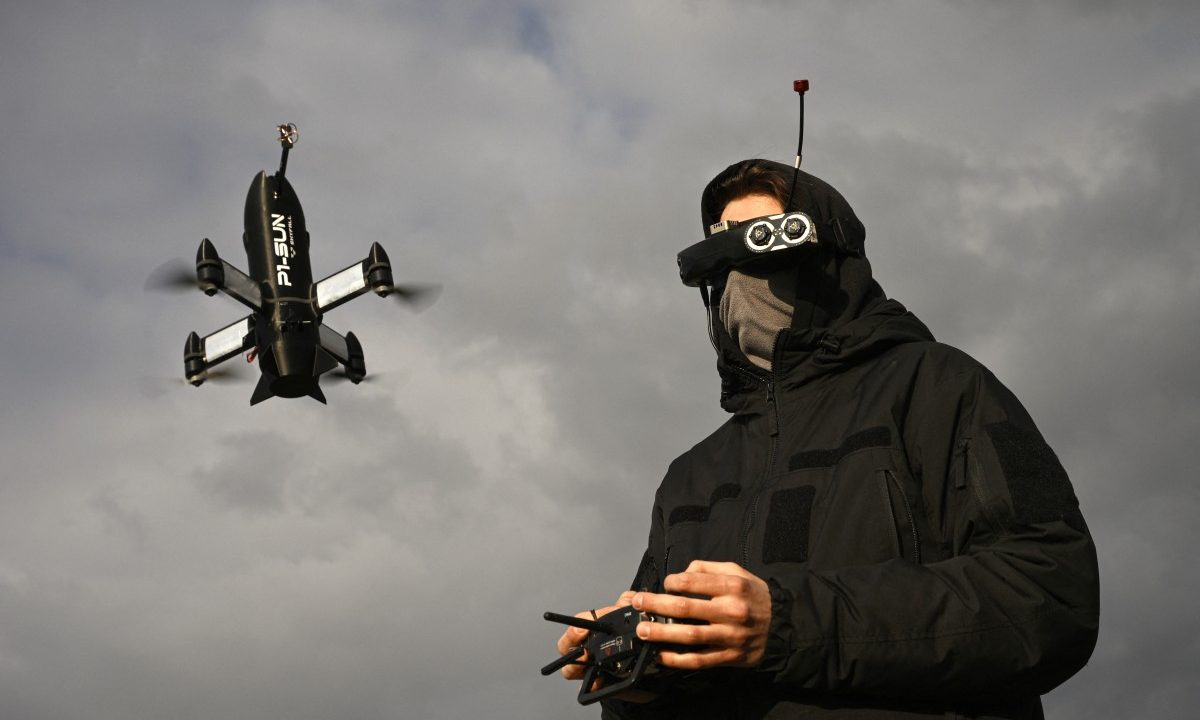
Taiwan knows that its military is going to need a lot more drones of all types. The government has put resources behind creating a robust domestic industry, and there are signs that policies are starting to bear fruit. But it’s still early days.
At the same time, Taiwan continues to acquire traditional weapons, including legacy systems purchased from the U.S. The recently announced $11 billion arms sale from the U.S. contains 82 new HIMARS rocket artillery systems and 60 M109A7 Paladin gun artillery systems, each costing around $4 billion.
At a panel event in Taipei on March 27, a Ukrainian combat veteran, whose current job title was undisclosed “because of some sensitivity reasons,” spoke about the lessons Ukraine has learned about drones on the battlefield. Moving from traditional artillery to FPV drones was saving money and increasing accuracy, Illia Hriaznov said.
“Normal artillery [shells] cost something like $6,000 to $7,000,” whereas small- or medium-sized drones cost “$1,000, $1,200, and they are much, much more accurate than artillery [shells],” Hriaznov said, adding that this change in cost and effectiveness had led to a 50% reduction in infantry deaths.
The event, titled the Democratic Resilience Roundtable, was cohosted by Taiwanese legislator Chen Kuan-ting (陳冠廷), who is the co-convener of the Foreign Affairs and National Defense Committee, and three NGOs: the Liberal Democratic League of Ukraine, Taiwan NextGen Foundation, and the Friedrich Naumann Foundation for Freedom.
Domino Theory caught up with Legislator Chen after the event to ask why Taiwan is still spending money on legacy artillery given the comments from the Ukrainian speaker.
“Artillery and drones. That’s my response to your questions. We need both,” Chen answered forcefully. Taiwan needs to respond to a forever-changing combat field, he added, and it needs a theory of how to deliver military power. But he emphasized: “We need everything. We have to prepare.”
Drones behaving like artillery is certainly a trend, said Misha Lu (呂亦塵) from Tron Future, a Taiwanese company that has already sold counter-uncrewed air systems, or counter-UAS, to the Taiwanese military. However, he pointed to differences between Taiwan and Ukraine. Both Ukraine and Russia were running low on artillery supplies when they made the switch to drones, he said, but Taiwan still has a “significant artillery stockpile.”
Artillery also has a devastating psychological effect, Lu said, that is hard to replicate with drones unless you coordinate a significant swarm onto a single position. Nonetheless, he pointed to Chinese military propaganda videos of the use of mass drone coordination, and said: “We don’t know if they are real. We don’t know if they are combat ready yet, but the trend is there.” Tron is taking this into consideration, Lu said.
Taiwan’s efforts to improve its domestic drone industry have included making it a priority under the military pillar of President Lai Ching-te’s (賴清德) Five Sectors industrial plan and building a dedicated drone research and development park in Chiayi, with a manufacturing industrial park and a testing facility to follow. Perhaps not coincidentally the manufacturing park will be in Chen’s own constituency. Taiwan has placed a lot of emphasis on building and providing a “non-red” supply chain for international partners who want to buy drones or drone parts that do not have Chinese components.
There are signs that this strong strategy is paying off. Taiwan exported approximately 123,000 units last year, a 35-fold increase on 2024, the Economist reported, citing Taiwan’s Customs Administration. It has already exported 85,500 in the first two months of this year alone. Almost all of them went to Czechia or Poland, but “industry insiders” told the Economist the ultimate destination was Ukraine.
Taiwan’s government is also trying to support domestic demand by ordering significant quantities of drones for itself. The government intendeds to purchase 50,898 commercial uncrewed air vehicles, or UAVs, between 2026 and 2028, and 48,750 military UAVs from 2026 and 2027, said Chen Hsi-Teng (陳汐騰) from the Ministry of Economic Affairs’ Committee for Aviation and Space Industry Development, speaking at the same event on March 27.
However, these purchases are threatened because of the ongoing legislative struggles to pass Taiwan’s defense budgets. The government’s proposal would support Taiwan’s drone industry through the $40 billion special budget. But opposition parties have said that domestic procurement should be funded through the regular acquisitions budget, which they say has more legislative oversight.
Taiwan’s legislature has been debating three different special budget proposals this week. However, Chen said that there has been “no progress” on the specific question of how to fund domestic drones. He said that he wants younger leaders from the opposition parties, like KMT mayor of Taipei Chiang Wan-an (蔣萬安), to “speak out” about this.


Leave a Reply