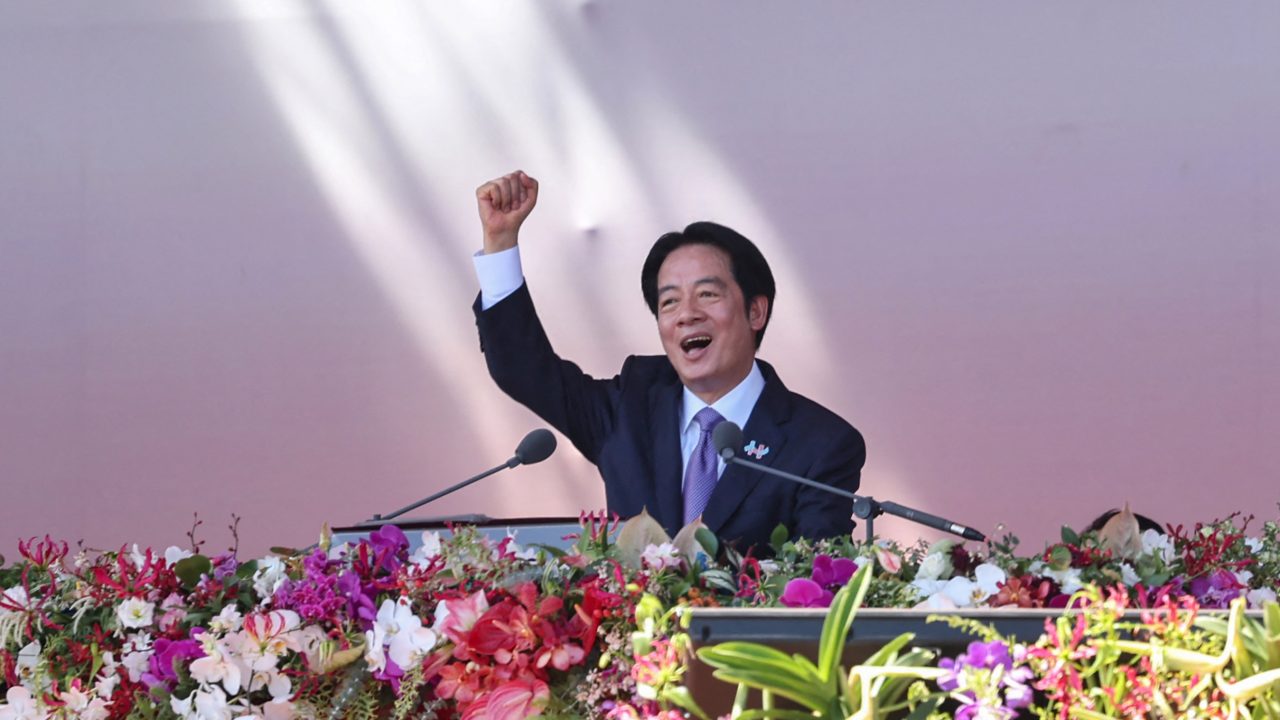
Taiwanese President Lai Ching-te (賴清德) is reviving the Cold War color code to distinguish between the good and bad sides of the global economy. “Taiwan, becoming a trusted security partner for our friends and allies, can jointly avoid the red supply chain and foster trust in defense among free and democratic countries,” Lai said during his National Day speech on Friday.
Building a “non-red” supply chain is essentially a political shorthand for the idea that democracies should prioritize economic security over efficiency by cutting China out. It has become a key part of Lai’s external messaging, but remains a grand vision rather than a concrete policy strategy for now.
The term seems to have been used for the first time by Kung Ming-hsin (龔明鑫) around 2019. At the time, Kung was Minister of State without Portfolio and head of the National Development Council for Tsai Ing-wen’s (蔡英文) government. He is now Lai’s Minister of Economic Affairs. The Chinese Nationalist Party (KMT) posted an article to their website in response to Kung’s use of the term in 2019, arguing that a non-red supply chain would “crush industries to death.” “Taiwan should maintain neutrality in the trade war, observing international law and contracts, and never place its bets on one side,” the article concluded.
The global economy has shifted since then. Before the pandemic and the first Trump administration, efficiency and the just-in-time model ruled. But the “restructuring of the global trade order that we’re seeing now has collapsed that and the same efficiencies that companies enjoyed have now become intolerable risk,” Charles Bower, a member of BowerGroupAsia’s executive committee and management team, said during a panel discussion organized by the U.S.-Taiwan Business Council at Semicon in September. “Trade wars, export controls and other crises, whether real or potential, create a spectrum of risk for supply chain disruption and business leaders have to equally weigh geopolitical uncertainty alongside their focus on products, on sales.”
Take MediaTek, Taiwan’s biggest fabless designer, for example. During the same panel discussion at Semicon, W. Patrick Wilson, Corporate Vice President for Government Affairs at MediaTek, highlighted the role that geopolitics plays in MediaTek’s business strategy, particularly as consumers increasingly care about where their technology is coming from. “I think one of the advantages we have as a Taiwanese company is we are respected as a fellow democratic ally,” Wilson said. This provides “a value add in the marketplace, and I think that’s going to continue.”
Wilson also said that a lot of companies, in Taiwan and elsewhere, are responding to the market pressure of geopolitical uncertainty. This has changed investment portfolios. Compared to 2017 or 2018, “it’s a really dramatic change,” Wilson said.
However, a quick look at their annual reports shows that while MediaTek has fewer investees in China now than they did in 2018, they were investing more than twice as much in the country by 2023.
Anduril founder Palmer Luckey thinks that the only way a democracy-friendly supply chain can be built is if “radical, ideological zealots” are put at the helm of a company’s supply chain strategy.
Speaking at National Taiwan University in August, Luckey honed in on the fact that adhering to export controls and other trade restrictions doesn’t ensure a non-red supply chain. “At Anduril, we became compliant with U.S. laws regarding Chinese supply chains and Chinese materials about two years ago. But it turns out it’s quite easy to comply with the law even if you’re still dependent on China.” Luckey gave a prescient example: “If you buy something that is made in a friendly country but that includes rare earth minerals entirely sourced from China, that still constitutes a reliance on China, even if it’s regulatorily compliant.”
Satoshi Inomata, Senior Research Fellow at the Institute of Developing Economies in Japan, agrees that “Economic Security is no longer a matter of regulatory compliance, but it should be regarded as a part of a company’s risk management practices.” Where the tipping point occurs between the benefits and risks of doing business in China, “nobody has an answer to the question. My opinion is that each company, each firm, should solve the equation by themselves,” Inomata said.
As the impact of geopolitics on the supply chain becomes increasingly fraught, perhaps Lai’s “non-red” framing will start to seem less ideological and more pragmatic. Indeed, just hours before Lai’s speech, China implemented the strictest export controls on rare earths to date.
In the vein of the U.S.’s foreign direct product rule, China will require companies to obtain an export licence for products containing even trace amounts of certain Chinese rare earths or produced using Chinese extraction or processing technology, no matter where the product is coming from or travelling to. China has a near monopoly on the mining and processing of rare earths, which are essential to producing semiconductors, cars and military technology.
As Inomata told Domino Theory, there are no short-term solutions to this dominance. “No country on our side can compete with China for this because processing of critical minerals is so environmentally costly.” China’s environmental regulations are looser than those in Japan and elsewhere. “In the end, we are actually choked up by our own regulations, not by the access to raw critical minerals, per se.” Satoshi says that the long-term solution is to develop environmentally-friendly production techniques that are cost-competitive.
On the one hand, the “non-red” framing allows Lai to market Taiwan’s as an indispensable economic contributor to the democratic world, particularly in light of China’s willingness to exert its supply chain leverage. On the other hand, the same logic that encourages diversifying away from China also flows to the conclusion that companies should diversify away from Taiwan. As financial journalist Marc Hijink said during a panel at Semicon: “the semiconductor industry has grown too successful to be depending on just a small fraction of the planet.”
Inomata worries about this for Taiwan. Big companies like TSMC “face increasing pressure from their stakeholders to offshore production bases from Taiwan, partly due to its domestic bottlenecks such as water supply, electricity and human resources, and partly, of course, due to the risks of incidents in the Taiwan Strait.”
While these companies can continue to thrive, people in Taiwan “may suffer because there will be less employment opportunities in the region, and also from the government viewpoint, less bargaining power vis-a-vis allied countries at the time of geopolitical crisis,” Inomata said.
Lai wants us to understand that technology is not ideologically neutral. The question is whether private sector actors can be convinced to take a scalpel to their supply chains.





Leave a Reply