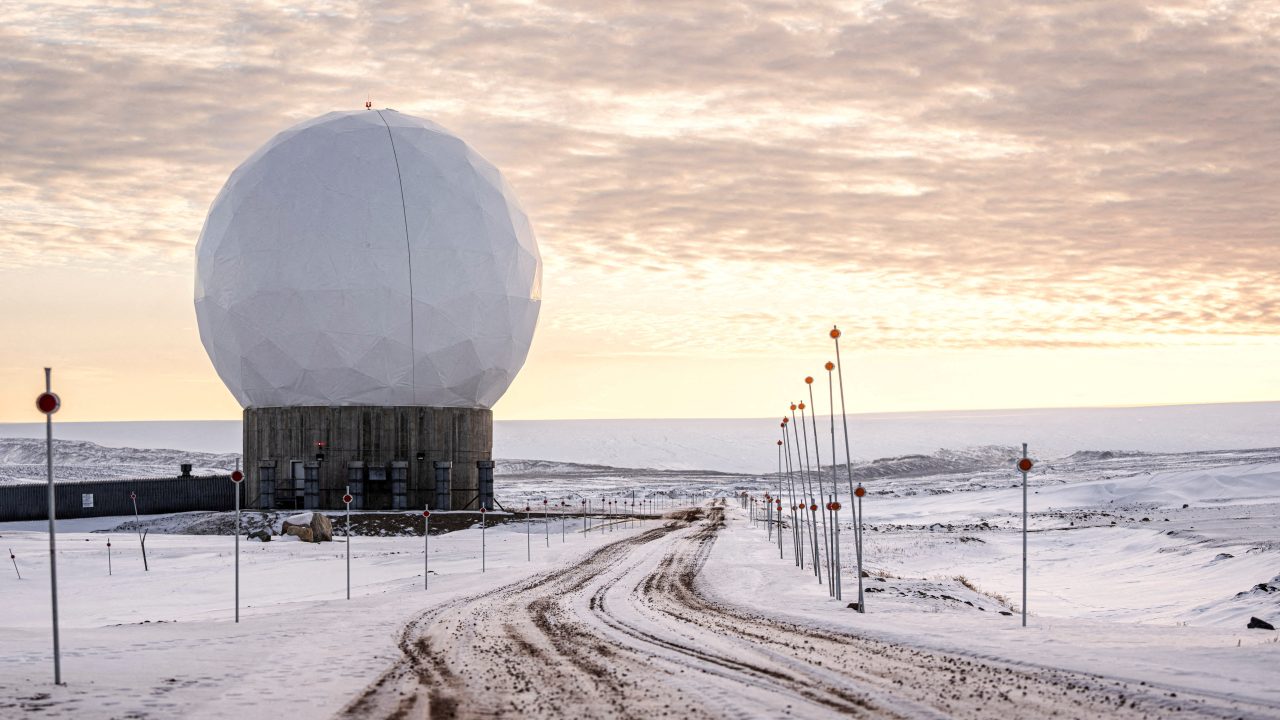
At the start of this year, when U.S. president-elect Donald Trump refused to rule out the use of force in taking ownership of Greenland, it was identified as an attempt to warn Greenlanders off allowing greater Chinese involvement on its soil. But what it also alluded to was a broader strategic battle for control of the Arctic that has intensified in recent years.
It’s long been held that the Arctic presents growing military and economic opportunities. Melting ice sheets are opening up new shipping lanes. The area contains an estimated one trillion dollars’ worth of precious metals and minerals, steadily more accessible for both technological and climatological reasons. And it’s the shortest route for intercontinental ballistic missiles between the U.S., China and Russia in an increasingly tense geopolitical environment.
All of that makes one of the coldest places on Earth a potential hotspot for competition between China and the U.S.
China’s Moves
Alongside more well-covered actions by Russia, China has responded to a changing Arctic with a number of moves into the region. In the ten years up to 2019, as U.S. polar budgets were capped post-2008 financial crisis, China invested more in polar capacity than any other nation.
It has built two permanent research stations in the Arctic, one in Norway’s Svalbard archipelago, another in Iceland.
It has set up satellite receiving stations for BeiDou-2, its strategic weapons navigating system, over the Arctic Ocean — recalibrating its strategic thinking based on a vertical map of the Earth which highlights a more direct route to the U.S. than a traditional horizontal map.
And after several other blocked efforts to build research facilities in Nordic countries, major Chinese firms have been investing in infrastructure projects at ports along Russia’s Arctic coast.
The U.S.’s Moves
A key complaint from the U.S. and NATO has been that its projects are so-called dual-use, where research capabilities can also be turned to military ends.
Chinese documentation, though, says this approach is actually based on longstanding U.S. strategy. “Military-civilian mixing is the main way for great powers to achieve a polar military presence,” the 2020 edition of one of its influential textbooks on military strategy noted.
“The military not only provides military equipment and logistical support for scientific research, but also directly participates in polar survival and polar military scientific research, crossing the westerly belt training and other projects,” it pointed out.
At the same time, U.S. documentation also makes clear that it increasingly sees the Arctic as a strategic priority.
After the 2013 National Strategy for the Arctic Region highlighted the importance of the region to U.S. security, the 2022 version emphasized increasing capabilities to prevent threats to the U.S. and its allies.
Most recently, the 2024 Arctic Strategy included commitments to update long-range early warning systems and tracking sensors and maritime surveillance systems for the North American Aerospace Defense Command, on top of conducting both independent and joint military operations.
What Are the Differences in Approach?
Clear differences between the two approaches still remain, though.
“[I]n the Arctic the main difference is that China is not an Arctic power and hence has no permanent presence or base there,” Stefan Wolff, professor of International Security at the University of Birmingham, told Domino Theory by email.
“There has been a lot of cooperation with Russia, including joint naval and air patrols. China defines itself as a near-Arctic power in its Arctic strategy (from 2018). It has a clear interest, especially in the northern sea route, and most of this is driven by economic interest (this is a much shorter route than around Africa or through the Suez Canal.)”
On the other hand, the U.S. has more of a focus on investing directly in its military capabilities in the region. In 2022, for instance, the U.S. Air Force paid for a $4 billion contract for operations at its Greenland base, and in 2023 it deployed four F-35s there for the first time.
“For the US, the Arctic really is much more of a security concern than for China (based on geographic proximity and perceived vulnerability),” Wolff explained. “It may be that in the future China-Russia cooperation will extend to China establishing a proper and independent military presence in the Arctic, but for now I am not aware of any of this.”
Environmental Costs?
The future from here, then, is not clear. Increasing Chinese presence in Greenland remains a prospect the U.S. does not want to countenance. China’s partnership with Russia provides obvious opportunities for its expansion into the Arctic.
However, one major concern should be that if tensions continue to grow, the Arctic environment itself will suffer — with a clear precedent existing for how this might play out.
At the opposite end of the world, in the Antarctic, geopolitical manoeuvring has eaten away at a steady consensus over conservation that has broadly developed since the 1959 Antarctic Treaty.
Last October, China and Russia were accused of blocking proposals for marine protected areas during the annual meeting of the Commission for the Conservation of Antarctic Marine Living Resources. The year before, at the 44th Antarctic Treaty Consultative Meeting, a U.K. proposal to upgrade the protection status of Emperor Penguins was blocked by China.
“China is definitely interested in increasing its geopolitical influence in the Antarctic Region,” Lynda Goldsworthy, research associate at the Institute for Marine and Antarctic Studies and Centre for Marine Socioecology told Domino Theory.
“Its current focus is clearly on fishing resource opportunities. It is yet to do anything in the region that overtly suggests mining interest per se, but it is certainly positioned to take opportunities if/when they arise. And its general stance is to block any proposals that might restrict access to areas, both ocean and continent.”
An atmosphere of self-interest doesn’t lend itself to environmental protection, which relies on a degree of consensus and trust.
The End of the Arctic Council
In the Arctic, the most obviously negative indication for the environmental future might already be in place. The Arctic Council, the forum for promoting cooperation among Arctic nations which has been responsible for a whole host of environmental agreements, has effectively collapsed after its decision to exclude Russia following its war in Ukraine.
With all of this as background, Trump’s pitch for Greenland and its huge store of minerals tells us quite a lot about where environmental protection sits in the major players’ list of priorities.



Leave a Reply