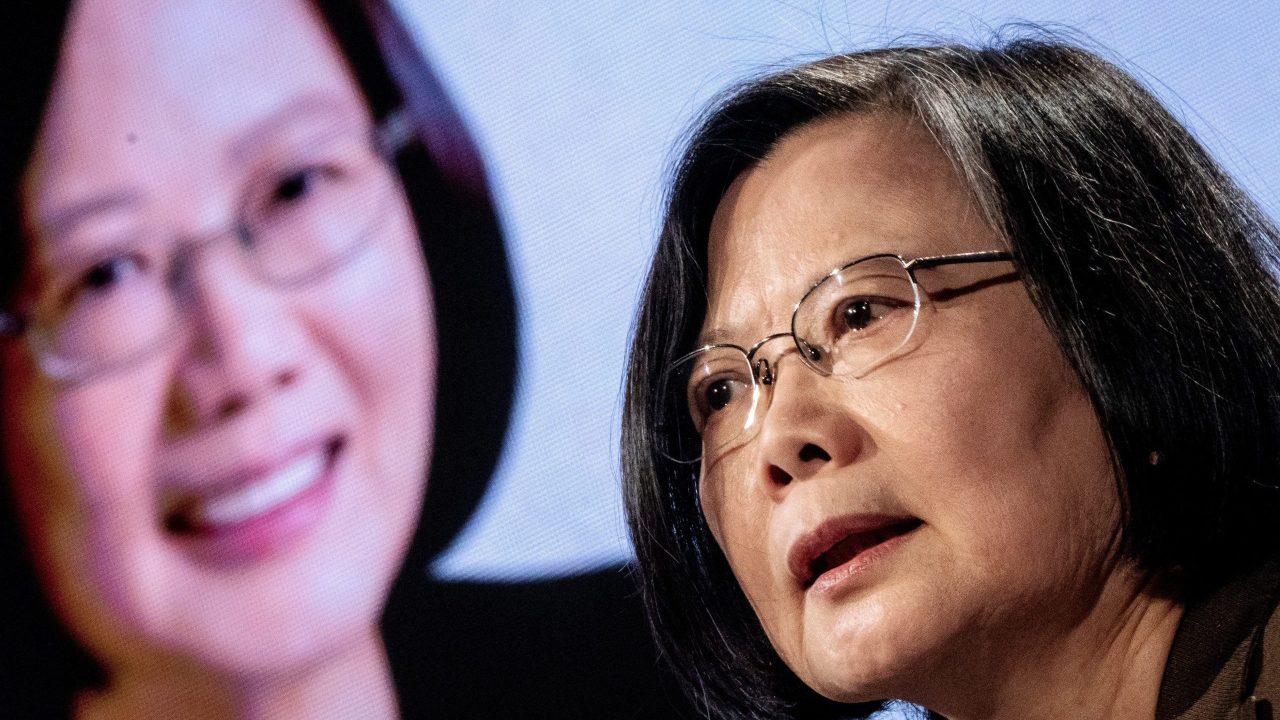
For Tsai Ing-wen (蔡英文), a trip to the U.K. was a homecoming of sorts. The former Taiwanese president completed her Ph.D. at the London School of Economics in the 1980s.
It was also another step into her future. Tsai seems more and more comfortable playing the role of retired stateswoman: a diplomat with real heft and recognition on the global stage, now freed of the travel restrictions that other countries imposed on her when she was president.
Tsai visited not only her alma mater in London, but also the Houses of Parliament, where she met with British legislators. This last leg on her three-country European trip came after reports that the British government had asked that a planned visit in the fall of 2024 be delayed to avoid disrupting the British foreign minister’s visit to Beijing.
Tsai also met with Lindsay Hoyle, the Speaker of the House of Commons. The speaker is a non-partisan figure who maintains “order” in the U.K.’s parliament’s elected body.
Hoyle’s meeting with Tsai “shows that he’s backing, in a way, Parliament’s voice,” according to Max Dixon, a Ph.D. candidate at the University of Portsmouth who is researching the U.K.’s foreign policy towards Taiwan.
Dixon told Domino Theory the speaker “recognizes that Parliament is a great arena to talk about Taiwan, recognizing that the government can’t or doesn’t want to.”
Hoyle was “demonstrating to a wider world, which obviously includes China, that he recognizes [Tsai’s’] status as president of Taiwan,” said Baroness Frances D’Souza, a member of the House of Lords, the U.K. parliament’s unelected body.
Baroness D’Souza explained that, by contrast, a major sticking point for the planning of Tsai’s trip had been the U.K. Foreign Office’s reluctance to be “seen to provide protection” for her. In the end, the Taipei Representative Office in the U.K., Taiwan’s de facto but unofficial embassy, arranged private security.
At the reception in Parliament, Baroness D’Souza said Tsai’s remarks focused on “promoting Taiwan’s membership of key institutions … such as [the] WHO.” (Taiwan is excluded from the World Health Organization due to Chinese pressure within the United Nations.)
This is an area where the British government already provides verbal support for Taiwanese participation.
Keir Starmer’s Labour government, in office for almost a year now, has sought to reset relations with China, but has continued to emphasize that it opposes Chinese military aggression towards Taiwan.
Last September while in Shanghai, Foreign Minister David Lammy said he had continued “to have dialogue with the Chinese on areas where we disagree; areas like Hong Kong, areas like Taiwan, areas like human rights in Xinjiang.”
The U.K. will soon release an audit of its policy towards China, but Reuters reports multiple sources say the document will not recommend major changes. It is unknown what if anything the audit will say about Taiwan.
“This is a time for Taiwan to act,” says Marcin Jerzewski, the head of the Taiwan Office European Values Center for Security Policy, a Czech think tank. He drew attention to the declining relationship between Europe and America:
“Europe might be more willing to turn a blind eye to some of the tensions with China to balance the decline in transatlantic ties, but it’s also an opportunity for Taiwan, because Europe will be looking for new partners.”
Jerzewski also suggested there is a personal element to Tsai’s London visit, pointing out that Tsai continually faced “disinformation” about whether she has written her Ph.D. dissertation at the London School of Economics. He said it is “symbolically powerful for domestic audiences that she was in the U.K. and that she did indeed engage with that community [her alma mater].”
Tsai “wanted to emphasize the situation that Taiwan finds itself in, that it reaffirmed that it’s a fellow liberal democracy and needs the support of the U.K., European countries, other fellow liberal democracies,” said Gray Sergeant, a research fellow in Indo-Pacific Geopolitics at the Council on Geostrategy, a British think tank. He also attended Tsai’s reception in Parliament and a question and answer session that Tsai held at the London School of Economics.
At that event, Tsai spoke on the theme of resilience and “internal resilience.” Sergeant told Domino Theory many Taiwanese students asked her what they could do to help Taiwan.
There were no big surprises during Tsai’s London stay, although the meeting with Speaker Hoyle was perhaps a small one. Tsai stayed on message, relentlessly focused on Taiwanese democracy.
It was a seasoned performance from a seasoned performer. But there was one little wrinkle that provided some insight into other concerns. Addressing an audience at the University of Cambridge at the end of her trip, Tsai said the recall campaigns that are currently roiling Taiwanese domestic politics are “a part of democracy.”
A shot across the bow, perhaps, of another Taiwanese politician, Andrew Hsia (夏立言), from the opposing party to Tsai, who was due to speak in Cambridge just one day after her.





Leave a Reply