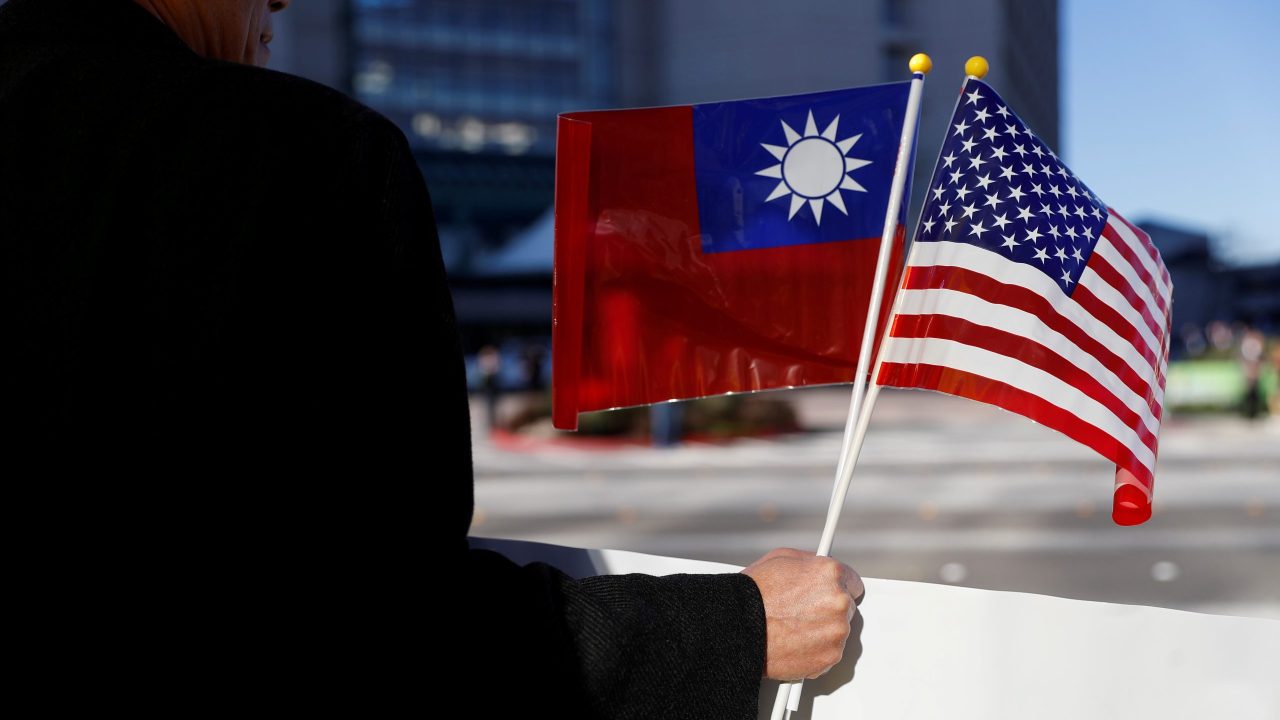
Read part two about how Taiwan gives humanitarian aid as a rich but politically isolated country here.
The Trump administration has cut around 80% of U.S. Agency for International Development’s projects and given the rest to the State Department. The cuts risk Taiwan’s ability to maneuver internationally, win friends and counter China.
There are two main ways in which cuts to USAID will impair Taiwan’s international development efforts and ability to project soft power. First, USAID helps countries resist the pull of receiving economic benefits from China in exchange for recognition of the “one China” principle. “Our investments with our partnerships, our commitments to supporting free and open and resilient economies, all of that helped our partners weather and push back against PRC economic coercion,” said Francisco Bencosme, the China Policy Lead for USAID during President Joe Biden’s administration.
The U.S.’s efforts to support Taiwan’s international recognition through the provision of foreign aid are well documented. For example, in response to Panama, El Salvador and the Dominican Republic switching their diplomatic recognition from Taiwan to the People’s Republic of China in 2018, the U.S. recalled its diplomats and threatened to reduce its foreign aid — which was in large part provided by USAID — to those countries. In 2020, Congress passed the TAIPEI Act, which advised the U.S. government to alter its economic, security, and diplomatic engagement with countries that undermine the security or prosperity of Taiwan and increase such engagement with countries that “enhance or upgrade” their relationship with Taiwan.
Second, USAID has been an important partner for Taiwan’s national development agency, the International Cooperation and Development Fund, or TaiwanICDF. For example, USAID and TaiwanICDF signed a memorandum of understanding in 2022 to jointly strengthen small business growth in Paraguay and enhance climate and disaster resilience in the Indo-Pacific.
USAID also acts as a convener, bringing Taiwan to the table by providing diplomatic cover for countries that would otherwise be hesitant to engage. The best example of this, according to Bencosme, is the Global Cooperation and Training Framework, which was established by the U.S. and Taiwan in 2015 to foster knowledge sharing on common challenges faced by countries in the Indo-Pacific. 133 countries have participated in the program, and Japan, Australia and Canada are full partners.
Beyond capacity building, U.S. support enables Taiwan to provide direct, on-the-ground humanitarian aid to non-diplomatic allies, according to Crison Chien (簡旭伸), a distinguished professor at National Taiwan University’s Department of Geography. Since Taiwan has the capability to provide aid but lacks the diplomatic status to engage with much of the international development world, it often has to rely on actors like the U.S. government and the European Bank of Reconstruction and Development to implement aid projects. For example, Taiwan joined the U.S.-led Global Coalition to Defeat ISIS in 2014. By early 2019, Taiwan had donated $32 million in cash and in-kind assistance to refugees fleeing ISIS through governmental and non-governmental collaboration with the U.S. As a result, Taiwan’s flag was raised in front of refugee camps along with the other donors — a first since Taiwan’s lost U.N. recognition in 1971.
The degree to which this is all at stake remains unclear. On the one hand, Patrick Cronin, the Asia-Pacific security chair at the Hudson Institute and the third-highest-ranking official at USAID during the George W. Bush administration, thinks that even with USAID’s capacity diminished, Secretary of State Marco Rubio could still save some of the agency’s most important projects.
Since several key players in the Trump administration have voiced support for Taiwan — including Rubio, Defense Secretary Pete Hegseth and members of the National Security Council’s Asia team — Cronin thinks that “if the United States can help Taiwan be a player in a critical moment, it’s more likely to try to do that than not.” Even if President Donald Trump struck some sort of deal with Chinese President Xi Jinping (習近平) to reduce cooperation with Taiwan, “a lot of this happens below that threshold of attention … You can’t be everywhere all the time when you’re the top leader.”
Moreover, Cronin noted that much of USAID’s funding is protected by legislation, and to a certain extent, these cuts still have to be adjudicated by the courts. The Trump administration has already moved to restore some foreign aid programs.
On the other hand, Bencosme said that mergers of foreign ministries and development arms empirically have weakened development architecture in countries like the U.K. and Australia. One reason Trump has given for folding USAID into the State Department is to sharpen the agency’s focus on countering Chinese influence. But as one of the people responsible for negotiating this balance between strategic aims and humanitarianism for the Biden administration, Bencosme worries that Trump’s approach links “our assistance to counter China’s aims in a way that is counterproductive. A lot of our partners don’t want to be caught up in a U.S.-China competition. They know that when great powers compete, smaller powers oftentimes lose out … I think our original way of providing assistance, which was to maybe implicitly be about China competition, was a lot more strategic.”
Bencosme thinks this should be a wake-up call for Taiwan: “Now’s the time, more than ever, for Taiwan to really increase and step up its leadership role as other international leaders in the space withdraw.” The question the next article in this series asks is, can Taiwan fill this vacuum without U.S. support?





Leave a Reply