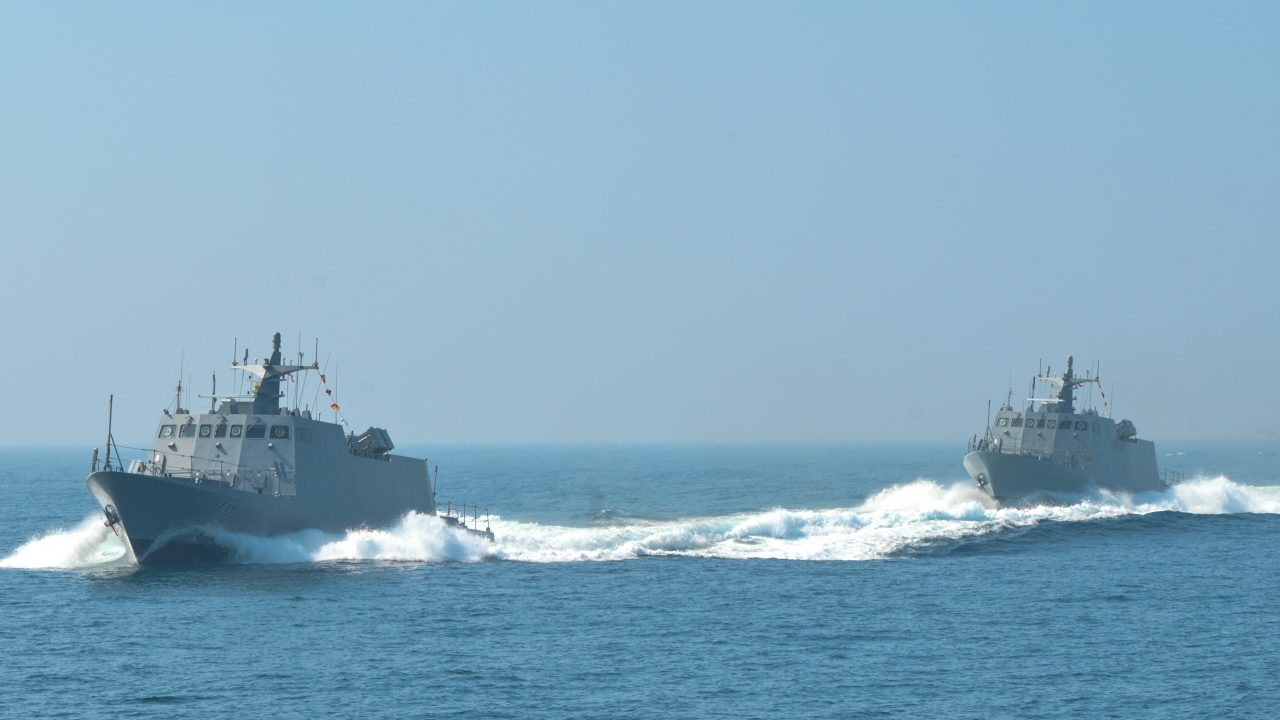
A much anticipated two-day war game organized by Taiwanese NGOs that simulated a Chinese invasion in 2030 ended this week with a lot of takeaways.
The purpose of this war game was to gather insights for Taiwan’s military preparedness. It involved 19 former senior U.S., Japanese and Taiwanese flag officers.
The goal was not to form an anti-China alliance composed of the U.S., Japan and Taiwan but to focus on a realistic simulation, with U.S. and Japanese teams acting independently based on their national interests and priorities, retired Taiwanese Admiral Lee Hsi-min (李喜明) later clarified at the post-war game conference.
The war game consisted of four scenarios or “moves.” In the first scenario, “intimidation,” China deployed increased naval and air forces and issued statements to intimidate Taiwan into submission. During the second scenario, “coercion,” China ramped up blockades and economic sanctions to pressure Taiwan to concede. “Punishment,” the third scenario, saw China conduct targeted strikes on Taiwanese assets to punish resistance. In the final scenario, “invasion,” China launched a full-scale invasion to take control over Taiwan.
Four former U.S. and Japanese military leaders participated: former U.S. Joint Chiefs of Staff chairman Michael Mullen; Dennis Blair, former commander of U.S. forces in the Pacific; former Japan Self-Defense Forces chief of staff Shigeru Iwasaki; and former Japan Maritime Self-Defense Force chief of staff Tomohisa Takei.
Tuesday’s session started with a simulated gray-zone conflict. The Chinese People’s Liberation Army (PLA) entered Taiwan’s 12-nautical-mile airspace and territorial waters, surrounded Taiwan and occupied Pratas Island. The control team was not happy with the Taiwan team’s response and asked for a “revision” for the next day.
Lee, who was a member of the control team, said the revision was requested because the Taiwan team, which consisted of five former flag officers and two civilian experts, could not explain how its action items balanced between escalation and protecting Taiwan’s sovereignty, and because it failed to propose countermeasures when the PLA advanced on Taiwanese territory.
For its revision, the Taiwan team introduced anti-blockade measures, planning two routes: a northeast route south of the Ryukyu Islands within Japanese waters to avoid China’s Coast Guard, reaching Yonaguni Island with naval escorts, and a southern route with U.S. Navy escorts from the Philippines, supporting 55 daily transits.

When facing a full-scale invasion by the PLA on Wednesday, the Taiwan team deployed asymmetric forces, positioning unmanned attack boats around Taiwan and conducting mine-laying operations. The air force prioritized repairing damaged runways to maintain combat readiness and dispatched jets to destroy PLA forces occupying Penghu. Ground forces in Taiwan conducted sweeps against landing PLA troops.
During the post war game press conference, Blair said two factors that would influence a U.S. intervention. The first factor was “how conflict would start,” the second factor “whether Taiwan has the ability and willingness to fight for itself.” Blair stressed that the U.S. is not in favor of “provocative actions” by Taiwan toward China, adding previous U.S. presidents made it very clear that “we do not support Taiwanese independence.”
Takei said Japan’s stance in the simulation also reflected its position under the U.S.-Japan Security Treaty. He later told Domino Theory that “it is most critical for Japan to enhance deterrence by steadily building capabilities and maintaining communication with Taiwan.”
When asked about why espionage was not included in the scenarios, given the recent publicity surrounding the arrests of former government and military personnel on allegations of spying for China, Lee said espionage was not included because the event was focused on warfare, while espionage was more of a societal concern.
The war game was co-organized by the Taipei School of Economics and Political Science Foundation, the Center for Peace and Security and the Council on Strategic and Wargaming Studies, supported by Fenrir Data Analytics.




Leave a Reply