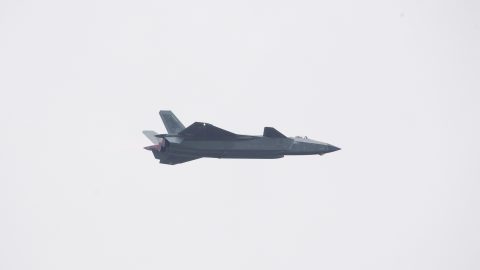
On December 26, images and videos appeared online of a jet flying over Shenyang in China. It had two engines, an unusual swept back wing and seemingly no tail. This plane was immediately understood to be a new and advanced military aircraft.
Almost nothing is known about this plane, and yet somehow articles full of specifications for its size, its speed and its capabilities have appeared. Domino Theory wanted to know how.
Online observers of the Chinese military have started calling the new jet the J-50. It has been described as a sixth-generation aircraft, but this is hard to substantiate. We currently lack a clear definition of what a sixth-generation plane will be.
James Bosbotinis, a British defense analyst who has been tracking many different sixth-generation fighter projects, says we don’t know whether the Shenyang aircraft is a demonstrator or a prototype, but he suspects the latter. That would indicate that what we have seen is quite close to what will enter service. He thinks that the J-50 is likely to be a fighter in the traditional sense, and thinks that it will be part of a broader force mix with the J-36, another larger next-generation plane that was also seen for the first time on December 26.
For more coverage of the J-50, this article by The War Zone is still currently unmatched, despite having been written the day it was first sighted. There’s also an assumption floating around that the J-50 will become the Chinese navy’s sixth-generation carrier-borne fighter, but this is mainly because the J-36 is clearly too large to do that. It’s entirely possible that another design will emerge to perform that role.
There is little real information about the J-50. But interest in it, while less than in the J-36, is still there. If you Google “J-50,” you will see a lot of hits. Like this one, from bulgarianmilitary.com. That article collates lots of information from different sources, including this YouTube video from The Military Curiosity, and this X.com post from Louis Cheng, which both give a lot of data on the J-50, such as its size, its range and speed, and even what weapons it will carry.
Many other news websites also reported these figures. Even publications like Liberty Times and Asia Times ran them. So why aren’t other military news sites using them?
The answer, unsurprisingly, is that the numbers are crap. They may or may not prove to be correct, but they are simply the guesswork of a Hong Kong analyst on X.com. But the stories that feature them are not acknowledging this. Indeed, much of the media reporting these figures probably has no idea where they came from, they are just citing another story printed by someone else.
This is a tale, in other words, about how uninterested in actual truth much of the online reporting about defense and security actually is.
Where is the ground zero for these numbers?
As best as we can tell, it is a website called Army Recognition. Army Recognition ran this story about the J-50 on December 30. In all the cases where other media cite the provenance of the dodgy numbers, they either cite the Army Recognition article directly, or cite another article which itself links back to Army Recognition (if they cite anything at all).
Army Recognition’s article says that their own editorial team conducted an analysis, and it also contains an image of a silhouette of the J-50 with the numerical data printed underneath it. These are the numbers that then propagated around the military news infosphere. Army Recognition CEO Alain Servaes told us that the information came from Weibo, but wouldn’t say which account. He said they used translation software to access it and that they don’t know where that information came from originally.
However, Domino Theory found that the X.com account Rational Pi (理智π) posted an uncropped version of the image on December 29, the day before Army Recognition published their article. According to their profile, Rational Pi is an aerospace and military enthusiast from Hong Kong.
Rational Pi didn’t respond to our request to talk, but from context and other posts they made, it’s clear that the information they include on this image is drawn from multiple places and includes their own estimates for numbers we simply can’t yet know. On December 27 they shared three previous variations of this image, each time updating and changing the information as their views updated.
To be very clear, Rational Pi is in no apparent way responsible for the propagation of this information into media reporting. They even posted screenshots of articles featuring the numbers on January 3 saying, “Do you know how uncomfortable it is for me when I see them seriously analyzing the images I made and the guessed data (瞎猜) in them.”
When Army Recognition published the image that matches that apparently created by Rational Pi, the watermark attribution was gone.
If the problem were that one website called Army Recognition was publishing inaccurate information, this would perhaps matter a whole lot less. But in fact what is happening is that a lot of people, including journalists, are clearly Googling “J-50,” finding that article, taking the information at face value and then propagating it.
In part this is a media literacy issue. If someone was more aware of military affairs, they would know to question much more strongly how such precise numbers could be publicly available so early. And bluntly speaking, if you spend a lot of time searching for military information online, you should already know that many sites simply can’t be trusted.
This case is more egregious because the numbers have broken out of that world and gotten into more trusted media, through sometimes surprising routes. Asia Times’s article got the information via a Ukrainian defense news website called Defense Express, for example. You might think that those guys would know their stuff.
In Taiwan, Liberty Times ran a translated, edited version of the Army Recognition article. Liberty Times is a major publication in Taiwan which is seen as being “green,” or in favour of a Taiwanese sovereignty that is distinct from China. Domino Theory called Liberty Times to ask about how they wrote their story. They told us to fill out a feedback form on their website.
When Liberty Times runs a story with bad information about the Chinese military like this, it is entirely possible that Taiwanese policymakers and legislators will read it and be influenced by it. Sadly, we cannot assume that they are well versed enough to spot that such accurate numbers at this stage are suspect.
Somewhat more amusingly, Rational Pi’s estimates have also made their way back into Chinese language blogs inside the PRC. A military blogger on Wechat called Zhanggong1133 (張弓1133) published an article about the J-50 on January 3 using same image as Army Recognition. They added their watermark to it. As of January 10 that article had been read at least 41,000 times. Zhanggong published the same article elsewhere, too.
Army Recognition told us that they try to check the information that they print, but that ultimately they cannot guarantee if it is true or accurate. But it’s questionable how much understanding they actually have about their own misinformation. When Rational Pi wrote that the J-50 will have “ACE” engines, they meant adaptive cycle engines. This is an advanced type of jet engine, also called variable cycle engine, that has long been linked to sixth-generation planes.
But Army Recognition said that these engines are “advanced combat engines,” a term with no specific meaning. It would have taken no more time to write the full name of ACE, if they knew it.
Ultimately, all media need to do our best to ensure that the information we publish is accurate. That is literally our job. In an ever less secure world where the provenance of information is ever less clear, the media needs to be better at sourcing than before, not worse. Otherwise the risk is you unwittingly misinform, or worse, you become an agent for someone else’s disinformation.






Leave a Reply