
Bike across a Taipei bridge or along the riverside during last month’s Han Kuang exercises, and Taiwan’s armed forces were easy to find. But walk along one of the island’s most vulnerable beaches, and it was a different story.
Much has been made of how this year’s exercises — which lasted twice as long as those of previous years, included more reserve soldiers and saw the integration of civilian drills — were “unscripted.”
But during a pivotal day of the drills, the day a Chinese amphibious landing was simulated, Domino Theory found that key beaches in Taiwan’s northwest coast were left almost unguarded, with no major deployments to defend the coastline.
While Taiwan is increasing its focus on urban combat and defense in depth, questions are also raised about what preparations to defend the beaches are actually being rehearsed.
July 13 was the fifth day of the Han Kuang exercise, and the first day of the “full-scale combat phase.” In other words, July 13 was “zero day,” simulating the start of a Chinese invasion. Taiwan’s military was to conduct anti-landing operations, Major General Tung Chi-hsing (董冀星), director of the Ministry of National Defense’s joint operations planning division, told Focus Taiwan ahead of the drills.
On the morning of the 13th, Domino Theory attended a press event in Taoyuan to witness a demonstration of the army’s new air defense system, Land Sword II (陸射劍二). After this, Domino Theory visited multiple sites along the coastline in northern Taoyuan and southern New Taipei to see what exercises were being carried out that hadn’t been announced to the media.
This area has long been seen as the most likely location for a Chinese invasion. There are two “invasion beaches” at Haihu and Linkou, where it’s thought possible to conduct traditional amphibious landings. Haihu is located close to Taoyuan Airport and Linkou is located close to the Port of Taipei, both key objectives that a landing would target for heavier reinforcements. Additionally, this region is relatively close to Taipei itself, putting Taiwan’s political center under immediate threat.

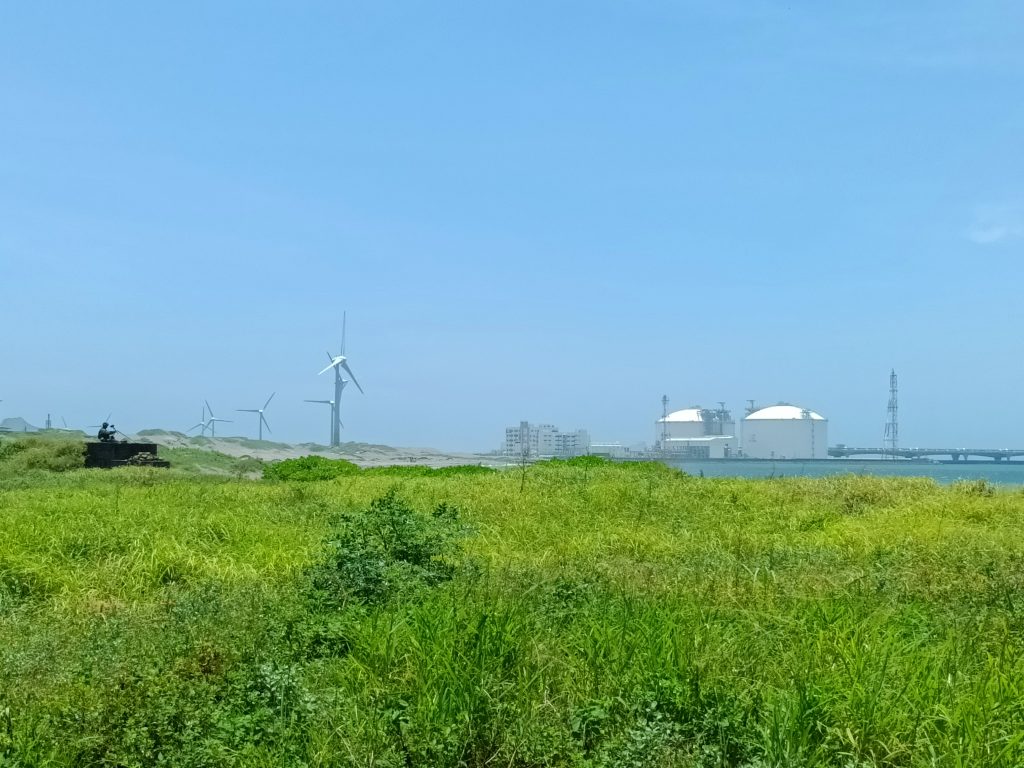
Defending this area is thus key to defending Taiwan. And indeed, the 6th Army Corps, responsible for northern Taiwan, was due to mobilize in Taoyuan on the 13th. However, the military presence observed along the coast and on the beaches was very sparse. In the 20 km between Baishajia Lighthouse and Zhuwei Fishing Harbor only two observation posts were seen, containing at most about a dozen personnel.
Zhuwei itself had a substantial deployment of part of a Sky Bow III (天弓三) long-range air defense battery. On the coast north of Zhuwei no deployment was observed except in the Port of Taipei, but there was substantial military traffic on the coastal road.
At no location along the 33 km of coastline did Domino Theory observe troops deployed whose primary purpose was to defend against an amphibious landing. That was only seen in Tamsui to the north of the port, where army engineering units had set up obstacles in the river mouth the previous day.

Ethan Connell is the Research Team Lead at Taiwan Security Monitor, an organization at George Mason University that tracks Chinese and Taiwanese military developments. Taiwan Security Monitor used Domino Theory’s findings to produce the above map, and Connell discussed some of its implications.
Connell said that Taiwan Security Monitor didn’t receive any reports about where in Taoyuan the 6th Army Corps had actually mobilized on July 13. However, “[the map] really emphasizes the stated focus from the MND (Ministry of National Defense) on defense in depth, in which a static defense of your first line of defense isn’t the most important,” he said. “There’s been a very strong stated emphasis on layered resistance, in which you can give up ground in the first waves of an invasion and then counter attack.”
According to a report published by the Research Project on China’s Defense Affairs this week, Taiwan’s defense ministry had announced in February that the 206th Infantry Brigade, a reserve formation, would mobilize in the coastal district of Dayuan, around Taoyuan International Airport. However, during the exercises the 206th shifted its mobilization to several districts further inland, within Taoyuan county’s “urban core areas.”
“In the past, [the Han Kuang] exercises often concluded with coastal defense scenarios,” Lin Ying-yu (林穎佑), a professor at Tamkang University and expert in China’s military, wrote in an article in The Diplomat. “This year, however, the exercise extended into urban areas, simulating PLA commando raids and fifth-column attacks.”
Sih Han-Tsun (薛翰駿), the editor-in-chief at Watchout, a Taiwanese NGO that focuses on civil defense, told Domino Theory that this year’s Han Kuang exercises focused on urban combat because the government wants people to know that Taiwan plans for defense beyond the beaches. He said that for a long time Taiwan’s military planners assumed that a Chinese invasion would be defeated at the beaches, but that the U.S. had challenged this, asking, “How can you [be] so confident?”
Connell from Taiwan Security Monitor highlighted the importance of survivability for Taiwan’s forces. “It’s not all or nothing. You are willing to give up ground for the bigger picture, maintain force … and then counter attack in a smart way.”
It’s very clear that this year the emphasis in Han Kuang shifted to exercises that focused on urban combat and defense in depth. It’s also undeniably the case that these well-publicized drills are also exercises in communication to domestic and international audiences, signalling that Taiwan is well-prepared and showing resolve. Acclimatizing people to the sight of military deployments inside cities is a part of that.
Domino Theory noted that the Han Kuang observation points were located in two of busiest stretches on the coastline, where many civilians enjoying their Sunday would inevitably see them. That fits with the idea that this is meant to reassure Taiwanese that preparations are well in hand.
But it also raises a more concerning question. If someone sees these visible deployments and reads glowing reports about the drills, do they assume that there is a similar amount of military activity on the more desolate stretches of sand?
Because Domino Theory went to those too, and there wasn’t.





Leave a Reply