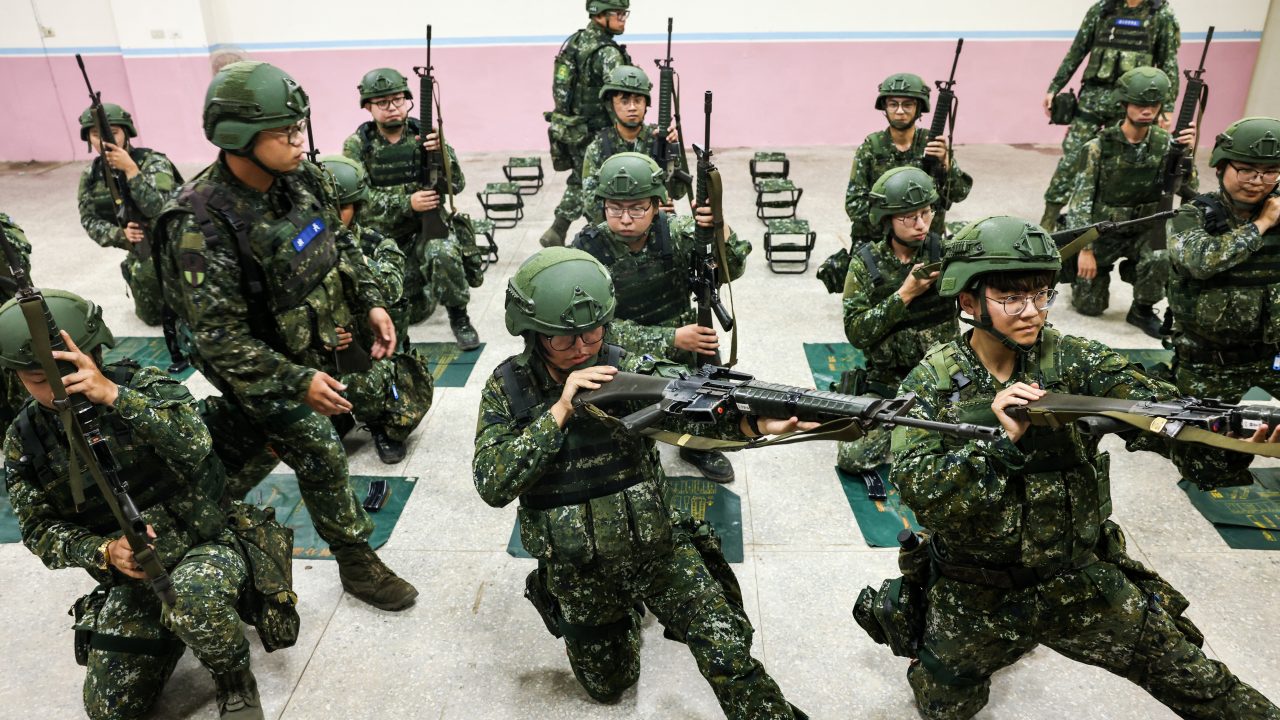
Taiwan commenced its annual Han Kuang military exercises today. The wargames are intended to practice and prepare for a Chinese invasion, as well as to signal Taiwanese resolve.
This year Taiwan will hold exercises for 10 days. This is a marked increase from previous years — in 2024 the exercises lasted for only five days. There is also more of an emphasis on reserve forces. Some 22,000 have been called up for the drills — approximately 7,500 more than last year. Taiwan’s reserves have been a source of criticism and controversy for years, and Taiwanese President Lai Ching-te (賴清德) is still implementing reforms initiated by former president Tsai Ing-wen (蔡英文).
This morning, TaiwanPlus reporter Jaime Ocon published images on X of the 206th Infantry Brigade in Taoyuan, and the Liberty Times reported on the 302nd Infantry Brigade in Miaoli, both reserved formations conducting training after mobilization.
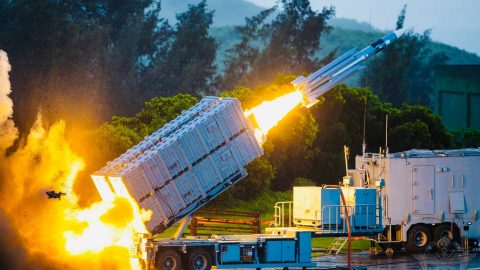
Han Kuang 41 will also see Taiwan’s new HIMARS rocket artillery firing for the first time in wider drills. Taiwan purchased 11 HIMARS systems, then ordered an additional 18 after their successful use in Ukraine. The first systems arrived in 2024. With a range of 70 kilometers for the regular GMLRS missile and 300 kilometers for the longer range ATACMS, HIMARS has the potential to be a gamechanger for interdicting amphibious assaults.
An even newer weapons system apparently seeing its first use in this year’s exercises is the Kuai Chi uncrewed surface vessel, or USV. Two were seen leaving Suao naval base this morning, according to the Liberty Times. Taiwan is currently testing and evaluating a number of USV designs for acquisition in 2026.
Tomorrow, July 9, will see two public events: a “urban resilience” drill conducted at several supermarkets in different cities, and live firing drills by Taiwan’s newest tank, the M1A2T Abrams, the first of which were delivered to Taiwan last year. These exercises will take place at Kengzikou Range in Hsinchu but will be live streamed for the public to watch online. Taiwan has ordered 108 M1A2Ts from the U.S. 38 arrived in December 2024. A further 42 were expected in the second quarter of this year, but there is no reporting that they have arrived.
Next week, the Taiwanese navy will conduct a minelaying exercise, which will also be livestreamed, presumably using its fast Min Jiang-class minelayers.
One factor to pay attention to is the weather. The last two years, the Han Kuang exercises have been curtailed by typhoons. This time, Taiwan may have dodged a bullet as Typhoon Danas passed through the strait on Sunday night and Monday morning. Ten thousand personnel were on standby to respond to the typhoon, according to the defense ministry, but it is not known how many were actually deployed. However, due to rain this morning, the reserves in Miaoli and Taoyuan were training weapon skills indoors rather than outside.
China does not usually hold “rival drills” when the annual Han Kuang exercises are ongoing, but Taiwan’s defense ministry did report an uptick in Chinese air force activity around Taiwan, after five quiet days.
China appears to be in the middle of a “defense news media blitz.”
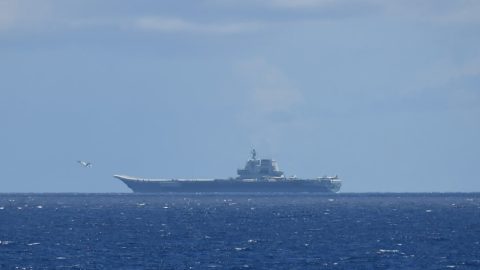
Last week saw a five-day port visit of the Shandong aircraft carrier to Hong Kong, the first by a Chinese carrier the Liaoning since 2017. Both the Liaoning and the Shandong spent June on exercises in the Pacific. The Shandong left Hong Kong on July 7. Its whereabouts are currently unreported.
Yesterday Chinese state broadcaster CCTV reported on a new variant of the J-15 fighter jet, the J-15T, which is adapted for catapult launching. But in the background, obvious yet unmentioned, was a carrier-capable fifth-generation J-35 fighter, a type that is yet to enter service. The J-15T and J-35 are expected to be deployed on China’s newest carrier, the Fujian, which might be commissioned later this year.
This morning, as the Han Kuang exercises got underway, China’s commerce ministry announced that it was placing eight Taiwanese defense suppliers, including aerospace and shipbuilding companies, on an export control list, cutting them off “dual use” items that have both military and civilian applications. Taiwan’s Mainland Affairs Council, which handles relations with China, said Taiwan will continue developing its defense industry for national security, adhere to “preparing for war to prevent war” to maintain the status quo, according to the China Times.





Leave a Reply