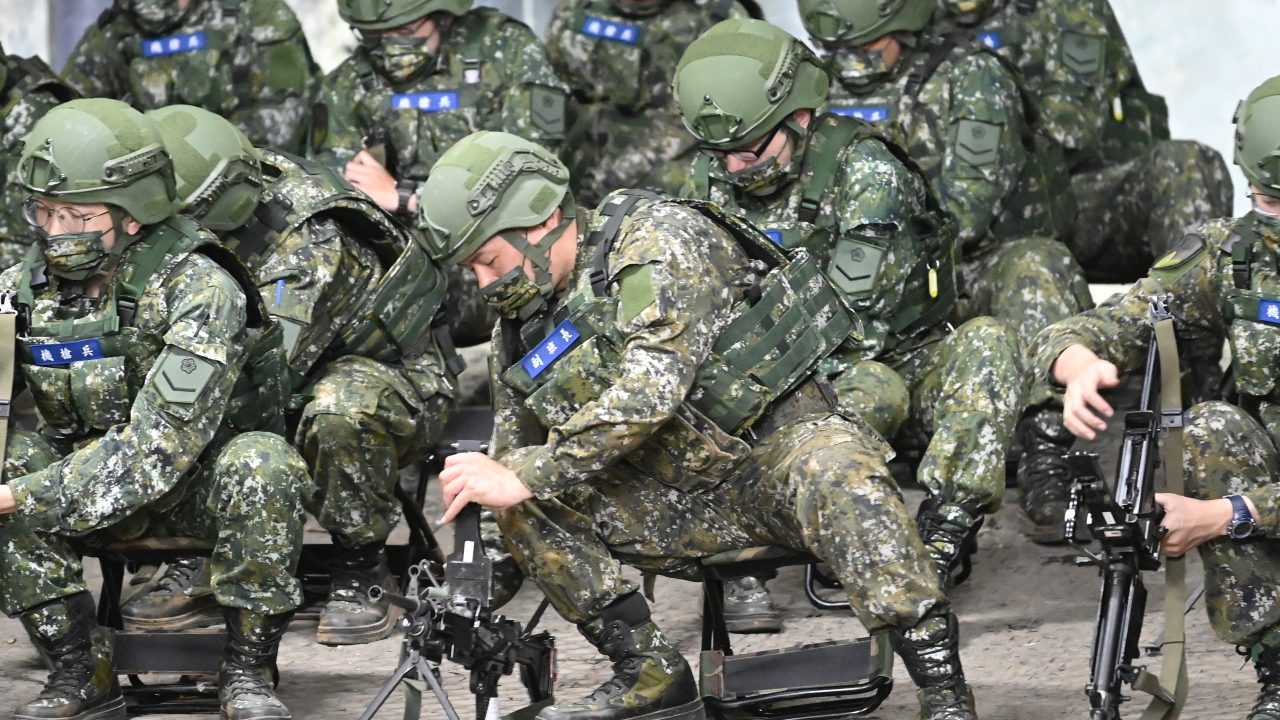
Taiwan’s active duty military is small compared to China’s. Its reserves are large, but they are under trained and ill equipped for the modern battlefield.
The government knows this, and has slowly introduced reforms. But are they enough?
Last week, Taiwan released its “Quadrennial Defense Review,” a document produced at the end of the first year of a presidential term that sets the strategic direction of Taiwan’s military forces.
The 2025 edition contains a much greater emphasis on the reserves, with more detail. The reserves should receive new equipment, including communications gear, new UAVs and air-defense and anti-armor weapons. Recall training should increase from one week to two, and should be more relevant to reservists’ actual responsibilities.
Who Are the Reserves?
Taiwan’s reserve force consists of personnel from two different sources: professional soldiers and conscripts. In wartime the intention is that reservists would take on responsibilities in line with their previous experience.
The former conscripts are also meaningfully divided by how long they did national service for. Originally it was two years, then one year, then four months. That effectively means that most of the youngest reservists are the least trained.
In 2022, the government announced the conscription training period would increase to one year again for those turning 18. However, because many Taiwanese do their national service after university or other deferment, most current conscriptees in 2025 are still only seeing four months of training. The four-month program was widely ridiculed in Taiwan as lacking rigor. The new one-year service is still in its infancy, but there is at least some indication that more relevant skills, like the use of anti-armor weapons, are being taught.
Counting Taiwan’s reserve forces is slightly complex. Until last week, reservists should have been recalled for training four times over eight years after they leave active service or conscription. Taiwan’s Ministry for the Interior just announced that this eight-year limit will be removed.
Reported numbers for the number of Taiwanese reservists vary wildly. Some numbers go as high as 2.3 million, but this is the number of reservists who could theoretically be called up. The overwhelming majority of reservists in this category do not train. According to a report by the Legislative Yuan, in June of 2024 the number of reservists who could be called up for training due to being within eight years of active service was 710,569.
Guermantes Lailari is a retired U.S. Air Force foreign area officer and currently a visiting researcher at the Institute for National Defense and Security Research, government-affiliated military think tank who has written about the need for reform in Taiwan’s reservists. In an interview with Domino Theory, he pointed out that under current plans the government says it trains 50,000 reservists for one week and 8,000 for two. Across two years that means that 116,000 reservists are being recalled before the process starts again, which is the base number he uses.
Lailari said the issues for Taiwan’s reserves are about throughput. Seven or 14 days is not enough training time, but if Taiwan wants to do more training per year, it will need more instructors, more training areas and more equipment.
That training too often happens at a small scale, Lailari added, where reservists are not training as a full unit and so are not developing unit cohesion.
2025 vs 2021
By looking at how the 2025 review compares to the 2021 edition, we can gain some sense of the relative increase in importance and direction of Taiwan’s reserves and reserve training. Note that this analysis was based on an English translation of the 2025 review by Taiwan Security Monitor, a student-powered research initiative at George Mason University.
In 2021, a section called “Reforming Mobilization of Reservists,” there were four sections about “Merging Units,” “Strengthening Reserves,” “Reinforcing Training” and “Improving Equipment.” The training section is the only part that really went into details.
The document for this year is far more detailed and calls for a lot of specific actionable items that will be easy to measure in 2029 to see if they have happened. The “Strengthening Reserves” section calls for increasing the number of junior officers in reserve units, expanding the quota and training of female reservists (there are far fewer than male reservists because Taiwanese women do not go through conscription) and establishing a digital mobilization database to allow the utilization of specialized skills.
In “Modernizing Equipment,” there is an emphasis on standardizing equipment with active-duty units, updating communications gear, and acquiring new UAVs and air-defense and anti-armor weapons. Expanding the logistics and repair facilities for reserve units is also an action item.
There is no “Training” section. Instead, this is covered by something called “Strengthening Coordination Between Reserve and Active Forces.” Reserves should take part in the annual Han Kuang military exercises, practicing the aforementioned coordination. Reserve training should be extended to 14 days (up from five to seven in most cases currently). Rather tellingly, the final item is about reserve units conducting drills aligned with their assigned combat missions.
Much of what is in the new defense review is not new — many items in the reserves section are measures or initiatives which have been announced in the last four years. But many will say that the review does not go far enough.
Chen Kuan-ting (陳冠廷) is the Democratic Progressive Party legislator for the second Chiayi county district. In a statement provided to Domino Theory by his office, Chen said that Taiwan’s reserve forces are “a vital pillar in our multi-layered defense architecture” that “truly extends [its] depth.”
“However,” he continued, “overall readiness, unit integration and morale still require significant improvement.” Chen gave the example of Israel. He said that Israel has “a population of only around 9 million — less than half of Taiwan’s — yet it mobilizes nearly four times as many reservists annually, with much longer training durations.”
Even as Taiwan makes improvements, it finds itself behind the curve. Improvements will need to continue.
Correction: This article originally stated “The Taipei Times reported last year that there are about 182,000 reservists who were within the old eight-year period of having left service.” That figure in fact refers to the number of reservists in alternative service, those who chose to do a civilian alternative to military conscription. The correct figure was 710,569.




Leave a Reply