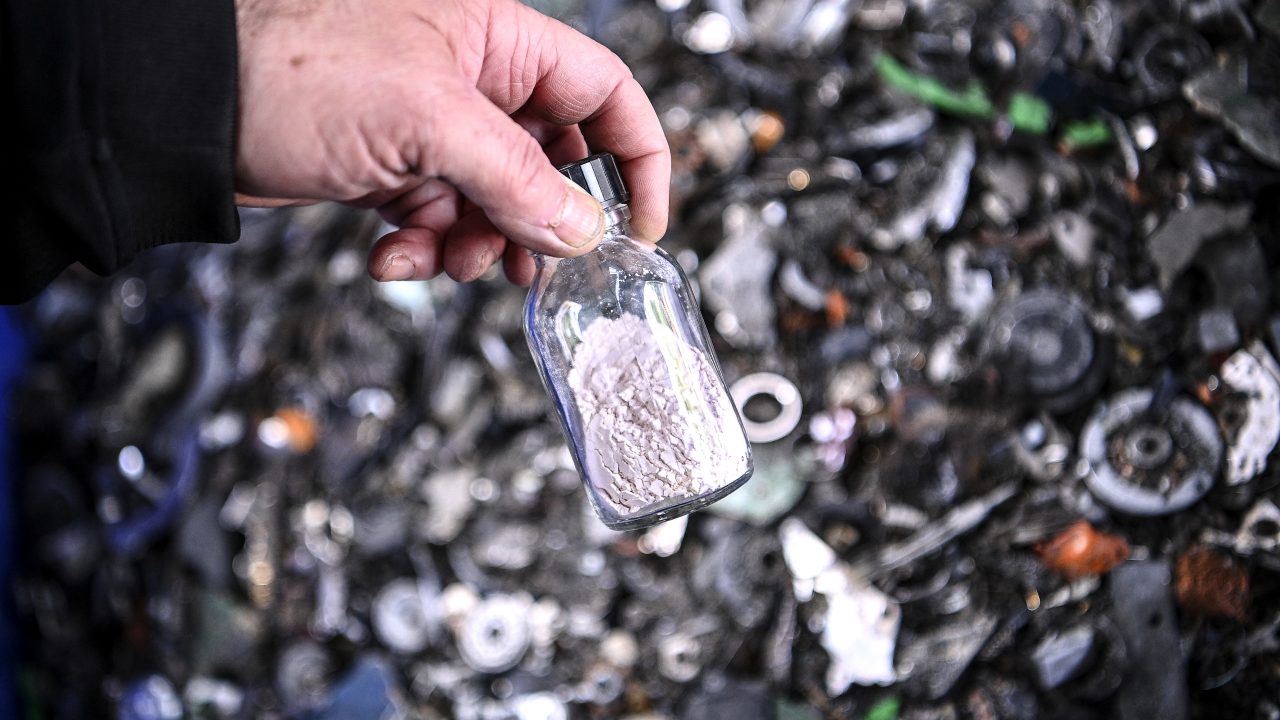
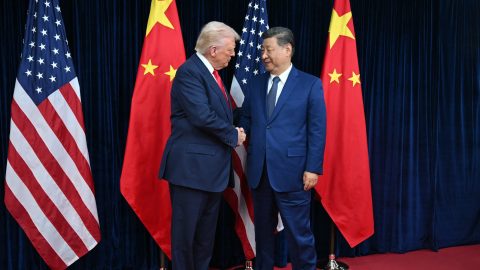
Imagine you’re a freedom-loving American patriot who works at a large investment firm. Last month, in the lead-up to President Donald Trump’s meeting with Chinese President Xi Jinping (習近平), you were appalled to learn just how much leverage China has over the United States when it comes to rare earth metals. So you go to your boss and ask for money to invest in an alternative supply chain, determined to ensure that your country will never be bullied ever again. He gives you $5 billion.
Boosting capital investment will be essential for shoring up the U.S. supply of rare earth metals, so you’re off to a good start. But there’s a reason your colleagues have been hesitant to try this before. “Corporate capital doesn’t love to deploy itself into highly regulated and challenging regulatory spaces,” explains William Burke-White, a law professor at the University of Pennsylvania.
Burke-White says that regulatory challenges will persist, even with the Trump administration’s aggressively anti-regulation approach. “Critical mineral refining requires significant infrastructure in physical plants and has significant environmental consequences,” he said. “So even if there’s less federal red tape, it’s not like you just see a critical mineral refining plan pop up on the local street corners.”
Another reason American investors like yourself have shied away from rare earths is that, for years, China has periodically flooded the market with low-cost products that crowd out all other competition. That makes it hard for newcomers to survive long enough to establish themselves. Julie Klinger, a professor of geography at the University of Delaware, thinks it’s a solvable problem, as long as the U.S. can get over its aversion to government involvement in private industry.
Things like price floors “are always political choices,” Klinger says. “How we organize markets, it’s not like the laws of physics, right?” The Trump administration has shown a willingness to buy stakes in U.S. rare earth companies. Some of these agreements include guarantees that the government will purchase a certain amount of production at a certain price. To Klinger, it’s a welcome change.
Once you realize that the political environment for American rare earth projects is improving, and you’ve come to terms with the regulatory headaches, now it’s time to decide which link on the supply chain to invest in. Rare earth minerals aren’t actually that rare, but isolating and refining them is a complex process that unfolds across multiple facilities, with each step bringing varying levels of technical difficulty and environmental impact. China remains the leader in every link, but its advantage in some areas is more lopsided than in others: The country controls 70% of worldwide rare earth mining capacity, but more than 90% of the market for refinement.
Ryan Fedasiuk, a fellow at the American Enterprise Institute, says that if your goal is to rebalance the geopolitics, you should invest in the refinement stage. “The problem is not getting earth out of the ground,” he says. “The problem is not even access to deposits in the ground per se. It’s about processing them and building up to a high purity for the minerals that we do acquire.”
By high purity, he means really high purity. Fighter jet engines are among the crucial national security applications of rare earths. To manufacture the magnets that hold together the F-35’s turbo-fan engines, engineers require refined minerals exceeding 6N purity, or 99.9999%. “[Building] something that can refine a mineral and separate it from every other element and manufacture it into magnets is incredibly difficult, and it takes decades to build that industrial base,” Fedasiuk says.
But before you worry about how long this is going to take, consider which elements your refinery is going to produce. Ryan Castilloux, founder of Adamas Intelligence, a market research consultancy that focuses on the rare earth industry, says that heavy rare earths, numbering 65 to 71 on the periodic table, are a “gleaming opportunity” for someone who can stomach the risks. In 2024, China accounted for 99% of the West’s supply of heavy rare earths. “If there was an alternative heavy rare earth oxide facility operating today, it would be in massive demand,” Castilloux says. “It would sell out almost immediately.”
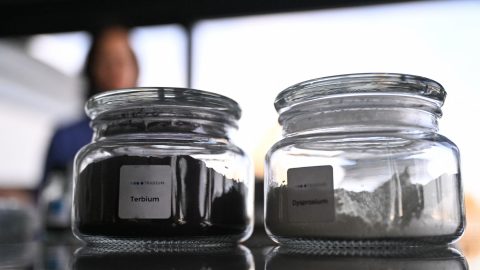
Dysprosium and terbium are two of the most strategically important heavy rare earths. Both are used to manufacture strong magnets that can withstand high temperatures, essential characteristics for holding together jet engines, among many other applications. Castilloux says that dysprosium and terbium would be the “bread and butter” products for a new heavy rare earth refinery. Customers like automakers would likely be willing to pay a premium over Chinese prices to ensure a steady supply of these elements.
But even if you can bank on steady income from dysprosium and terbium, you’ve still got to worry about monetizing the other elements contained in your raw materials. Samarium, europium, and many others are likely to be mixed in, and the path to profiting from them is less clear. “You need to decide on a strategy [where] you’re not going to end up with a bunch of material in a warehouse,” Castilloux says.
Once you have a good business strategy in place, you’ll want to be sure you can hire the right people to execute it. That’s no easy task either. “The U.S. just isn’t producing enough geological engineers or enough chemists that are wanting to work in this sector,” says Karl Friedhoff, an Asia Studies fellow at the Chicago Council on Global Affairs.
In a report published last month, Friedhoff noted that something like half of all mining workers in the U.S. will need to be replaced by 2029 as people retire from the industry. The education system is struggling to keep up. In 2023, the U.S. graduated just 300 students in mining and mineral engineering, down from 517 in 2015. Before you think about going to China to poach their top talent, consider this: The Chinese government has been tracking down the country’s rare earth specialists to confiscate their passports.
Lastly, you’ll need to have an answer for your boss on how long it’s going to take for your investment to pay off, both financially and geopolitically. In an interview with “60 Minutes” earlier this month, Trump offered an ambitious suggestion. “Within a year from now to a year and a half, we’ll have everything we need,” he said. But that’s not the sort of number that’s likely to pass the sniff test with billions of dollars on the line, according to most experts.
Friedhoff’s guess is 10 years, maybe five. “At the very fastest, if we started right now, it might be five, but that would mean you need everything to go perfectly. You need all the refineries ready to go and ready to be built,” he said. “I don’t think we’re there yet.”




Leave a Reply