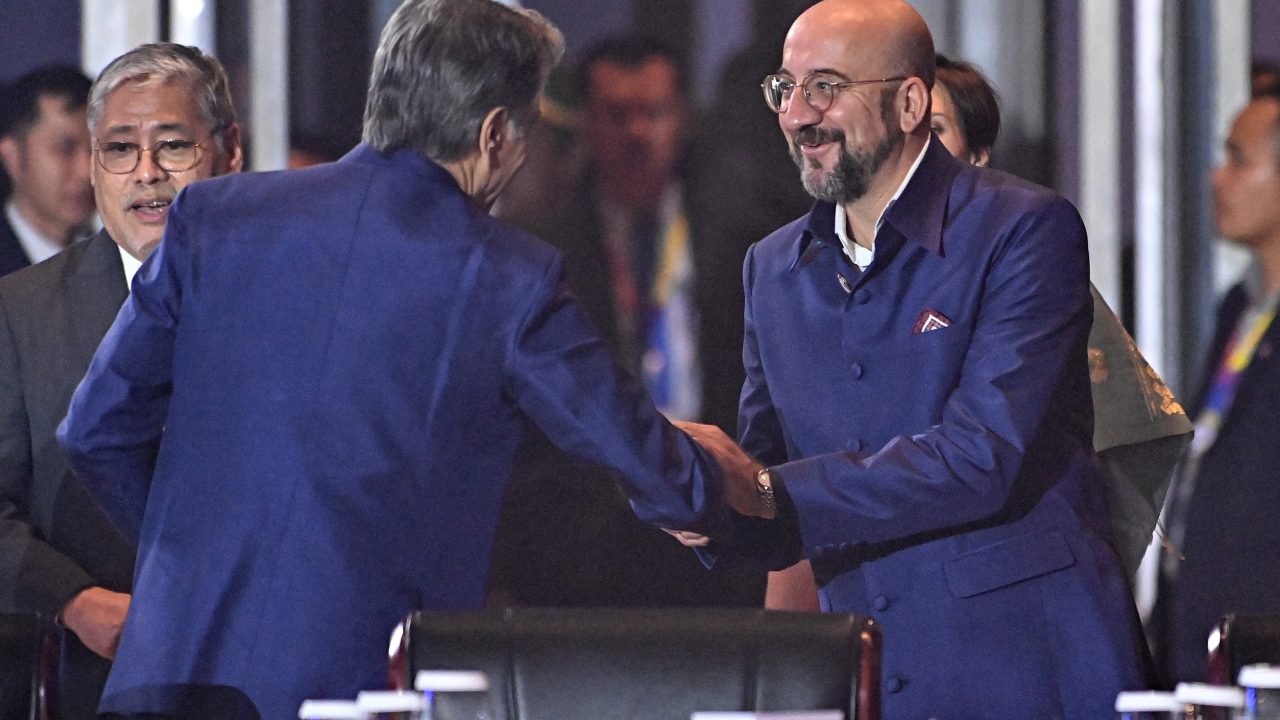
The European Union and China are in the midst of their biggest trade dispute in years, with Brussels preparing to impose tariffs of up to 45 percent on China’s electric vehicles. President of the European Council Charles Michel is attending the Association of Southeast Asian Nations (ASEAN) summit in Laos. And Taiwan’s former president Tsai Ing-wen (蔡英文) is using her first international trip since leaving office to speak at the Forum 2000 conference in Prague.
All of these threads are connected, and the new book “Partners in Peace: Why Europe and Taiwan Matter to Each Other” explains how.
Europe’s relations with China have entered a “downward trajectory” in response to the “authoritarian convergence” of China and Russia, the COVID pandemic and China’s “assertiveness” in the Indo Pacific region, according to author Zsuzsa Anna Ferenczy, an assistant professor at National Dong Hwa University in Taiwan. As a result, the EU has been “de-risking” economically from China. But it has also been developing partnerships with Taiwan and the Association of Southeast Asian Nations as part of its Indo-Pacific strategy.
The extent of these shifts in Europe’s collective view can be marked by the gap between Ferenczy’s latest work and her previous one. Published in 2019, “Europe, China, and the Limits of Normative Power” details Europe’s difficulties in setting a collective China strategy. It highlights EU members pursuing “interests over values” in dealing with China, particularly through bilateral deals. It does not mention the Indo-Pacific region (by that name.) And it only mentions Taiwan once.
“Partners in Peace,” by contrast, describes how new moments of coherence in Europe’s China strategy have come alongside a new “momentum” in relations with Taiwan in particular.
As chip sanctions and supply chain restructuring have provided a basis for one area of European convergence over China, trade connections with Taipei are expanding. Taiwan’s mask diplomacy during COVID and support for Ukraine has won hearts and minds. And fundamentally, Taiwan is now seen as a “partner on its own merit in the Indo-Pacific, as a mature democracy thriving on a bottom-up development of Taiwanese identity, rather than through the China lens only.”
All of this is seen as no coincidence. The argument throughout “Partners in Peace” is that Europe is beginning to see its fate as bound up with Taiwan’s and that it has good reason to. “The thinking in many parts of Europe is that partnering up with Taiwan, an economy that punches well above its weight, might help Europe to move up from where it is today, meaning punching way below its weight,” Ferenczy summarizes. At the same time, “Closer trade and technological cooperation with Europe will support Taiwan and its right to exist against external pressure.”
There are several key layers to this. Ferenczy says both partners have reason not to want China to dominate the Indo-Pacific region. Europe because it believes “the display of force and increasing tensions in regional hotspots such as in the South and East China Sea and in the Taiwan Strait may have a direct impact on European security and prosperity.” Taiwan by virtue of China’s direct military threats against it. In addition, Taiwan stands to gain from Europe purchasing more of its semiconductors, while Europe needs Taiwan as a part of securing its supply of semiconductors. Authoritarian disinformation campaigns affect both, and Taiwan could teach Europe some lessons on how to deal with them. And even Taiwan’s messaging about itself as a democratic success story is brought up as something the European Union could do with picking up.
Ultimately, “Partners in Peace” serves as a call to push these strands further. Ferenczy’s previous book, “Europe, China, and the Limits of Normative Power,” sets out a belief in the power of ideas, and the same view is expressed alongside identifying many of the new developments here. While there is “momentum” in the Europe-Taiwan partnership, Ferenczy says more could still be done if there is the “political will” to do it.
On China, she says: “[T]he bloc has sharpened its focus on China, [but] its approach has been reactive, given the lack of a long-term strategy.” On Taiwan, she calls for further cooperation in a number of areas, for example over foreign information interference, and over Europe’s Minerals Security Partnership, which Taiwan is currently not included in.
There will of course be many who do not share this analysis. For some, Europe’s primary reason for any security policy is following where the U.S. leads, and the U.S. does not want China to have regional hegemony in the South China Sea. But even for those who disagree, this is a comprehensive account of major landmarks in European relations with China and Taiwan.
“Partners in Peace: Why Europe and Taiwan Matter to Each Other” is available here.
The ebook version of “Europe, China, and the Limits of Normative Power” is priced from £20/$26 from ebook vendors. Print editions of the book can be ordered from the Edward Elgar Publishing website.





Leave a Reply