
In late September, the expiration date on U.S. President Donald Trump’s latest tariff pause was still more than a month away. U.S. investors had just struck a deal to buy TikTok. And Trump had just spoken on the phone with Chinese President Xi Jinping (習近平) announcing afterward that the two would meet in South Korea in October. Relations between the world’s two biggest economies, volatile for so much of Trump’s second term, appeared to have stabilized.
Then things fell apart. On October 9, in response to an obscure rule change from the U.S. Bureau of Industry and Security, or BIS, that dramatically expanded the scope of its Entity List, China announced a new regime of export controls on rare earth minerals that sent markets plunging and bilateral relations back into a tailspin.
The potential for agencies like the BIS — which experts say is staffed with people more skeptical of China than Trump — to trigger anxiety and retaliation from Beijing is just one of the many factors that could undermine the truce reached last week in South Korea.
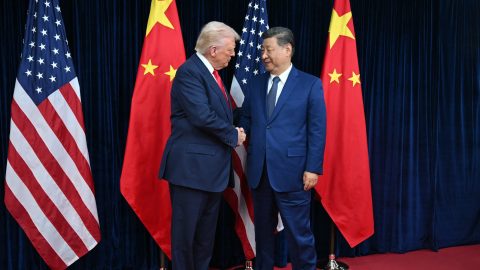
The details of the agreement remain unclear, but the basic outlines could be gleaned from a Truth Social post that Trump made during his flight back to Washington. The U.S. agreed to cut tariff rates on China by 10 percent. China agreed to resume purchases of U.S. soybeans and other agricultural products that it had suspended. China also agreed to pause its rare earth export control regime for one year pending further negotiations.
The White House touted the deal as “a massive victory that safeguards U.S. economic strength and national security while putting American workers, farmers and families first.” Beijing’s response was more reserved. “China is willing to work with the United States to jointly safeguard and implement the important consensus reached at the meeting between the two heads of state,” declared state-owned Xinhua News.
What exactly that consensus is remains somewhat unclear, a fact that Amanda Hsiao (蕭嫣然), a director in Eurasia Group’s China practice, says could threaten the stability of the agreement. “Beijing will follow through on its commitments as long as it believes Trump wants stable relations and is not breaking with the understandings reached,” Hsiao wrote in an email. “There will be room for interpretation, however, and with it, some fragility.”
One issue not addressed in either side’s readout from the meeting was the issue of AI chips. Under the first Trump and Biden administrations, the U.S. imposed export controls to limit China’s access to the most advanced chips, a strategy experts say could help the U.S. maintain its lead in one of the few areas of technology where it still holds a significant advantage.
Trump had appeared willing in recent months to upend that consensus. A day before his summit with Xi, Trump’s meeting with Jensen Huang — the Nvidia CEO who has lobbied for access to the Chinese market — fueled speculation that he would allow the company to sell a modified version of its flagship architecture to China. Trump told 60 Minutes on Sunday that no such deal was in the works.
“It is unclear if the U.S. promised to not pursue actions that would further restrict U.S. tech exports to China — this would be viewed negatively by Beijing and would likely provoke a Chinese response,” Hsiao said.
Fred Gao (高鷹石), a reporter for the Chinese state-owned media outlet CGTN, said that chip controls could be a continued sticking point for Beijing. “As long as the U.S. maintains its current strategic perception of China and its anxiety over preserving a ‘technology lead’ persists, Washington will continue seeking alternative avenues to restrict chip exports to China. This could introduce turbulence into the current bilateral relationship,” Gao wrote in an email.
On Tuesday, The Wall Street Journal reported that Trump’s top advisors, including Treasury Secretary Scott Bessent and Secretary of State Marco Rubio, expressed unified opposition to letting Nvidia sell its downgraded Blackwell chip to China, a move Trump had previously appeared open to.
According to Ali Wyne, a senior research and advocacy advisor in the Crisis Group’s U.S.-China practice, the disconnect between Trump’s perspective on China and that of the rest of the U.S. government could threaten the longevity of the deal. “It’s all too easy to envision that the Commerce Department or the Treasury Department or the Department of War … or some other component of the U.S. bureaucracy — potentially unbeknownst to Trump — could make a decision that China believes undermines the spirit of the tactical pause,” Wyne said in a phone interview.
But on the whole, Wyne sees reasons for optimism about the deal persisting. Chief among them is a recognition in both countries of how vulnerable they are to one another’s threats. “If there is one silver lining that might potentially make the short-term tactical pause have a little bit more longevity,” Wyne said, “it’s that the past several months have demonstrated quite painfully for both the United States and China how much economic damage they can inflict on each other.”
Zichen Wang (王子辰), the author of the popular China-focused newsletter Pekingnology and a Research Fellow at the Center for China and Globalization, a think tank in Beijing, agrees with that sentiment. Wang said in response to an email query that China’s willingness to use its rare earth export control regime has balanced out the U.S.’s AI chip leverage. “If Washington can weaponize chips and semiconductors and others, China can do the same with its unique advantage,” Wang said. “That creates a form of mutual deterrence neither side can ignore.”
Perhaps the primary reason to expect the current trade truce to hold, however, is the fact that Trump and Xi are expected to meet in person again several times in the coming years. After the meeting in South Korea last week, China confirmed that it is planning to host Trump for a visit to Beijing in April. Next year’s APEC summit is scheduled for November in Shenzhen. In December 2026, the U.S. plans to hold the G20 summit at a Trump resort in Miami.
“Given the political calendar,” Hsiao said. “There is a good chance that this agreement will hold and be renewed.”





Leave a Reply