
During a policy presentation for the highland indigenous people constituency (山地原住民選舉區), independent legislative candidate No. 3 Lin Shih-wei (林世偉), an artist from Jianshi Township in Hsinchu County, went viral. Lin grew emotional as he addressed recent sexual harassment accusations against him and swore multiple times. He was getting more agitated the more he spoke when he moved to the topic of how Taiwan’s indigenous people have not been treated fairly. “All the nuclear waste created by the Taiwanese is dumped in Lanyu,” he said. “You people failed to consider the Dawu tribe’s right to survival, which of you in the government… f***, f***, my dentures have fallen out. I swore so much that my dentures fell out.”
It is always special for Taiwanese people when they receive their voter pamphlets (選舉公報) each election year. They get to read about who is in the race and what kind of platforms they have. As Taiwan becomes more open and democratic, in recent years these pamphlets have begun to feature candidates who most people would have a hard time taking seriously.
Several candidates for seats in the 2024 Legislative Yuan came up with some unique campaign proposals. In the sixth district of Taipei City, candidate No. 5 Chu I-Ming (朱翊銘) of the Taiwan Renewal Party (台灣維新) wanted to ban people from adding taro to hot pot and the stirring of curry rice. He was also for “lowering the age of consent for sexual acts from 16 to 13” and “cisgender females being allowed to join organized crime groups.” In Taipei’s third district, candidate No. 2 Chen Yuan-fa (陳源發) advocated shortening the education system to four years of elementary school, two years of junior high and two years of high school, allowing graduation from high school at age 14. He also encouraged healthy, intelligent and beautiful young men and women from all over the world to have children with Taiwanese people to produce “hybrid vigor” (雜種優勢).
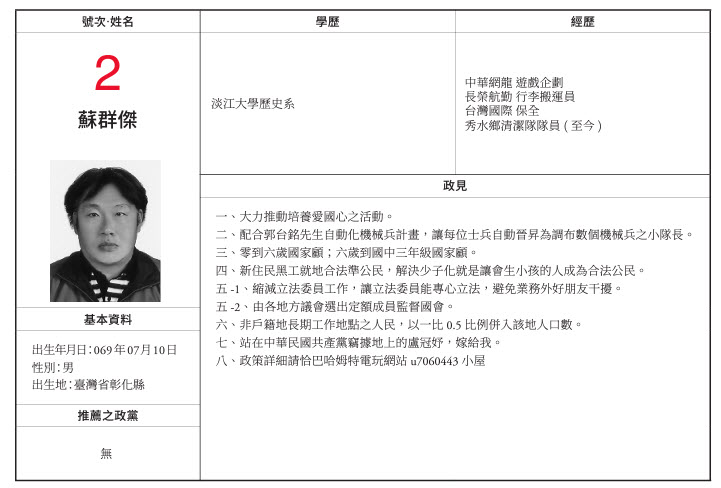
Among the eight campaign proposals presented by Su Chun-jie (蘇群傑), Changhua County district 1’s candidate No. 2., was a marriage proposal to a woman. Su asked Lu Guan-yu (盧冠妤), who currently resides in China and has blocked him on Facebook three times, to marry him.
After Lin, the candidate for the highland indigenous people constituency, shot to fame with his dentures, someone uploaded a clip of him dancing in an erotic fashion on a stage at a wedding banquet.
Other campaign strategies from indigenous candidates included hiring trucks to drive around broadcasting campaign slogans in different tribal languages, with the message: “Animals, tell your hunters to go vote on January 13. And remind them to not forget to bring their ID cards and chops, as there will be no hunting on that day.”
In 2018, a manager of a small bank branch named Wu Er-yang (吳蕚洋) ran for mayor of Taipei City. Wu did not live in Taipei City. He said he was running because the Buddha told him to. Wu then proceeded to break Taiwan’s internet by using his time at the televised mayoral debate to expound on the health benefits of drinking honey with lemon. Then he sang a song for no apparent reason.
Another amusing candidate during the 2018 election cycle was entrepreneur Lin Yi-fung (林義豐). The Tainan City mayoral candidate funded his own campaign. On top of promising to cancel various local taxes, Lin became famous nationwide with a campaign commercial in which he said he would organize a public concert at the local night market every Friday and invite whoever local youths suggested to perform.
Some candidates even change their names to draw attention to themselves. Huang Hong-cheng (黃宏成), who has run for various offices in Chiayi since 2010, changed his name to “Huang Hong-cheng, Ah Cheng from Taiwan, World’s Greatest Man, God of Wealth, and President” (黃宏成台灣阿成世界偉人財神總統). Huang has yet to be elected to public office.
None of these candidates have been elected. In Taipei City, Chu I-Ming, who wanted to ban taro in hot pot, received 660 votes. Chen Yuan-fa (陳源發), who wanted attractive foreigners to make babies with Taiwanese people, received 1,851 votes. Over in Changhua County, Su Chun-jie, he of the unfortunate marriage proposal, received 5,503 votes. Toothless twerker Lin Shih-wei won the most votes, with 6,331. Huang last ran in 2022 in Chiayi’s mayoral election and won 535 votes.
How do these people get on the ballot in one of the freest, most democratic elections in the world? With a deposit of NT$200,000 (about $6,375), any person who is at least 23 years old, holds R.O.C. Taiwan nationality and has resided in Taiwan for at least four months consecutively is eligible to run for a legislator at-large seat. A person who previously had household registration in Taiwan but has been domiciled abroad for more than eight consecutive years is eligible to run as an overseas compatriot candidate for a legislator at-large seat, though they must represent a political party. Candidates who are not elected and receive less than 10% of the total number of votes in their constituency will not have their deposit refunded.
While an election is important because it decides the future framework of a country, it is indeed interesting to have these individuals sharing their ideas on this public platform, as it can be a way to celebrate Taiwan’s freedom and democracy, and it also demonstrates that anyone can enter the election. It tells you a bit more about the people of Taiwan than if you just read the professional press releases from the main parties or broad summaries of what is going on from academics.




Leave a Reply