
1. U.S.: Secretary of Defense Speech at Shangri-La Dialogue and a Call for Increased Numbers of U.S. Troops in Taiwan
In his speech at the Shangri-La Dialogue in Singapore, U.S. Secretary of Defense Pete Hegseth said China was “credibly preparing to potentially use military force to alter the balance of power in the Indo-Pacific” and was rehearsing for “the real deal” of invading Taiwan.
Retired U.S. Navy rear admiral Mark Montgomery said the U.S. has around 500 U.S. military personnel stationed in Taiwan, and called for that number to be increased to 1,000. He was giving testimony to the U.S. House Select Committee on Strategic Competition between the U.S. and the Chinese Communist Party.
Taiwan’s government lowered its growth target for 2025 due to ongoing concerns about economic instability, following the tariffs imposed by the Trump administration. Taiwan’s GDP is expected to expand 3.10% in 2025, while a previous estimate predicted 3.14%.
Alongside dozens of other countries, Taiwan had a 90-day pause placed on its tariffs at the end of April, and the foreign ministry said Taiwan was in the “first wave” of countries set for tariff talks after reports Taiwan was not being prioritized. At the end of May, Taiwanese President Lai Ching-te (賴清德) said Taiwan would purchase more U.S. gas and oil as part of “more balanced bilateral trade.” At the start of June, Taiwan’s government said trade talks were ongoing but it could not comment publicly on them.
Taiwan’s military confirmed it had received the first batch of 16 Army Tactical Missile System (ATACMS) missiles. Taiwan has ordered 84 ATACMS in total from the U.S.
John Moolenaar, chair of the U.S. House Select Committee on China, and U.S. Senator Marsha Blackburn wrote to executives of the Hilton, Marriott and Hyatt hotel chains asking them not to refer to Taiwan as “Taiwan, China” on their websites.
2. Japan: Controversy Over Survey Vessel in Japanese Waters and Closer Ties With Taiwanese Allies
In early June, a Taiwanese research vessel sailed within Japan’s exclusive economic zone for 17 hours, according to Japan’s coast guard, which asked the vessel to halt survey activities during this time. Taiwan’s foreign ministry called for negotiations to resolve disputes over the boundary between Taiwan and Japan. The vessel was close to Yonaguni Island, the closest part of Japan to Taiwan.
Japan upgraded its relationship with Taiwan ally Guatemala to the level of “strategic partnership.” A Japanese foreign ministry official said engaging with Taiwan’s diplomatic allies is key to countering Taiwan’s international isolation. “Given their economic significance, it’s essential to cooperate with Guatemala and Paraguay to maintain Taiwan’s presence on the global stage,” the official said. Guatemalan President Bernardo Arevalo visited Taiwan before visiting Japan to sign the agreement.
3. Europe: Calls for Taiwan’s Inclusion at World Health Organization and French President Emmanuel Macron’s Comments on Taiwan and Ukraine
Ahead of the 78th World Health Assembly (WHA) last month, Taiwan’s foreign ministry thanked countries including Czechia, France, Germany, Lithuania and the U.K. for urging the World Health Organization to include Taiwan. “Our exclusion weakens global action, while our inclusion strengthens,” it said.
During the event this year, Taiwan sent a “WHA Action Team” to Geneva, led by Minister of Health and Welfare Chiu Tai-yuan (邱泰源). President Lai said the team held more than 40 bilateral meetings, international forums and news conferences.
At the Shangri-La Dialogue, French President Emmanuel Macron linked Ukraine’s fate to Taiwan’s. If Russian President Vladimir Putin could successfully invade Ukrainian territory “without any restrictions, without any constraints … what could happen in Taiwan?” he asked.
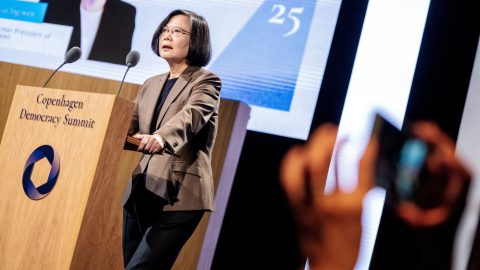
Following former Taiwan president Tsai Ing-wen’s (蔡英文) visit to the U.K. last month, Rupert Hammond-Chambers of the U.S.-Taiwan Business Council told Nikkei Asia a range of British companies are behind Taiwan’s indigenous submarine programme and Taiwan “requires the political and technological support from the U.K.” to maximize the potential of the Hai Kun class of boats.
Co-founder of Labour Friends of Taiwan, Andrew Yeh, who is also executive director of the China Strategic Risks Institute, told Nikkei Asia the U.K. “should step up intelligence-sharing, coordinate best practice and lead joint efforts to hold saboteurs accountable.”
At the end of May, a Labour Friends of Taiwan delegation visited Taiwan and met with the Taiwan Confederation of Trade Unions.
Academic Chiang Ya-chi (江雅綺) was appointed deputy head of the Taipei Representative Office in the U.K.
Former lawmaker and heavy metal musician Freddy Lim (林昶佐) was appointed as Taiwan’s next representative to Finland.
4. India: India-Taipei Association Director General Manharsinh Yadav ‘Very Hopeful’ About Economic Relations
After the India Taipei Association, Taiwan’s Ministry of Economic Affairs and the Industrial Technology Research Institute held the Taiwan-India Investment Strategy Partnership Forum in Taipei on May 21, India-Taipei Association Director General Manharsinh Yadav told Taiwan News both India’s Production Linked Incentive Scheme and its Electronics Component Manufacturing Scheme were aimed at Taiwanese companies.
Yadav said Taiwanese companies should look to get involved in India’s emerging electric vehicle and machine tools sectors, adding he was “very hopeful” about Taiwan-India economic relations. “The momentum is just building up … More and more Taiwanese companies are tying up with Indian companies,” he said.
Vice Dean of the College of Law and Politics at National Chung Hsing University Chen Mu-min (陳牧民) was named head of Taiwan’s representative office in India.
President Lai sent condolences to “the people of India, the U.K., and other nations impacted by the devastating crash of Air India flight AI171.” Taiwan is monitoring the situation closely and extends sympathy to all affected in this difficult time,” he wrote on X.
5. Diplomatic Allies: Former Pacific Island Allies Turn Against Taiwan
Taiwan’s former vice president Chen Chien-jen (陳建仁) attended Pope Leo XIV’s inauguration at the Vatican in May. President Lai did not.
Taiwan’s Minister of Foreign Affairs, Lin Chia-lung (林佳龍), accused China of using cash to win over developing countries to its position on Taiwan’s statehood and right to participate in international organizations like the U.N. Taiwan’s formal diplomatic allies are down to just 12 after a number of losses in recent years.
A joint statement at the China-Pacific Island Countries Foreign Ministers’ Meeting in Xiamen said “that Taiwan is an inalienable part of China’s territory.” Among the signatories were Nauru, Kiribati and the Solomon Islands, all states that until recent years recognized Taiwan.
6. Additional Developments: President Lai Says Opposition Parties Can’t Stand for Taiwan at Straits Forum
President Lai said Taiwan remains open to dialogue with China during an appearance on the Mindi World News podcast, but only on the basis of equality and mutual respect. He also said that cross-Taiwan Strait dialogue could not be based on cooperation with Taiwan’s opposition parties ahead of former Chinese Nationalist Party KMT) President Ma Ying-jeou (馬英九) attending the Straits Forum in Xiamen, China, this month.
In a separate interview, Lai reiterated his commitment to “non-communist” supply chains.



Leave a Reply