
1. U.S.: Bipartisan Delegation Visits Taiwan, U.S. House of Representatives Passes Two Taiwan-Related Bills, Continued Efforts to Push for Taiwan’s Inclusion in World Health Organization
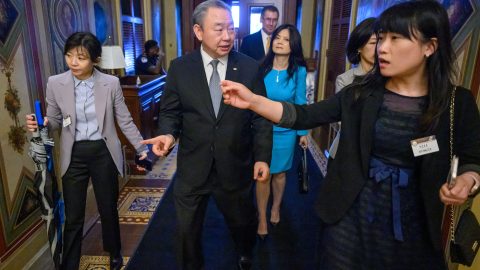
Republican and Democratic lawmakers traveled to Taiwan for the first trip since U.S. President Donald Trump came into office between April 16 and 18. After 32% tariffs were initially imposed on Taiwan by the Trump administration, the bipartisan delegation sought to reassure onlookers that relations between the U.S. and Taiwan would remain steady. Senator Pete Ricketts, chair of the Senate Foreign Relations Committee’s Subcommittee on East Asia, the Pacific and International Cybersecurity Policy said “Look past the rhetoric and look at the action.” Taiwanese President Lai Ching-te (賴清德) told the delegation his administration is committed to promoting non-communist supply chains.
Alongside dozens of other countries, Taiwan had a 90-day pause placed on their tariffs at the end of April, and its foreign ministry said it was in the “first wave” of countries set for tariff talks after reports Taiwan was not being prioritized.
Raymond Greene, director of the American Institute in Taiwan, said Taiwanese companies will be “critical” to Trump’s goal of re-industrializing the U.S.
Taiwan National Security Council Secretary General Joseph Wu (吳釗燮) congratulated Elbridge Colby as he was confirmed as the U.S.’s new under secretary of defense on April 9.
At the end of April, an unnamed spokesperson for the U.S. State Department told Taiwan’s Central News Agency the U.S. would continue to push for Taiwan’s inclusion in the World Health Organization.
Last week, the U.S. House of Representatives passed two Taiwan-related bills. The Taiwan International Solidarity Act states that United Nations General Assembly Resolution 2758 did not address the issue of representation of Taiwan at the U.N. or related institutions. The Taiwan Assurance Implementation Act directs the U.S. State Department to regularly review guidelines for U.S.-Taiwan engagement.
Also last week, Republican Senator John Curtis and Democratic Senator Jeff Merkley reintroduced the Taiwan Relations Reinforcement Act to the U.S. Senate. If passed, the act would change the position of the American Institute in Taiwan’s director to “representative,” and their appointment would have to be approved by the Senate — moving it closer to the role of ambassador. The American Institute in Taiwan is the de facto embassy of the U.S. in Taiwan. The act would also instruct the U.S. government to push for Taiwan’s participation in international organizations.
This week, Taiwan’s Ministry of National Defense confirmed delivery of 108 M1A2T Abrams main battle tanks are on schedule to arrive by early 2026. Thirty-eight arrived in December 2024, 42 more are on track to be delivered by the second quarter of 2025, and the final batch of 28 are scheduled to arrive by the first quarter of 2026.
Also this week, Taiwan performed its first test-fire of Lockheed Martin’s High Mobility Artillery Rocket Systems, or HIMARS. It has purchased 29 of the systems and so far received 11.
2. Japan: Joint Statement With NATO and Annual Diplomatic Report Highlight Cross-Strait Peace
Japan’s annual diplomatic report highlighted the importance of peace and stability across the Taiwan Strait.
NATO Secretary General Mark Rutte and Japanese Prime Minister Shigeru Ishiba sent out a joint statement on April 9, which included the idea that: “Our basic positions on Taiwan remain unchanged, and we emphasize the importance of maintaining peace and stability across the Taiwan Strait as an indispensable element in security and prosperity in the international community. We encourage a peaceful resolution of cross-Strait issues.”
3. Europe: Former Taiwan President Tsai Ing-wen’s European Tour Extended, Chinese Nationalist Party Vice Chairman Also Travels to Europe
Former Taiwan President Tsai Ing-wen (蔡英文) is visiting Europe this week, with a trip to the U.K. added to stops in Lithuania and Denmark. In her speech to the Copenhagen Democracy Summit on Tuesday, she said democracies should maintain individual and collective security responsibilities to stop adversaries from eroding democratic institutions. Her office said the visit to the U.K. comes at the “invitation of friends in the U.K. parliament” to further enhance the cordial relations between Taiwan and the U.K.
Andrew Hsia (夏立言), vice chairman of Taiwan’s main opposition Chinese Nationalist Party (KMT), has also traveled to Europe this week, headed for Denmark — where he has also attended the Copenhagen Democracy Summit — the U.K. and Belgium. He said the visit aims to demonstrate his party’s commitment to defending freedom and democracy and contributing to peace and stability in the Taiwan Strait and the broader Indo-Pacific region.
4. India: President Lai Condolences to People of India After Terror Attack in Kashmir, Indian Festival Taiwan
President Lai offered his “deepest condolences to the victims’ families and all those impacted,” after the terrorist attack in Kashmir. He added: “Taiwan stands with the international community in strongly condemning this atrocious act of violence against civilians. Our hearts are with the people of India.”
The Indian Festival Taiwan took place at the end of April. Organized by the Taipei India Music and Culture Center, with the support of the India Taipei Association, Taiwan’s Ministry of Culture and the New Taipei City Government, the event is a celebration of Indian culture, commemorating 30 years since the establishment of the India Taipei Association — the representative office of India in Taiwan.
5. Diplomatic Allies: President Lai Didn’t Attend Pope’s Funeral, Palau President Commits to Taiwan
In a statement addressing Pope Francis’s death, Taiwan’s Ministry of Foreign Affairs said President Lai instructed the Embassy of the Republic of China (Taiwan) to the Holy See to extend sincere condolences on behalf of the government and people of Taiwan to the Vatican.
Lai did not attend the funeral of Pope Francis, despite Taiwan’s deputy foreign minister, Wu Chih-chung (吳志中), saying the government was in talks with the Vatican over his attendance. Former vice president Chen Chien-jen (陳建仁) attended instead, as special envoy. As did deputy foreign minister Wu.
Lai congratulated new Pope Leo XIV on X, saying “We look forward to building on our diplomatic ties with the Holy See, 83 years strong, to advance peace, justice, solidarity & benevolence.”
At the end of April, Taiwan’s Minister of Foreign Affairs, Lin Chia-lung (林佳龍), met Eswatini’s King Mswati III and Queen Mother Ntombi at the groundbreaking ceremony of Taiwan and Eswatini’s largest joint infrastructure project, the Strategic Oil Storage Facility. Lin said on X: “A major milestone in our 57-year friendship, built on trust, teamwork & shared prosperity.” On the same trip, Lin also visited a hospital to donate medical equipment.
In an interview in April, the president of Palau, Surangel Whipps Jr., said he intended to maintain diplomatic relations with Taiwan throughout his four-year term. Re-elected last November, he said he believed in the “principle that when you’re married, you’re married ’til death do us part.’” However, he also added that smaller countries needed to demonstrate the value of such partnerships by proving to their own people that they created “jobs, opportunities, [and] livelihoods.”
6. Additional Developments: Somalia Blocks Taiwanese Passports
Somalia blocked Taiwanese passports at the start of May, citing the “One China principle” and U.N. Resolution 2758 as an explanation. It has been speculated that the move is to please China, though it is also possible Somalia may be responding to warming ties between Somaliland and Taiwan. Somaliland is an unrecognized territory claimed by Somalia.
Taiwan was ranked 24th in the World Press Freedom Index by Reporters Without Borders.





Leave a Reply