
At this year’s Ketagalan Forum in Taiwan, former United States ambassador to the United Nations Nikki Haley was invited to give a keynote address, during which she mentioned a couple of things that drew people’s attention. Haley said that Taiwan should be in the World Health Organization and that it should have full U.N. membership. However, it was her comments on U.N. Resolution 2758 that drew Domino Theory’s attention: “Taiwan should be a full member in the United Nations. You have every right to sit at the same table with the world’s countries.”
On the same day, the Australian Senate passed a motion to affirm that U.N. Resolution 2758 does not cover Taiwan’s sovereignty. The motion states that the People’s Republic of China’s sovereignty does not cover Taiwan, nor does it have a say on Taiwan’s future in the U.N. and its participation in U.N. agencies.
That these two events took place on exactly the same day is surely a coincidence. However, it speaks to a wider and renewed focus on Resolution 2758 that invites investigation.

“The General Assembly … [d]ecides to restore all its rights to the People’s Republic of China and to recognize the representatives of its Government as the only legitimate representatives of China to the United Nations, and to expel forthwith the representatives of Chiang Kai-shek from the place which they unlawfully occupy at the United Nations and in all the organizations related to it.”
This is the text of U.N. Resolution 2758. This resolution has become infamous because it represents the moment, in 1971, that Taiwan was kicked out of the U.N., or to be more accurate, the moment that the U.N. “China” seat (and Security Council membership) was stripped from the Republic of China and reassigned to the People’s Republic of China.
This event is crucial for understanding Taiwan’s international situation today. It was the inflection point for the Republic of China’s diplomatic recognition. Soon after, more countries recognized the P.R.C. than did the R.O.C. Today, Taiwan’s official “allies” have dwindled to just 12. The ability of China to wield U.N. institutions to exclude Taiwan from all sorts of international bodies, fora and organizations has been crucial to its goal of furthering Taiwan’s international isolation.
The People’s Republic of China has also used the United Nations as a source of legitimacy, arguing that because it holds the U.N. seat it is the “real” China. Curiously, Mao Zedong (毛澤東) and Zhou Enlai (周恩來) never seemed to mention the inverse of this argument when the Republic of China held the seat.
In recent years, China has begun to talk more about Resolution 2758 in particular. The 2022 White Paper on Taiwan was the first to talk about the resolution as a source of legitimacy at length, but even before this, it can be seen in China’s international language.
When Nauru announced it was severing ties with Taiwan after the election of Taiwanese President Lai Ching-te (賴清德) in January, it mentioned it was following Resolution 2758. It is believed this is the first time the resolution has been cited in such a “switching” announcement.
In July, a Joint Statement between China and East Timor on “Deepening the Comprehensive Strategic Partnership” stressed that “the authority of UN General Assembly Resolution 2758 is unquestionable.” It’s worth noting that East Timor is the most democratic country in Southeast Asia.
However, the recent focus on Resolution 2758 seems to date back to the previous year, 2021. In August of that year, Taiwanese Foreign Minister Joseph Wu (吳釗燮) published an article on Lithuanian news site 15min.lt in which he said, “the language of the resolution is very clear: it only addresses the issue of China’s representation at the UN, does not mention China’s sovereignty claims to Taiwan, nor does it grant the PRC the right to represent Taiwan in the UN system.”
Two months later Chinese Foreign Ministry spokesperson Zhao Lijian (趙立堅) said, “Hyping up the ‘Taiwan independence’ agenda is a blatant challenge and a serious provocation to the one-China principle, as well as a flagrant violation of Resolution 2758, and will not gain any support.”
On the fiftieth anniversary of the passing of the resolution, also in October 2021, the German Marshall Fund held an online public session to discuss Resolution 2758. U.S. Department of State official Rick Waters (who was also present at Ketagalan this week talking on other matters) said, “The People’s Republic of China has misused Resolution 2758 to prevent Taiwan’s meaningful participation.”
The German Marshall Fund and its Managing Director for the Indo-Pacific Bonnie Glaser have been key to raising awareness of Resolution 2758 from 2022 onwards. In March of that year, she and Jessica Drun published the first of two reports on Resolution 2758.
In this article the authors make a critical point, one that may or may not have escaped readers up until now:
“UN Resolution 2758 does not include the words ‘Republic of China’ or ‘Taiwan’ — it merely alludes to the former vacating its UN seat. Accordingly, it does not present an institutional position on the status of Taiwan, even though the PRC claims it does — it solely states that the PRC will, from that day forth, represent ‘China’ at the UN.”
This article will explore why the P.R.C. argues the opposite, even though it is undeniably the case that Resolution 2758 does not state that Taiwan is a part of China.
In April 2024, the German Marshall Fund published another report on Resolution 2758, co-authored by Glaser, with Jacques deLisle. This time policy recommendations were forthcoming. In particular, the report featured the following recommendation:
“Coordinate efforts by the United States, Taiwan’s diplomatic allies, and other like-minded UN member states, and exploit their diverse advantages and collective impact to counter the influence of the PRC and states that support its position on Resolution 2758 and related matters. Call out the flaws in the PRC’s legal arguments on Resolution 2758 and Beijing’s ‘one China’ principle to counter misinterpretations and inadvertent acquiescence by the UN and the international community.”
In May, Yang Tao (楊濤), director-general of the Department of North American and Oceanian Affairs of the Chinese Ministry of Foreign Affairs, said: “The Resolution resolved once and for all the question of the representation of the whole of China, including Taiwan, in the United Nations as a political, legal and procedural issue. It made clear that there is only one China in the world and that Taiwan is a part of China, not a country. It also made clear that there is only one seat of China in the United Nations, and the Government of the People’s Republic of China is the sole legal representative, precluding ‘two Chinas’ or ‘one China, one Taiwan.’”
Why does he say the resolution makes it clear that Taiwan is a part of China when it clearly does not state that? To understand this logic, we can turn to an editorial in the Communist Party newspaper Global Times from June. Academics Zhang Haipeng (張海鵬) and Feng Lin (馮琳) argue Resolution 2758 states “that the government of the People’s Republic of China is the only legitimate government representing all of China in the United Nations and clarifying Taiwan’s status as a non-sovereign entity. Taiwan is part of China and cannot have a place in Resolution 2758.”
It’s ironic that a paper called the Global Times would print a circular argument.
In June, retired Foreign Service Officer John Tkacik wrote in Taiwanese newspaper The Liberty Times that two U.S. deputy assistant secretaries of state had visited Taiwan that month, without attracting the media’s attention, and met with about 20 representatives from Taiwan’s allies, as well as those from other like-minded nations. As Courtney Donovan Smith pointed out in the Taipei Times, “a meeting of 23 countries and the EU being held in Taipei with two top American State Department officials is unprecedented.”
It’s clear then that the U.S. has been gearing up for a while for a big narrative push on Resolution 2758. Whether China is simply responding to this or is also making its own extended push is harder to ascertain. At the very least, the new insistence on including language on the resolution in joint statements, and the contorted attempt to insist it says that Taiwan is a part of China suggest that China genuinely believes that this narrative battle matters.
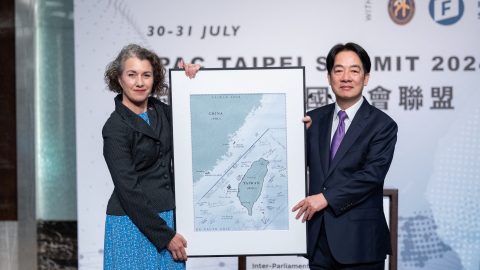
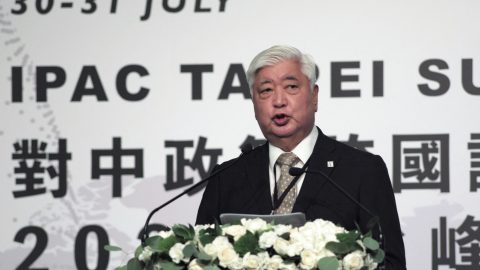
On July 30, during this year’s Inter Parliamentary Alliance on China (IPAC) forum in Taiwan, IPAC argued that U.N. Resolution 2758 does not include Taiwan under China’s sovereignty, and presented the Model Resolution on 2758 — a staunch move to reject Beijing’s interpretation of the resolution and international law on Taiwan’s status. The model resolution is intended to be taken back to IPAC members’ national assemblies and passed there.
Addressing the IPAC summit, President Lai said, “China’s acts to expand power often come through lawfare and the distortion of history. Laws should serve as a line of defense for fairness and justice. History should serve as a mirror for introspection — not as an excuse for aggression. The United Nations General Assembly Resolution 2758, which you will all discuss shortly, is a notable example of this.”
The motion in the Australian Senate this week was put forward by Senators David Fawcett and Deborah O’Neill, who both attended the summit in Taipei. O’Neill said, “It must be made crystal clear and affirmed without question or doubt in this place that Resolution 2758 does not establish P.R.C. sovereignty over Taiwan.” The motion passed unanimously with no dissenting voices raised during the debate.

In contrast, Haley’s speech at the Ketagalan Forum in Taipei is mostly an exercise in rhetoric:
“Taiwan has been a victim of a great injustice for more than 50 years. When the United Nations passed Resolution 2758 in 1971, it gave the Communist Party the right to represent China. Ever since, Beijing has claimed that that resolution makes Taiwan a part of China. But it doesn’t. The resolution doesn’t mention Taiwan at all. The U.S. and our allies should have called that out from the start. But instead, Beijing continues to call the shots.”
Nonetheless, if it becomes common for officials from democratic countries to push back on the resolution every time they mention Taiwan, the cumulative effect will be significant.
It is early days. One motion in the Australian Senate does not a global narrative shift make. And yet, the U.S. has had substantial success in recent years in persuading allies such as the G7 to include language about peace and stability in the Taiwan Strait in their statements. It may well have similar success over Resolution 2758.
Against this, China chooses a familiar tactic. As Orwell wrote in 1984, “The Party told you to reject the evidence of your eyes and ears. It was their final, most essential command.”


Leave a Reply