
“The Ugly Side of Eswatini-Taiwan Relations.”
That was the title of an article by James Baron published in The Diplomat on April 22.
Baron knew he would get pushback for the piece. He didn’t know he would be accused of smearing and spreading Chinese propaganda, and he certainly didn’t expect to be threatened with legal action.
The ugly side turned out to reveal an ugly face. Taiwan prides itself on freedom, but at times prioritizes pushing back against Chinese cognitive warfare over more universal values like press freedom.
Baron’s piece detailed what he described as “a series of scandals and disturbing allegations” at Taiwanese projects or events in Eswatini, Taiwan’s last diplomatic ally in Africa. Eswatini is one of the world’s few remaining monarchies. A dictatorship, in other words.
One scandal related to working conditions at the Taiwan-Africa Vegetable Initiative, or TAVI, a program funded by Taiwan’s Ministry of Foreign Affairs, as well as its Ministry of Agriculture. Baron reported that Swati employees were only allowed to eat after their Taiwanese bosses at events, sometimes going many hours without food. The allegations also include that Swati employees were not allowed to use their native tongue at work and that they must always smile in front of Taiwanese staff to show their gratitude.
Baron’s sources told him employees of the International Cooperation and Development Fund, or ICDF, which is a foundation under Taiwan’s Foreign Ministry that handles foreign aid, were frequently present at TAVI events where some of the allegations took place. The ICDF subsequently vociferously disputed this.
After Swati employees, including Baron’s sources, filed grievance claims related to these allegations against TAVI, they were told their contracts would not be renewed. There is now an ongoing labor dispute case related to their dismissal.
A separate part of Baron’s story relates to a cybersecurity workshop run in Eswatini by the Taiwan Digital Diplomacy Association, or TDDA, a non-governmental organization that “promotes innovation in citizen diplomacy” and often acts as a conduit between government and citizen projects. A TDDA employee told Baron the Swati participants in this workshop “wanted the tools and knowledge to take down Facebook posts criticizing the government.”
“Taipei is bolstering the capacity of authoritarian regimes to crack down on such rights,” Baron wrote.
Baron did not report TDDA itself was involved in labor rights issues.
The institutional criticism and response to Baron’s piece came in the form of public statements released by the organizations involved, as well as requests for changes or retractions from The Diplomat.
“The Ministry of Foreign Affairs deeply regrets that some media outlets or information sources have cited related content without verification, and even disseminated it in conjunction with specific political narratives,” the Foreign Ministry’s statement read.
Without directly naming Baron, the Foreign Ministry urged all sectors “to avoid unwittingly becoming a channel for certain forces to conduct cognitive warfare” and said that China’s “supply chain of misinformation,” under the guise of freedom of the press and speech, “actually undermines the democratic and free system and the functioning of society.”
Baron “made false links to deliberately smear ICDF’s image,” the development fund alleged, denying any involvement in the events featured in the article. The statement said the foundation, in addition to sending a letter requesting corrections, would “reserve the right to pursue legal action.”
The Diplomat’s article contained “untrue and misleading descriptions of the operations of the TDDA,” a letter published by the digital diplomacy association on its Facebook page read, adding Baron had used quotes from the TDDA staff member selectively, distorting the nature of an event TDDA had participated in.
After receiving correspondence either directly or indirectly from all three bodies, The Diplomat made several minor changes to the article, including clarifying the nature of the cybersecurity workshop and adding ICDF’s denial of any connection to the events in the piece.
I am not going to relitigate the claims made in Baron’s article. After speaking or attempting to speak to everyone involved, including one of the former Taiwan-Africa Vegetable Initiative employees in Eswatini, it is my belief that he conducted an extensive and thorough investigation. I have found no reason to think that what he reported is anything other than substantively correct.
Sitting down with Baron several weeks after the piece was published, it was obvious he was still bruised by the experience. A British journalist and long-time Taiwan resident, he rejected both the attacks on his reporting and on his motivations for doing so. The days after the publication were a whirlwind of trying to respond to the pushback. The Diplomat supported Baron, and, by his characterization, the attempts to “strongarm” the publication into retracting many of the claims backfired.
The Foreign Ministry tried to smear him by suggesting he was parroting Chinese talking points, Baron told me, and he felt what they said was “close to the bone.” But he said that ICDF’s statement was the most offensive, and he felt particularly attacked by that organization, because he had worked for ICDF two decades ago. He clearly felt betrayed that an organization that “knew” him in some sense would still go after him like this.
Both from Baron’s own account and other sources, it is clear that TDDA’s response was the least unreasonable. “Their language wasn’t inflammatory,” in Baron’s own words.
“After the article was published I wrote letters to The Diplomat to ask them to correct some sentences,” said Chiayo Kuo (郭家佑), the president of TDDA, who agreed to speak with me for this article. “We strongly protested to The Diplomat that there are some facts that James framed that were not true.”
But Kuo said she didn’t want to dismiss James’s pursuit of public interest or accountability. “I would not just say James is a bad guy just because he caused a lot of trouble to me.”
She went on to explain that “Taiwan is under a different context because we are attacked by China fake news a lot.” Kuo said she knows there are people in Taiwan who are hired by the Chinese government to write articles attacking the Taiwanese government.
It’s worth noting that disinformation is part of Kuo and TDDA’s remit. Disinformation is certainly a real concern in Taiwan. An oft-cited 2024 report from the University of Gothenburg found that Taiwan remained the country most severely affected by foreign disinformation for the 11th consecutive year.
The first reaction of the Taiwanese government to Baron’s article, to go on the defensive and criticize him, is very normal, Kuo said. “They might think James might have some collusion with China.” Kuo also initially had the same idea, but asked around and decided that he didn’t.
Both ICDF and the Foreign Ministry sent short written responses in response to questions about Baron’s piece.
“The TaiwanICDF Technical Mission in Eswatini has officially written to The Diplomat for fact clarification and correction to safeguard our rights. Please be advised that we will not make separate comments on individual inquiries,” ICDF said, not addressing whether it plans to take legal action against Baron.
“Regarding your inquiry about our position on the article published by journalist James Baron in The Diplomat in April, please refer to our press response to that report dated April 23, 2026,” the Foreign Ministry replied.
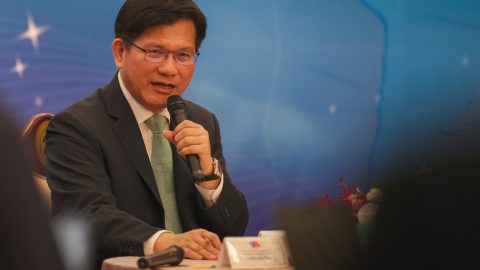
“Sometimes we have to be very loud,” said Taiwan’s foreign minister, Lin Chia-lung (林佳龍), speaking at a Taiwan Foreign Correspondents’ Club event on Wednesday afternoon. In response to my question about Baron’s story, Lin said once something untrue becomes a headline, it can be very hard to explain.
“Some journalists are innocent,” Lin continued, adding that unintentional mistakes could be communicated and corrected. But if this happens again and again: “Then we believe there’s an invisible hand behind it, but we might not know it.”
Taiwan is obviously sensitive to accusations of misconduct in its relations with its few remaining diplomatic allies. It might be especially sensitive in the case of Eswatini, a repressive state that shares very little in common with Taiwan, which international organizations consistently cite as one of the most democratic countries in the world.
Some in Eswatini say bad things about Taiwan. It does not automatically mean that China pays them to do so. When those things are repeated in pro-China Swati media that oppose the government and operate from outside Eswatini because of it, it does not automatically invalidate them.
In its statement, the Foreign Ministry seized upon the fact that some of the labor issues Baron reported had appeared in Swaziland News, a media outlet about which Baron writes in The Diplomat article: “[T]here is strong circumstantial evidence that Swaziland News receives funding from Chinese sources.” That Swaziland News might be distributing “deliberately distorted content” is easy to believe. Certainly, it has an interesting preoccupation with cross-strait relations.
But the Foreign Ministry then said “no such labor rights allegations have been reported in mainstream Swaziland media.” In 2026, Eswatini ranked 101st in Reporters Without Borders’ World Press Freedom Index, which described the situation as “difficult.” It’s no mystery why those allegations might not have appeared.
Reporters Without Borders isn’t the only organization worried about press freedom in Eswatini. TDDA’s director Kuo confirmed to me that they removed “some practical context from our materials that would help the Eswatini government to oppress the civil society” when delivering the cybersecurity workshop that featured in Baron’s article. This was exactly what Baron highlighted in his reporting that TDDA had been asked questions about handling Facebook posts criticizing the Eswatini government.
Taiwan’s government does not want to read stories about Taiwanese staff abusing African workers. Wanting to avoid negative press is understandable. But perhaps the response when Swati employees at Taiwanese organizations allege misconduct should be to listen and investigate, rather than knee-jerking into China disinformation narratives.
The Foreign Ministry has a track record of reacting to negative foreign press and accusing reporters of having a pro-China bias, Courtney Donovan Smith, who writes a biweekly column in the Taipei Times about Taiwan’s political scene, told me. Often, he added, “they are in fact pro-China or have viewpoints that Beijing would approve of, so it is appropriate to respond in kind.” But he said these incidents are rare and don’t have a lot of impact.
ICDF’s threat to pursue legal action “smelled more like posturing to underscore their denial than a real threat,” Smith said, but it could still be “interpreted as a threat against” following up on this story.
“The media helps Taiwan to reach out to the world,” Huang Yu-Lin (黃玉霖), ICDF’s secretary general, told a group of foreign reporters on Wednesday. Huang, who was speaking at the Taiwan Foreign Correspondents’ Club event with Lin, the foreign minister, said media coverage helps the international community “understand Taiwan’s value and contribution in global development.” But evidently some understandings are more welcome than others.
I’ll let Baron have the last word. We met in an old noodle shop in Taipei that he’s been eating at for decades. “It’s not because I’m trying to beat up on Taiwan,” he said while we waited for our food to arrive. “It’s the opposite, because I’ve lived here half my life. My kids are Taiwanese. I feel indebted to this country.”
“All you have to do is have a look, a brief look at what I’ve written over the years. It’s invariably been to support Taiwan’s case.”




Leave a Reply