
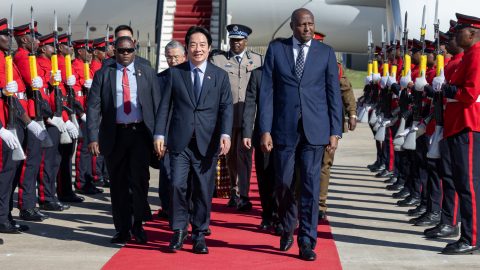
More than a week after Taiwanese President Lai Ching-te (賴清德) cancelled a planned visit to Eswatini because three Indian Ocean countries on his route didn’t grant overflight permission, details continue to emerge. But this is only provoking more questions rather than providing answers.
Lai’s presidential office announced the cancellation of the trip on the evening of April 21, claiming that Seychelles, Mauritius and Madagascar had all withdrawn overflight permission due to Chinese pressure. Mauritian newspaper L’Express subsequently reported that an unnamed Mauritian official said they had never granted overflight permission.
The trip had been postponed “after careful assessment by the national security team, and considering the safety of the head of state, the visiting group, and flight safety,” said Pan Men-an (潘孟安), Secretary-General to the President. He further alleged that the three countries were asserting “control of the flight identification zone.”
Therein lies the problem and the question. Under international aviation law, countries have no sovereignty over their flight identification regions, which are simply regions where their air traffic control is responsible for the management and safety of aircraft. Governments have the right to grant and deny access to the airspace directly over their territory, and there are specific conventions that apply for diplomatic flights carrying government officials.
None of this applies in the wider flight information region. “The government as such cannot say, in the exercise of my sovereignty rights, I withdraw the permission to cross the FIR [flight identification region]. They cannot do it,” according to Elmar Giemulla, honorary professor of aviation law at Berlin University of Technology.
A state could theoretically deny air traffic control services to aircraft within its flight identification region, Giemulla told Domino Theory, but “they shouldn’t do so, because they are there for safety.”
The flight identification regions of Mauritius, Seychelles and Madagascar are expansive and would have been hard to avoid when flying across the Indian Ocean. But that is empirically not the case for their sovereign airspace, especially given that all are island nations.
Much coverage of this episode has assumed that the three countries had the legal capacity to restrict Taiwan’s access to the relevant airspace. But given it’s now clear this is not the case, what was the safety issue that made the presidential office call it off?
In response to Domino Theory’s questions, the presidential office said: “President Lai’s visit was disrupted due to Beijing’s interference. By pressuring countries like Madagascar to revoke overflight permits, Beijing is once again attempting to suppress Taiwan’s international presence.”
When asked to clarify about the flight identification regions, and the fact Taiwan shouldn’t have required overflight permits, the spokesperson declined.
There was also no answer from the foreign ministries of Madagascar, Mauritius and Seychelles when asked what kind of overflight clearance was not granted, given they have no right to restrict access to their flight identification regions.
It’s thus unknown exactly what they relayed to the Taiwanese side that led to the cancellation of the trip due to safety concerns.
It’s worth noting in passing at this point that none of the three countries have the fighter jets that would typically be used to police airspace and ultimately deny access to it.
When approached for comment on the issue, a spokesperson for the American Institute in Taiwan, the de facto U.S. embassy, said that the countries were interfering in the safety and dignity of routine travel by Taiwanese officials. “These countries manage international airspace within their delegated Flight Information Regions that extend well beyond the sovereign airspace above their territories. This management responsibility exists solely to ensure aviation safety, not to serve as a political tool for Beijing.”
In order to land in Eswatini, Lai’s plane would have had to fly over either South Africa or Mozambique, through their sovereign airspace and not just their flight identification regions. This would have required diplomatic overflight clearance that could have been legally refused.
When asked if that clearance had been granted prior to the cancellation of the trip, neither the South African nor the Mozambican foreign ministries replied. Taiwan’s presidential office’s full response to questions was already printed above, and left this point unaddressed.
All parties here are incentivized to disclose as little information as possible. That’s understandable given the delicate unofficial diplomatic relationships involved.
But at the moment a misconception that the trip was impossible is being allowed to stand. In reality the Taiwanese government appears to have made a decision that President Lai’s safety in international airspace could not be assured.
That probably deserves a little more interrogation than it’s currently receiving.





Leave a Reply