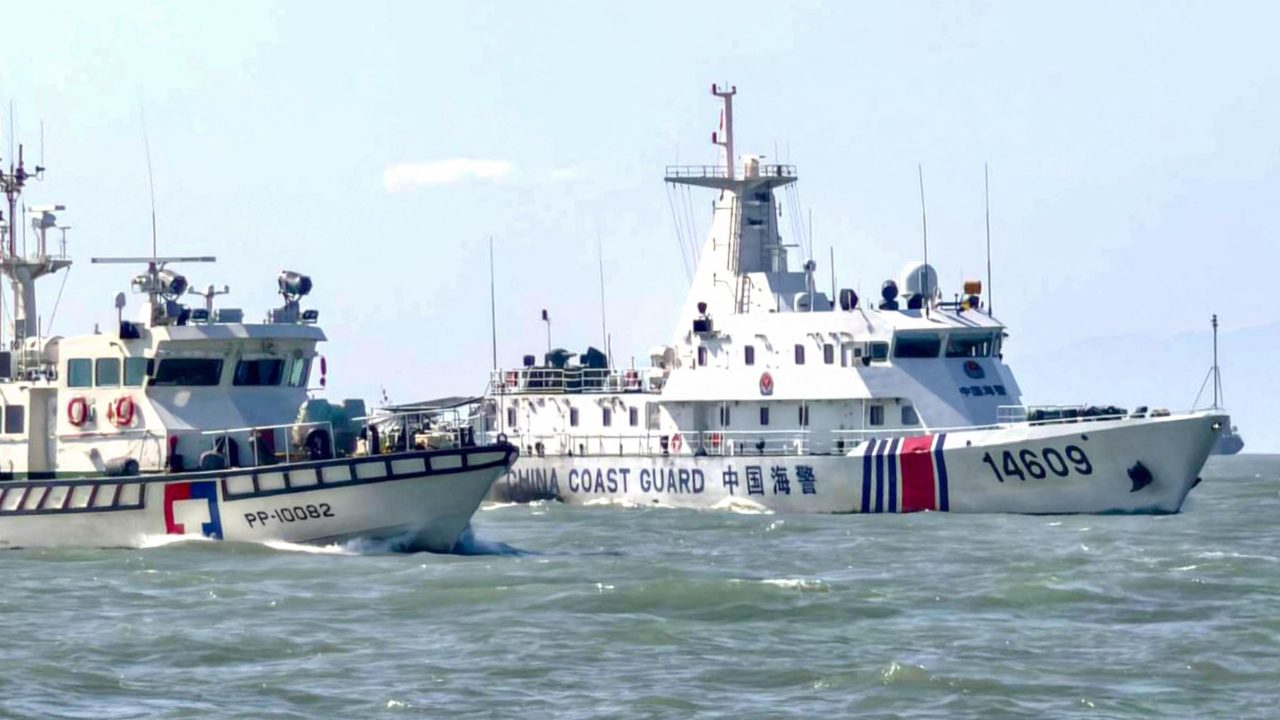
Chinese maritime law enforcement operations around Taiwan escalated to a new and concerning level this week.
China announced a “special maritime law enforcement operation” in the waters east of Taiwan on June 6. Today, Xinhua reported that the four-day operation had concluded.
Taiwan’s Coast Guard Administration revealed on June 9 that Chinese law enforcement vessels had been hailing civilian ships off Taiwan’s east coast and asking them for information.
Chinese vessels have previously hailed Taiwanese vessels, but extending this practice to international commercial traffic represents a notable expansion of Beijing’s efforts, said Ethan Connell, of Taiwan Security Monitor, an organization that tracks Chinese and Taiwanese military developments. He said China is trying to assert jurisdictional authority beyond its recognized maritime claims.
This new development will spark concern in Taiwan, and among Taiwan watchers, due to rising fears that Beijing may try to coerce Taipei using a gray zone, civilian-led blockade scenario known as a quarantine.
China is “attempting to first claim the eastern waters as their domain, like casting a large spider’s web over the area,” Defense Minister Wellington Koo (顧立雄) told Taiwan’s parliament on Monday, as reported by Reuters.
In a quarantine, coast guard and maritime safety ships would assert their sovereignty over international commercial traffic to and from Taiwanese ports., Most shipping companies are likely to comply with Chinese pronouncements, a report by the Center for Strategic and International Studies concluded. The authors added that obtaining compliance from international companies and other countries would demonstrate China’s power over Taiwan.
China’s actions this week are an attempt to normalize Chinese administrative control over international shipping transiting waters where China has no recognized enforcement authority, Connel from Taiwan Security Monitor told Domino Theory.
The announcement of a Chinese special maritime law enforcement operation in the waters east of Taiwan came after Japan and the Philippines said they would initiate negotiations to resolve their overlapping Exclusive Economic Zone (EEZ) maritime claims. Those claimed zones overlap in the seas east of Taiwan, in an area which both China and Taiwan also claim as part of their respective EEZs.
“China will by no means accept Japan and the Philippines bypassing China to initiate the so-called delimitation talks concerning waters east of China’s Taiwan,” said Lin Jian (林劍), a spokesperson for the Chinese foreign ministry.
Even though China says these exercises are aimed at Japan and the Philippines, it is Taiwan that is more directly implicated, because of the quarantine threat. During previous large-scale Chinese military exercises, Chinese coast guard and law enforcement vessels announced they were practicing “inspection and capture, interception and detention operations against unwarranted vessels,” but there is no evidence these drills involved real actions against commercial shipping.
The area where Chinese vessels are currently operating is not Taiwanese territorial waters. However, while sailing around Taiwan’s southern tip on June 7, some Chinese law enforcement vessels did enter Taiwan’s contiguous zone, a band of water that surrounds Taiwan’s sovereign territory, according to Taiwan’s Coast Guard Administration. The contiguous zone, which Taiwan calls restricted waters, is rarely entered by Chinese navy or civilian enforcement vessels and thus operates as a kind of buffer zone. But China is pushing into it more and more.
Several of the vessels involved belong to the China Maritime Safety Administration, a law enforcement agency, which operates both separately and in conjunction with the Chinese coast guard. Taiwan’s Coast Guard Administration said that one of the China Maritime Safety Administration vessels, Haixun 06 (海巡06), hailed a Singapore-registered vessel on June 7, and vessels registered in Liberia and Benin on June 9, asking them what ports they were bound to and from, as well as how many crew they had onboard.
Xinhua News reported that the special maritime law enforcement operation had inspected 198 vessels, and corrected three violations of regulations and laws. It’s unclear whether these three “corrections” correspond to the three hailings reported by Taiwan.
Haixun 06 is the exact vessel that China deployed after Speaker Nancy Pelosi’s visit to Taiwan in 2022, and again after then-President Tsai Ing-wen met Speaker Kevin McCarthy in the U.S. in 2023. It is assigned to the Fujian Maritime Safety Administration, with responsibility for the Taiwan Strait.
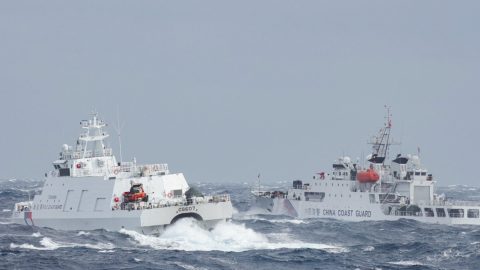
Taiwan’s Coast Guard Administration also reported the presence of Haixun 08 (海巡08), from the East China Sea Navigational Guarantee Center, and Haixun 09 (海巡09), from the Guangdong Maritime Safety Administration. Haijing 2202 (海警2202), from the China Coast Guard, and Donghaijiu 113 (東海救113), from the China Rescue Service and Salvage Bureau are also reportedly in the flotilla. Xinhua made no mention of any coast guard involvement in its report.
In response to this flotilla, Taiwan deployed five coast guard vessels to monitor it: Kaohsiung (高雄), Hualien (花蓮), Tamsui (淡水), Jian (吉安), and Changbin (長濱). The coast guard broadcast this message to the Chinese ships:
“This is the Exclusive Economic Zone of Taiwan, Republic of China. China has no jurisdiction. Please do not harass navigating vessels. Your behavior has already violated international law, and I demand that you leave immediately.”
It broadcast a different message to the international cargo ships:
“This is the sea area of the Republic of China. China does not have any sovereign rights, nor does it have jurisdiction. Please maintain normal navigation and do not heed the broadcasts from Chinese official vessels. If you need any assistance, please contact Taiwan Coast Guard vessels immediately via radio or other communication methods.”
Joseph Wu (吳釗燮), the secretary general of Taiwan’s National Security Council, called China’s actions “a major escalation of regional tension” on X, and called on all commercial vessels in the area to ignore Chinese coast guard radio calls.
The current situation in waters to the southeast of Taiwan may not play out to Beijing’s advantage, said Philip Shetler-Jones, who researches Indo-Pacific security at the Royal United Services Institute. Its demand for commercial shipping to provide information “could be framed as a form of harassment that unnecessarily raises alarm in an industry whose nerves are already worn thin.”
Taiwan is highly dependent on international shipping for the flow of critical commodities like fuels, food and pharmaceuticals, Shetler-Jones added. And he warned: Although Taiwan is a major ship-owning and ship-building economy, many of those commodities are carried by ships entirely under foreign ownership and sailed by foreign crews.





Leave a Reply