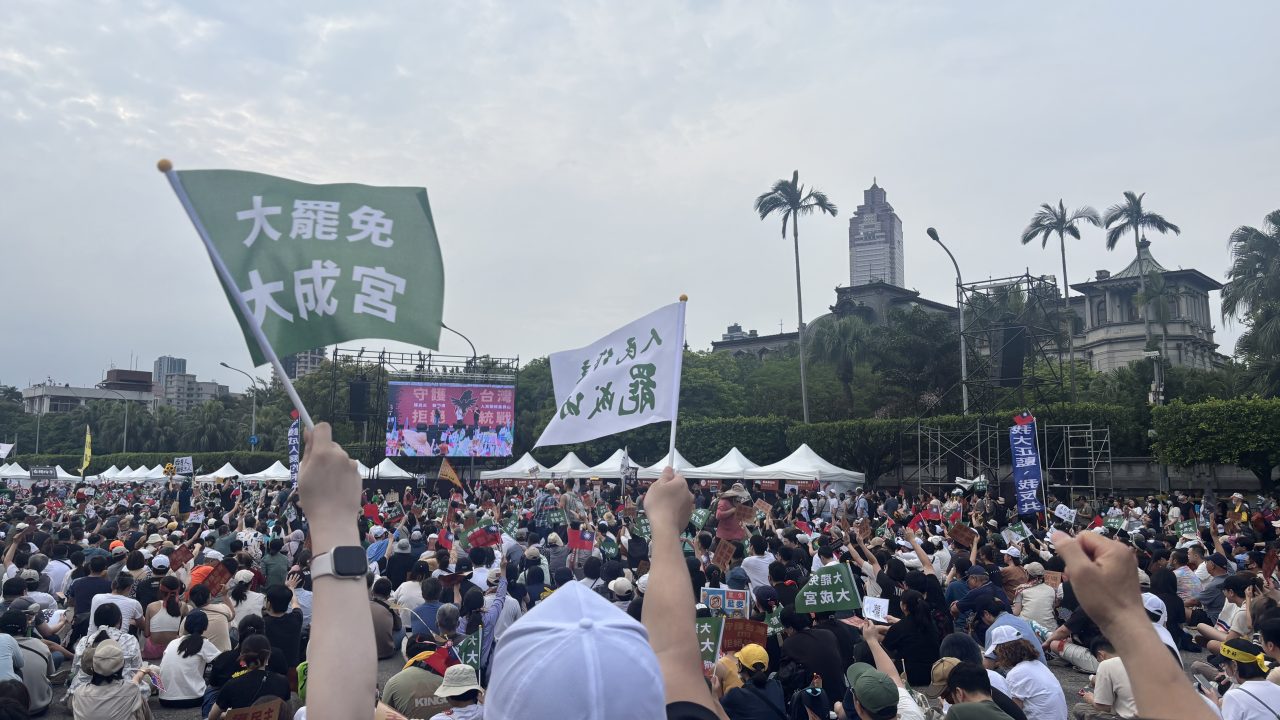
Scores of elder Chinese Nationalist Party (KMT) supporters in Taipei’s Daan District have signed a petition to recall the district’s KMT legislator, Lo Chih-chiang (羅智強), according to testimony on the recall movement’s official website. Although Taiwanese politics is deeply divided along party lines, the testimony says these elders are willing to recall a member of their own party because they want their grandchildren to live in a free society.
Lo is one of 35 KMT legislators who are facing recall following a year of controversial legislation that has led many to believe that the KMT has “been fully penetrated by the [Chinese] Communist Party,” said Ming-sho Ho (何明修), a professor at National Taiwan University who specializes in political sociology and social movements.
But as one of the most aged, wealthy and KMT-leaning districts in Taiwan, Daan’s recall movement is exceptional. Whether or not Lo ultimately loses his seat, there seems to be a movement toward (or at least an attempt at a movement toward) greater alignment between the KMT and DPP under an anti-communist, anti-authoritarian banner.
After fleeing China in the 1940s, the KMT settled many of its military, civil servants and educated elite in Daan District, among other parts of Taipei like Zhongshan and Songshan districts, said Nathan Batto, an associate research fellow at Academia Sinica’s Institute of Political Science. Today, a relatively high proportion of Daan’s residents are mainlanders and their descendants who remain sympathetic to the KMT. Daan has not once elected a legislator from the Democratic Progressive Party (DPP), which favors more distant relations with China, since the districts were redrawn in 2008, despite the fact that Taiwan has had a DPP president for most of that time.
While the KMT’s performance in the 2024 national elections demonstrated a wide base of support, during the past year, the KMT has been “pushing limits in ways we haven’t seen before,” said Batto. Specifically, the KMT has tried to push through several pieces of controversial legislation that many believe overstep the KMT’s traditional preference for engagement and dialogue with China, including bills that slash the budget and reduce the time required for Chinese immigrant spouses to become Taiwanese citizens.
There’s also a sense that the KMT is cozying up to China behind constituents’ backs, said Ho. Before the legislative session began last year, a prominent KMT legislator from Hualien, Fu Kun-chi (傅崐萁), led a delegation of other KMT legislators to China. On another occasion, Fu secretly travelled to Hong Kong ostensibly to meet with a member of the Chinese Communist Party while indicating on his Facebook that he was sick at home.
According to Batto, Daan’s legislator, Lo Chih-chiang, is part of a faction of the KMT aligned with former president Ma Ying-jeou (馬英九) that seeks better relations with China and sees the future of Taiwan as inevitably tied with China. Describing this faction of the KMT, Batto said, “[Taiwan] can’t escape its ethnic heritage and its geographical position. And you know, there are people who think that trying to resist that is a fool’s errand.”
While both the KMT and the DPP officially support maintaining the status quo in cross-strait relations, the KMT supports Taiwan’s sovereignty within the framework of the Republic of China, which is the official name of Taiwan. As a part of this framework, the KMT recognizes the “1992 Consensus,” which refers to a reported understanding between the KMT and the Chinese government that there is one China but that there can be different interpretations of what China is. The KMT considers China to be the Republic of China.
KMT supporters generally agree with this framework — it’s a key schism with the DPP, which rejects the idea that Taiwan and China are a part of “one China” and tends to prefer the label “Taiwan” over “Republic of China,” even though the country still formally operates within the Republic of China framework. Still, “if you are one of the people who’s dedicated your life to the Republic of China, and think that the Republic of China is your north star, then playing friendly with the People’s Republic [of China] maybe is going too far,” acknowledged Batto.
At this stage in the movement, there doesn’t seem to be a strong notion that KMT supporters in Taiwan — even those who support the recall — are inclined to reject the KMT wholesale. According to recall volunteers, the movement has tried to unite all voters, regardless of party-affiliation, against anti-communism and anti-authoritarianism. “The main idea of this whole thing is to fight China, to fight communists. So it’s not about which party you are in in Taiwan,” said recall volunteer Ting Yi Liu (柳亭伊), who was gathering signatures for Daan at a KMT recall rally on April 19. “Most people, we just want to make sure we have our freedom, we have our democracy,” Liu added.
Chia-hung Tsai (蔡佳泓), a professor National Chengchi University specializing in Taiwanese elections, thinks that some KMT supporters, maybe just a small proportion, are beginning to accept the cohesiveness of the Republic of China and Taiwan, recognizing that it’s better to be united than to be overly friendly with Beijing. Ming-sho Ho from National Taiwan University thinks that what is happening right now with the recall movement is “promising to be a shakeup of the political alignment.” By next week, most of the campaigns will have completed their second stage, which is to gather signatures from 10% of eligible voters in that legislator’s district in order to initiate a recall election. The campaign against Lo in Daan has already gathered signatures from over 10% of eligible voters.
The fact that Lo will have to face a recall election is a big deal. Given how “ideological” Daan is, if the election “were to even come close, you would expect the entire recall effort nationwide to be a wave,” said Batto. But Batto also warns against accepting the narrative that there is a widespread shift in the electorate without skepticism. Ultimately, Batto doubts that Lo will lose.
Even if Lo is ousted, both Batto and Tsai agree that a DPP politician might not be elected in his place. The impact of this recall might be “to moderate the KMT, not necessarily diminish it,” said Batto. This might be due to internal politics within the KMT. Batto and Tsai also both noted that some moderate KMT politicians, particularly city councilors, might not be working very hard to resist the recall because they could potentially fill the seats of recalled legislators.
Henry, another recall volunteer and resident of Daan who preferred not to share his full name, put it this way: “In the future, who comes into power, that is for the next election to decide … Our goal is not to annihilate the KMT but to make them think about what their stance on China is.”



Leave a Reply