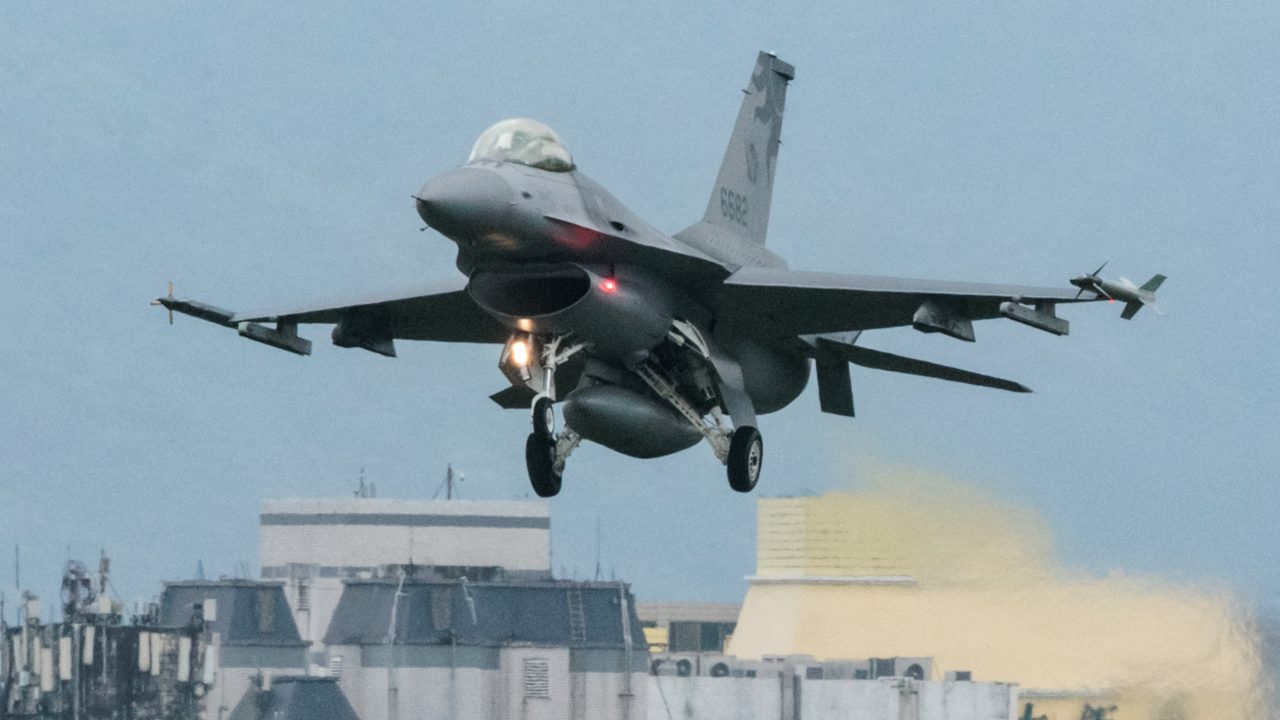
Picture the scene: A Taiwanese fighter jet takes off from the air force base in Hualien, on the island’s east coast, and climbs into the sky, carrying a payload of anti-ship missiles to sink at least some of the ships in a Chinese invasion fleet. It crosses the high peaks of the central mountain range, but before it can get anywhere near the waters of the Taiwan Strait, a Chinese surface-to air-missile fired from Fujian knocks it out of the sky.
China already has an impressive slate of long-range air defense systems, surface-to-air missiles, like the domestic HQ-9 or the Russian S-400. At the September 3 World War II victory parade in Beijing, more were unveiled, like the HQ-22A. These missiles likely have ranges in excess of 300 kilometers, although exact numbers are unknown.
The Taiwan Strait is approximately 200 kilometers wide, and much narrower at about 135 kilometers between some of the islands in Fujian and northern Taiwan. While air defense is usually thought of as, well, defensive, targeting aircraft or missiles flying into Chinese airspace, these long-range systems are capable of reaching Taiwanese airspace.
The question thus pertains: Could China position its air defense systems in Fujian on the Western side of the strait and target aircraft in the skies over Taiwan itself, in a form of air defense offense? Could this even close the skies over Taiwan and force Taiwanese aircraft to stop flying?
“The whole airspace west of [the] central mountains will be very unsafe because of very long-range missiles,” said Xu Tianran (徐天然), a senior analyst focusing on Northeast Asian security and missile systems for Open Nuclear Network, a nuclear risk reduction nonprofit in Austria.
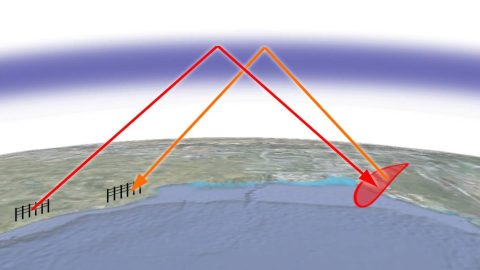
Xu’s theory is that the Chinese military will be able to use long-range air defense missiles in tandem with airborne early warning and control system, or AWACS, radar-carrying aircraft, instead of the vehicle-mounted radar that is integrated into the batteries on the ground. Because of the curvature of the Earth, ground-based radar can’t see low-flying aircraft or missiles at long distance. However, “if you have some of [these] airborne systems flying over Fujian or even further away, you can already maybe see a lot of things flying low,” Xu said.
Effectively, surface-to-air missiles fired from the ground in Fujian would have the range to hit aircraft in the sky over Taiwan, hundreds of kilometers away. Radar flying at altitude over Fujian would have the range and line of sight to see those aircraft.
Obviously, it could not be so simple. There is another piece of the puzzle. “Those new types of missile, they are all active radar,” Xu pointed out. Active radar means that the missile carries its own radar seeker — in the terminal phase they can find a target independently, so “they don’t rely upon third party illumination from those [AWACS] aircraft or from illumination radars on the ground.”
But all of this is contingent on whether the targeting information from the radar on the aircraft can be shared with the missiles before launch and perhaps during their flight to allow for mid course corrections. As Xu put it: “If you don’t have the cooperative engagement capability, you don’t have the data link, it’s hard to shoot at those targets. But I assume they have this capability.”
Others are not so sure.
“I don’t know if China has this capability or not,” said Carl Rhodes, the director of Robust Policy, a defense analysis firm. He said it’s complex to “close that loop of command and control,” because “you have to get the message there at the right time, [and] ensure that you’re all talking about the same target.”
Rhodes said that this “is kind of at the edge of the U.S.’s capability, as well as the edge of China and Russia’s capability.”
Rhodes had another concern as well. “The longest-range missiles are not the most maneuverable.” Long-range air defense is meant for large aircraft, like Taiwan’s own AWACS, “a big thing that’s not very maneuverable.” On the other hand, “engaging a fighter is a different story, because a fighter is built to maneuver around these things.”
Additionally, Rhodes noted that at the limits of a missile’s range, it loses “kinetic capability to turn,” because it has used more of its fuel so cannot respond as effectively to the change in position of its target.
Nonetheless, Rhodes said that “even right now, China can do some of that,” referring to the ability to put air defense missiles into the air over Taiwan. His concerns revolve more around the targeting and effectiveness at range
A further issue is “sorting out ally and adversary,” said Mark Montgomery, a retired U.S. Navy rear admiral and senior fellow at the Foundation for Defense of Democracies. He said that in the first days of a conflict, the Chinese military would be able to assume that “everything flying over Taiwan [is an] adversary,” but as things progressed and China started flying into Taiwanese airspace, this would become much more difficult.
Montgomery said that “having a long-range stick like that matters.” He just thinks it is “part of an integrated air missile defense that makes things harder” for the Taiwanese air force, rather than a capability to really deny Taiwan’s airspace to its own military.
While the experts consulted disagreed on whether China already has the capability to seriously threaten Taiwanese airspace with its surface-to-air missiles, there was broad agreement that the continuing advance in Chinese capabilities is worsening Taiwan’s tactical situation. The solution? “Think about asymmetric ways to attack this threat,” said Rhodes.



Leave a Reply