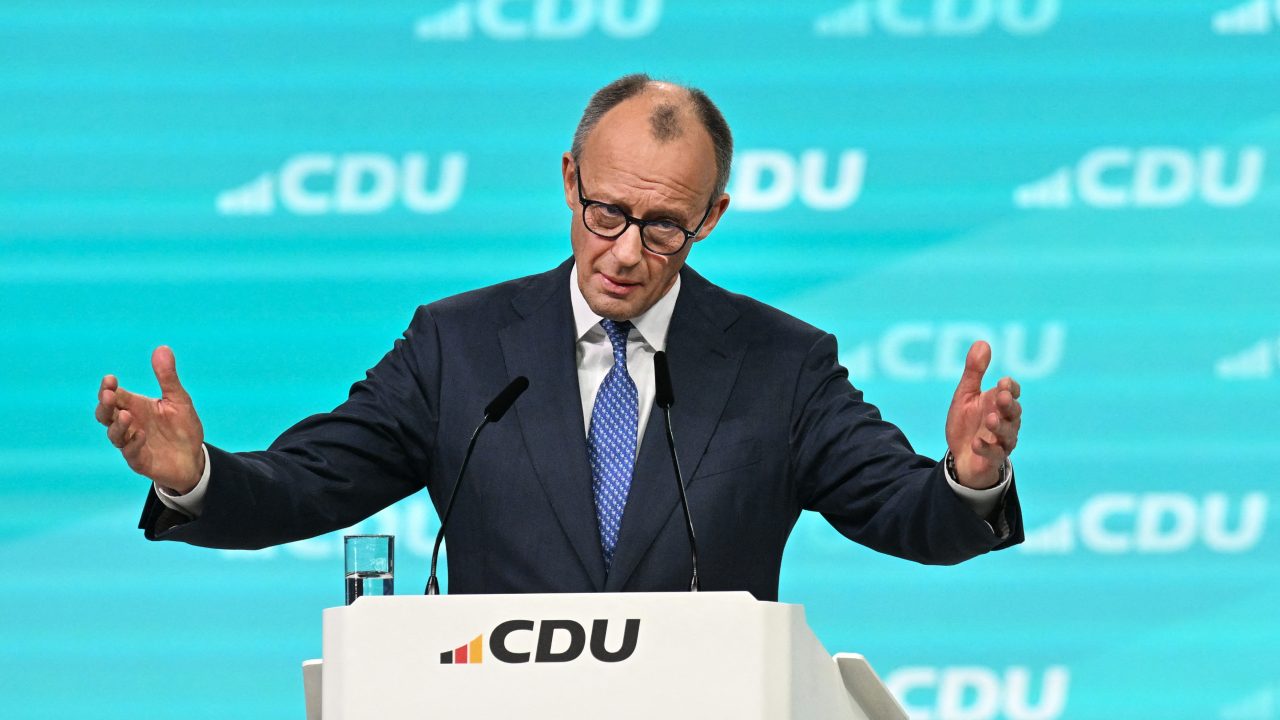
German chancellor Friedrich Merz will arrive in China on Wednesday for his first visit to the country while in office. He is expected to focus on trade ties between Beijing and Berlin, but in a speech during his party conference last week made surprisingly robust remarks about freedoms and rights. His forthrightness is atypical of democratic leaders about to visit China, at least recently.
Merz will spend two days in China, visiting Beijing for meetings with Chinese President Xi Jinping (習近平) and Premier Li Qiang (李強) and tech hub Hangzhou to visit Chinese and German companies. Germany’s economy and especially its automotive industry has been struggling to deal with declining sales of cars in Germany. Other issues on the table are likely to be access to rare earths and Chinese support for Russia’s invasion of Ukraine.
Merz set out his vision of a world of great power competition at his conservative Christian Democratic Union party’s conference last week. “China today sees itself in explicit opposition to the U.S. and claims to define a new multilateral order according to its own rules,” he said, adding that the country lacks freedom of expression, freedom of religion and freedom of the press, and that a commitment to human rights is rejected as interfering in China’s internal affairs.
He concluded the thought by pondering: “Wouldn’t it be right for us Europeans, together with the Americans, to offer a better alternative, rooted in our shared understanding of freedom and humanity than what we are hearing from the Middle Kingdom?”
This suggestion is going to go down like a lead balloon in Beijing.
Merz is the latest in a line of European leaders to have visited China in recent months. Irish Taoiseach Micheal Martin, Finnish Prime Minister Petteri Orpo and British Prime Minister Keir Starmer all made the trek in January. Canadian Prime Minister Mark Carney was another high-profile visitor. Spanish Prime Minister Pedro Sanchez is expected later in the spring.
One leader who has frequently visited China during his tenure is French President Emmanuel Macron, who was in Beijing for a fourth state visit in December. Macron has cultivated a relatively close relationship with Xi, who unusually accompanied him out of the capital, to Chengdu, something the French president described as “very touching.”
Like Merz, Macron has not been afraid to criticize China. “Either we rebalance economic relations cooperatively — engaging China, the U.S. and the EU in a genuine partnership — or Europe will have no choice but to adopt more protectionist measures,” he said in an editorial in the Financial Times after his visit. Earlier this month he referred to a “Chinese tsunami on the trade front,” when talking to reporters, described the combination of this with American instability as “a profound shock — a rupture for Europeans.”
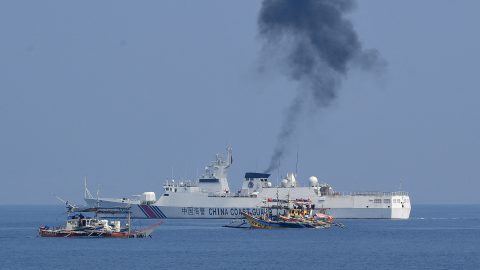
But there is an obvious difference in kind between Macron and Merz. Macron limits his critique to the economy, whereas Merz has been happy to address much wider issues. And his remarks at the party conference were not an outlier. China is “aggressively expanding naval bases in the South China Sea, encircling Taiwan, and openly declaring its readiness to use military force, if necessary, to bring about the so-called reunification of China,” Merz said at a campaign event last week, according to Bloomberg.
It’s not clear why Merz is speaking so freely. Frankly, some of his language risks Chinese tantrums, as was evidenced when his foreign minister had a visit to Beijing delayed last autumn over comments on Taiwan and Japan.
On the face of it, one might assume that Merz was speaking from a position of strength. The reverse is probably true. German car manufacturers are being eaten alive by their Chinese counterparts, and not just in China. German foreign interests have historically been steered by a need to maintain automotive exports. If Merz is no longer concerned about speaking softly to Beijing, perhaps he holds little hope that the once ubiquitous Volkswagens will make a Chinese comeback.





Leave a Reply