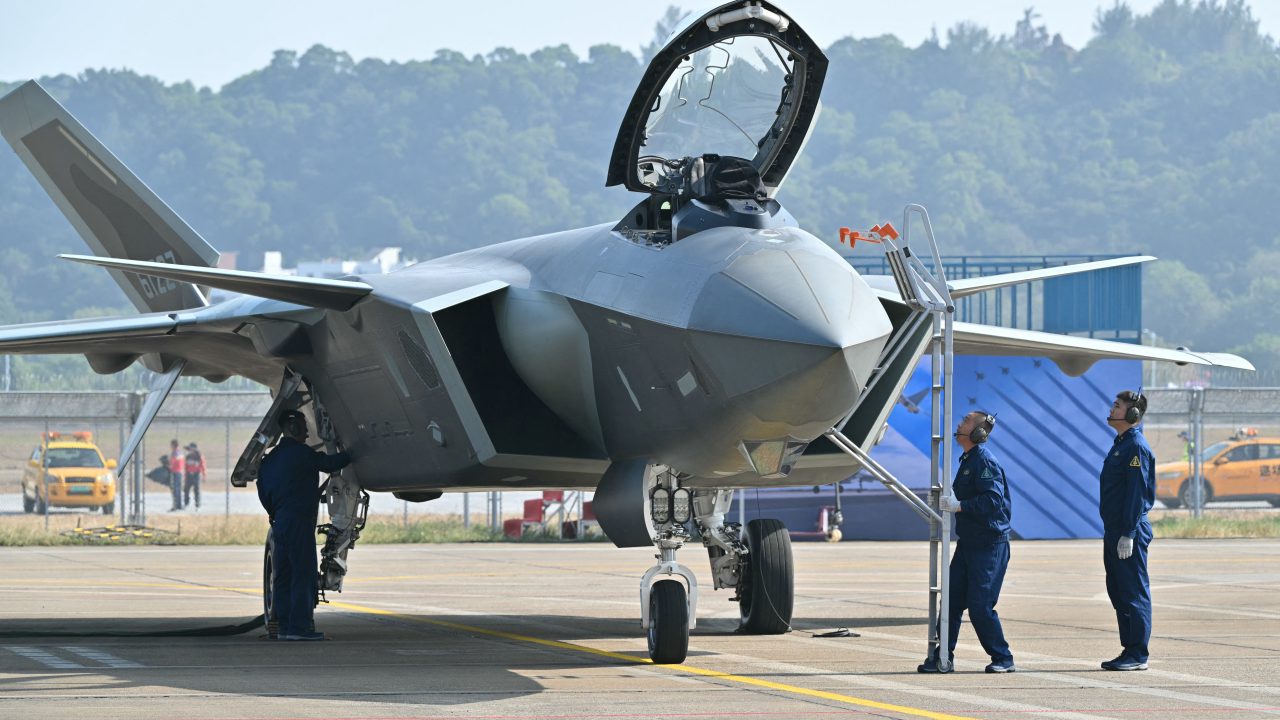
During and after the Justice Mission 2025 exercise in December, China released a huge volume of propaganda material. Among the childish cartoons of Taiwanese President Lai Ching-te (賴清德) and the schmaltzy yet sinister pleas for Taiwan to “return” to China, something more interesting was interspersed: footage that suggested Chinese aircraft had flown into Taiwanese territory, or even over Taiwan.
There is no reason to believe this is true.
Taiwan’s Ministry of National Defense has denied that Chinese aircraft breached Taiwanese territorial airspace. The images that appear to show aircraft flying over Taiwan can be explained. But those explanations require work, and quite often instead of doing and covering that work, commentators and media have simply reported on the claims made and then moved on.
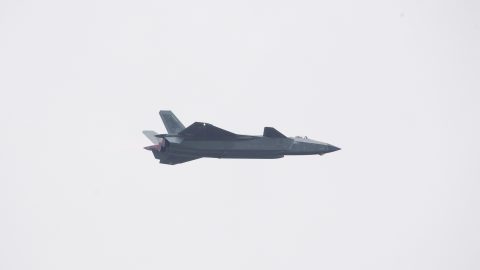
Take, for example, an image that seems to show a Chinese J-20 stealth fighter flying over the coast of Pingtung:
After it was released, Taiwanese media asked how such a picture could have been taken. China Times, a media outlet in Taiwan, ran an article that printed speculation from a former Taiwanese navy captain that the claim was true. “A picture is worth a thousand words,” Lu Li-shih (呂麗詩) said.
What’s the exchange rate for pictures to lies? Rather less, I imagine?
China Times followed this with a second piece, this time quoting former Taiwanese Air Force Deputy Commander Chang Yen-ting (張延廷), who said that photo “clearly captured” Hengchun Airport, and other features. Chang also speculated on whether Taiwanese radars had failed to detect the stealthy J-20.
These claims fell apart, though, when it was revealed that the image of the J-20 was actually captured over Fengshun County in Guangdong, China, not Taiwan. Taiwanese lawmaker Wang Ting-yu (王定宇) posted a screenshot on Facebook showing that a WeChat account called Big Fish Sees Water (大魚鑑水) had found the exact location.
Anyone can satisfy themselves that this is true by going to Google Earth and checking the respective locations.
Despite this, the South China Morning Post, based in Hong Kong, ran an article the next day that repeated the claims of Lu and Chang, and only introduced the idea that the plane was never there later in the piece, as if something that the paper could have confirmed to be true was simply another perspective.
“A lie can travel halfway around the world while the truth is still putting on its shoes,” as Mark Twain once didn’t say.
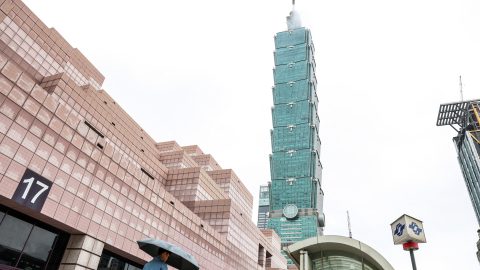
Another example is a picture of Taipei 101, which many initially claimed was taken from a drone flying over Taipei.
A wider angle of the same view showed that the Danjiang Bridge on Taiwan’s coast is also in the shot. Some basic high school trigonometry shows that in order to take such a photo of Taipei 101 and the bridge, a camera would need to be situated extremely far away, well outside Taiwan’s territory.
In this case, although some Taiwanese media like FTNN ran initial reports on the release of this imagery without interrogating it, others like Deutsche Welle were quick to challenge the authenticity of the picture or where it could have been taken.
In neither of these cases did the Chinese military or state spokespeople explicitly state that Chinese aircraft had entered Taiwanese airspace. That was left to those who carry water for them, unwittingly or otherwise.
Taiwan has more than enough trouble with Chinese disinformation propagated by those who are explicitly pro-Beijing. It doesn’t need people ostensibly on Taiwan’s side jumping in and adding their weight without thought or consideration.




Leave a Reply