Taiwan is endlessly criticized for its limited efforts to promote self-defense — by both the U.S. and China, oddly enough. Incoming U.S. President Donald Trump has implied that Taiwan doesn’t deserve the U.S.’s defense assistance. And Chinese state media pushes the narrative that Taiwan is ill-prepared for war and would roll over under the immediate threat of conflict with China.
As Taiwan faces the growing threat of war with China, a specific source of criticism is civil defense, or Taiwan’s efforts “to enhance the resiliency and preparedness of civilian populations for disaster or conflict.” The Taiwanese government is under equipped and ill prepared to train civil defense forces. But this does not mean that Taiwanese society is ill prepared. In fact, Taiwanese religious groups that have been fostering community resilience for decades would likely form some of the strongest pillars of Taiwan’s self-defense in the event of war with China. Domino Theory spoke to the two most prominent organizations at the intersection of civil resilience and religion: the Buddhist Tzu Chi Foundation (慈濟基金會) and Academia Formosana (福摩薩學院).
“We have to be more resilient,” said Joe Wang (王運敬), director of the Office of the CEO at Tzu Chi, “because we don’t have any place to run, just … this island.”
Why It Works
Although the administration of Taiwanese President Lai Ching-te (賴清德) is trying to improve civil defense coordination in Taiwan, government leadership in civil defense is still lacking. “We have enough capacity [but] it’s not leveraged in the right way, there’s no solid framework,” said T.H. Schee (徐子涵), a civil defense expert who specializes in information and crisis management, recently serving as an advisor to the Taiwanese government on digital resilience. As a result, crisis response in Taiwan tends to be heavily improvised. There are two problems with this.
First, Taiwan has not experienced a massively destructive natural disaster since 1999, and Taiwan has not directly experienced war in recent memory.
Second, many civil defense groups impossibly “try to prepare everyone as [if they are] a one-man army,” said Ek-hong Ljavakaw Sia (謝易宏), founder and leader of Academia Formosana. Sia says the most crucial element of civil defense during a crisis is knowing who you can trust, who will support you and who you can turn to for leadership.
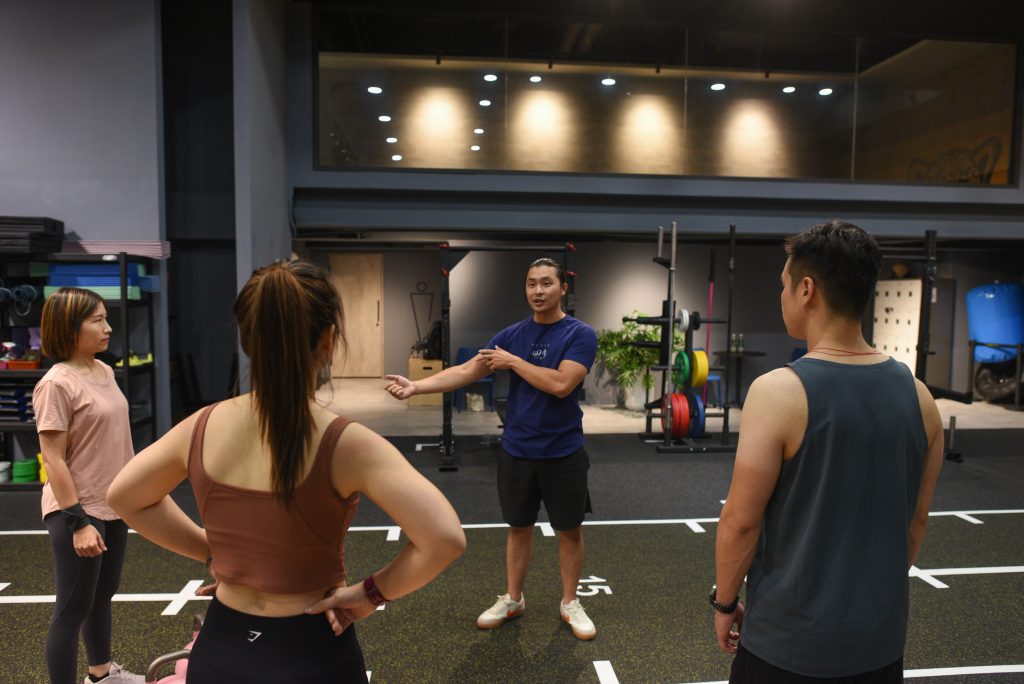
Faith-based organizations, which are deeply rooted in the social fabric of Taiwan, have been highly effective organizers of civil defense in Taiwan because they have strong, extant networks that can answer these questions for people.
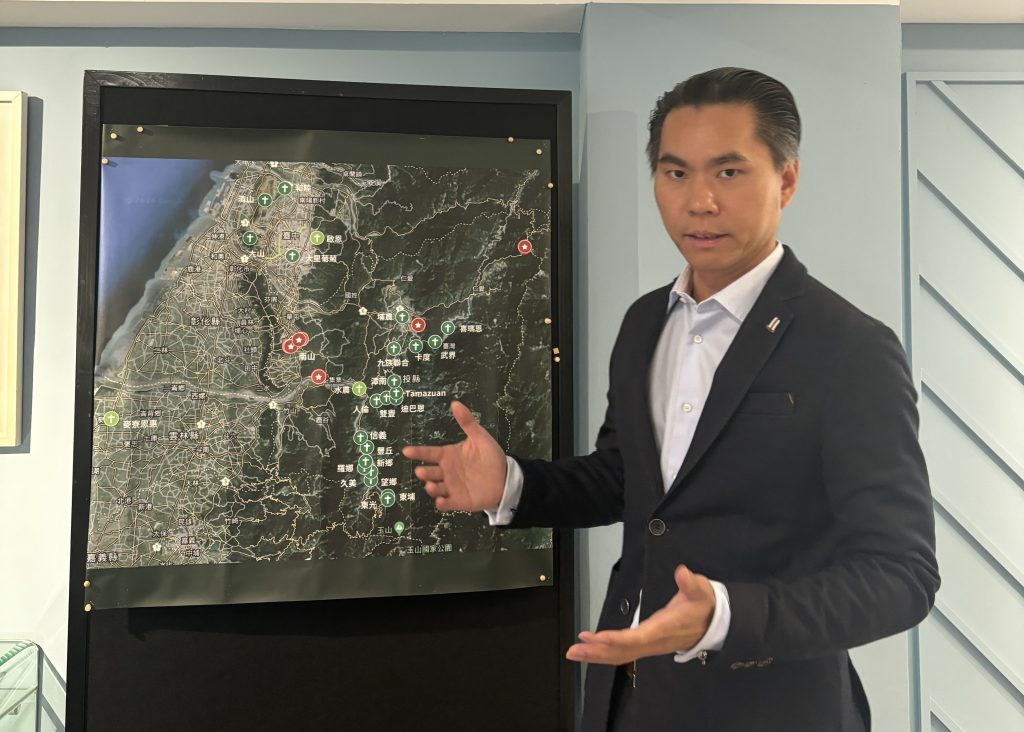
Although Academia Formosana was only established last year, it taps into Taiwan’s Presbyterian religious tradition. Academia Formosana coordinates civil defense training with a network of 1,300 Presbyterian congregations around Taiwan, many of which are led by indigenous pastors and located in mountainous, rural areas. “We should make good use of this existing network, existing infrastructure, rather than to create a new one, because we are in a race against time,” said Sia.
Leveraging the existing Presbyterian network ensures that Academia Formosana’s civil defense training is effectively layered into existing practices. Different congregations “have different needs and goals,” said Sia. Academia Formosana hosts tabletop exercises that bring together pastors and elders from regional groups of Presbyterian churches to discuss disaster preparedness. This includes devising an incident command system based on the existing organization structure of the church, discussing regional cooperation amongst congregations, and preparing for the shortage, distribution and management of resources during crises. Academia Formosana understands the importance of providing a framework for preparedness without ignoring the centrality of local knowledge. The organization guides pastors in preparing “their community for themselves. What we can do is relatively little. They can do more for their own people,” said Sia.
While Academia Formosana hopes to implement civil defense courses across the island, it is currently focusing on congregations in the central, mountainous areas of Taiwan because during wartime, Taiwan’s demography will change dramatically as urban populations flood into the mountains for safety.
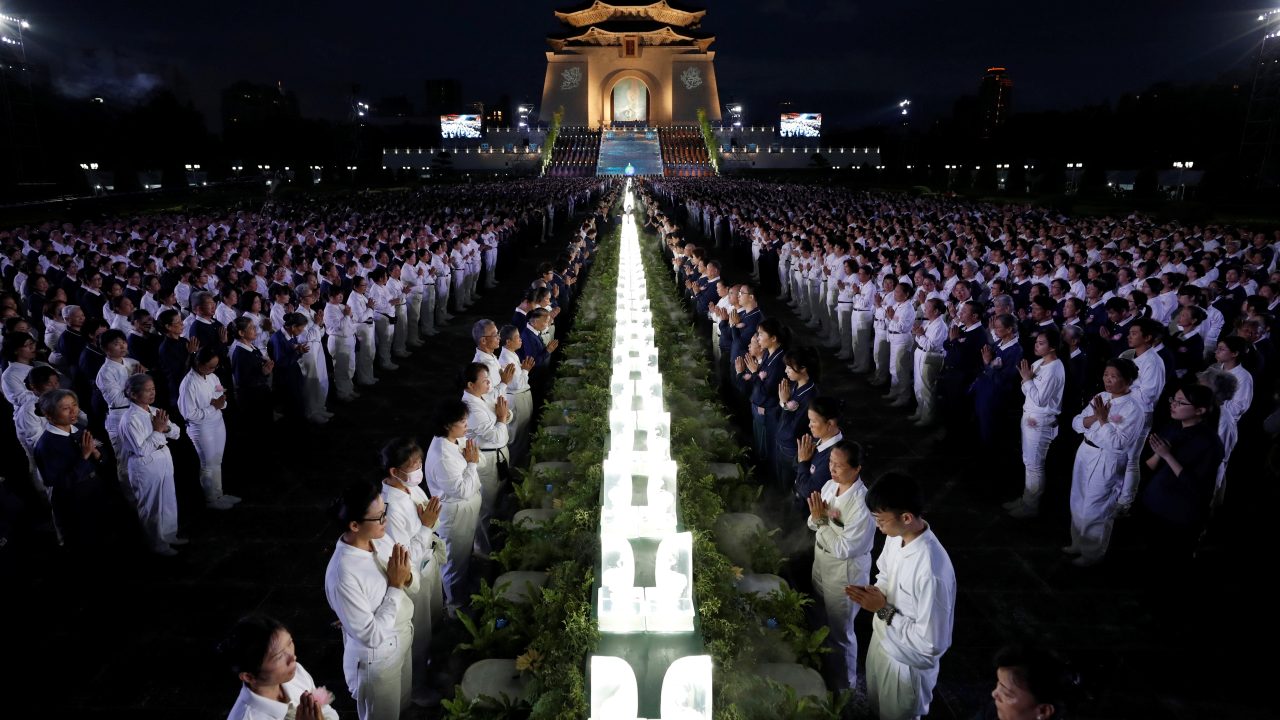
Tzu Chi is a very different organization, but it similarly has a robust, faith-based network. Tzu Chi was founded nearly 60 years ago by Buddhist nun Cheng Yen (證嚴法師). The humanitarian relief organization started as a network of 30 housewives in Hualien and has since become the largest civil society organization in Taiwan, with over 200,000 volunteers in Taiwan and thousands more in 68 countries around the world. Tzu Chi is estimated to have ten million members worldwide. In contrast to the Presbyterian network, almost 90% of Taiwan’s Tzu Chi volunteers are in Taipei, Taichung and Kaohsiung, according to Wang.
Tzu Chi has an incredible amount of infrastructure and resources. The organization has built eight hospitals across Taiwan and a university in Hualien. In 2023, Tzu Chi provided over $200 million in aid to people in need globally. In contrast, Taiwan’s National Police Agency has allocated a relatively meager $3.79 million for the next three years to train its civilian defense forces. When Taiwan has experienced major natural disasters, Tzu Chi’s U.S. offices (of which there are 63) have coordinated with local offices to provide humanitarian assistance to Taiwan.
It is not hard to imagine that during a Chinese invasion, Tzu Chi would be able to organize large amounts of American aid to the island.
In addition to resources, Tzu Chi has decades of experience coordinating disaster relief alongside government agencies in Taiwan. “They never mention civil defense, but the capacity is the same,” said Schee, adding that Tzu Chi “provides some of the best logistics” support in Taiwan, organizing and delivering essential resources and services during disasters. Tzu Chi even develops and operates technology for disaster response, including a large drone team based in Hualien. It’s Schee’s impression that the organization is somewhat militaristic: hierarchical and highly disciplined.
How Tzu Chi and Academia Formosana Differently Navigate Taiwanese Politics
As faith-based organizations, Tzu Chi and Academia Formosana are driven by values that are independent of politics. And yet, politics is something both organizations must navigate, as civil defense is highly politicized in Taiwan. It not only draws ire from China for being driven by “separatists,” but it can also be a touchy subject among Taiwanese precisely because it has become associated with the Democratic Progressive Party (D.P.P.) and the Taiwanese independence movement. This is a large part of the reason why Taiwan’s official civil defense forces are so lacking.
For Tzu Chi, Buddhist values are at its core. Wang said one of the major reasons that Tzu Chi has attracted so many volunteers is that it is able to connect with people through Buddhism, which the vast majority of Taiwanese are at least familiar with. One of the “Four Great Mountains,” or monasteries, of Taiwanese Buddhism, Tzu Chi is guided by ten precepts that Master Cheng Yen developed. The final precept is “do not participate in politics or political demonstrations.”
Tzu Chi’s apolitical approach is central to its humanitarian work. Tzu Chi receives no government funding and does not get involved in politics in any capacity. This is not only core to “the soul but also the branding” of Tzu Chi, said Wang, as its purity of purpose makes people feel comfortable with volunteering. Tzu Chi’s separation from politics also allows it to work on humanitarian aid missions that may be viewed as politically controversial in Taiwan. For example, Tzu Chi has been providing aid to China for 30 years, and opened the first foreign NGO office in the country. Wang made it a point to say that Tzu Chi’s offices in China are funded independently: “for the past 10 years, Taiwan citizens never sent one cent of money from Taiwan to mainland China.”
Academia Formosana is similarly driven by faith-based values. The organization’s main project is called the “Ark Plan,” which is a reference to the Noah’s Ark story of the Old Testament. Sia chose this title because Christians understand that it means to “guard our homeland and our people.”
Compared to Tzu Chi, Academia Formosana is much more explicitly geared toward preparing for war with China and perhaps relatedly, is more political. This is due to the history of authoritarian suppression of the Presbyterian Church during the White Terror period. In the 1970s, one of the most important general secretaries of the Presbyterian Church, Kao Chun-ming (高俊明), was imprisoned by the Chinese Nationalist Party (K.M.T.) authorities because the Church openly was openly supportive of democratization and hiding pro-democracy dissidents. “Presbyterians have a very high consensus on protecting Taiwan’s democracy” compared to average Taiwanese and are more attuned to the threat of Chinese invasion, said Sia.
Considered a longtime ally, the ruling D.P.P. government has a cooperative relationship with the Church. “We want to build up this resilience network to support our government during wartime … so the government can stand firm … against the Communist Party,” said Sia. President Lai spoke at an Academia Formosana training session for 150 indigenous pastors in September. In his speech, Lai made the most definitive statement as president regarding Taiwan’s self-defense to date by declaring that Taiwan would “absolutely not” sign a peace accord with China. Sia said he was surprised: “[Lai] hadn’t said that before.”
Despite their divergent approaches, Tzu Chi and Academia Formosana are able to dodge or leverage politics to their advantage — as opposed to being undermined by it. This enables them to be effective drivers of civil resilience. At the end of the day, faith “transcends other values. It’s probably even bigger than democracy,” said Schee.



Leave a Reply