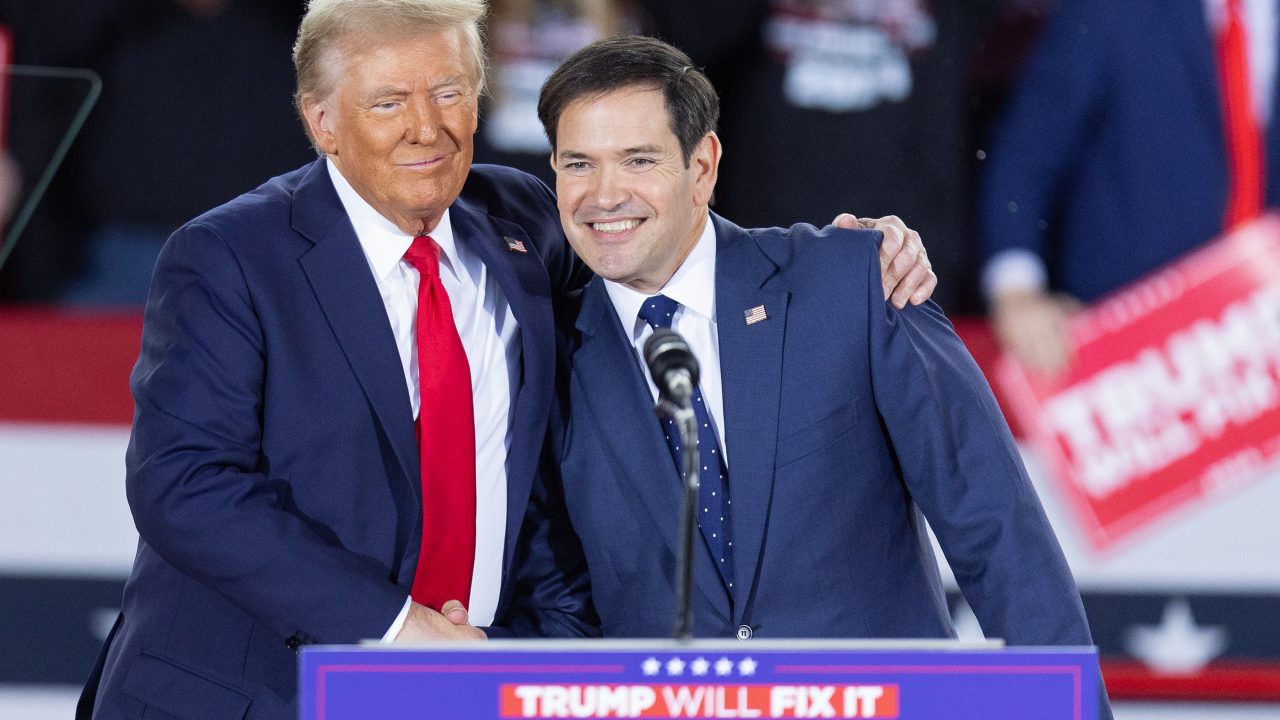
U.S. Senator Marco Rubio would be the first Secretary of State to be sanctioned by China (twice). Having served on the Senate Foreign Affairs East Asia Subcommittee since 2015 and on the Select Committee on Intelligence as vice chairman, Rubio is perhaps the most prominent China hawk in Washington and a steadfast supporter of Taiwan. But it remains to be seen whether he will neatly fit into Trumpism.
Thirteen Years on Taiwan and China
Rubio, born to Cuban immigrant parents, has campaigned against global authoritarianism throughout his tenure in the Senate and advocated for an interventionist, muscular approach to foreign policy. In a 2011 speech Rubio gave during his first year as a Senator, he said, “The American armed forces have been one of the greatest forces of good in the world during the past century … But evil remains potent — and America remains the strongest line of defense, often the only line of defense.” One of the “evils” he referenced was the “growing challenge from China which seeks to dominate East Asia, but won’t even let its own people use Google.”
Rubio now believes that China seeks to dominate not just East Asia, but the world. He worries that China hands, the government and Congress take American supremacy for granted, underestimating China’s strength and ability to supplant the U.S. Rubio has sponsored major bills related to Chinese human rights, including the Uyghur Forced Labor Prevention Act and the Hong Kong Human Rights and Democracy Act. He is in favor of banning TikTok, closing loopholes in the CHIPS Act and countering the influence of China in American academia and elsewhere.
On the Taiwan issue, Rubio’s senatorial record indicates a desire for more. More engagement, more arms sales and more strategic clarity. Rubio has worked to strengthen Taiwan’s diplomatic presence in the world by advocating for its inclusion in multilateral organizations like the WHO. He has also suggested that the U.S. use economic pressure to compel countries that receive significant aid from the U.S. to formally recognize Taiwan. Rubio has multiple times introduced the Taiwan Relations Reinforcement Act to elevate the U.S. government’s focus on Taiwan, and the Taiwan Peace Through Strength Act, which would fast-track arms sales to Taiwan. He wants to rename the Taipei Economic and Cultural Representative Office (TECRO) to the “Taiwan Representative Office,” in order to better reflect TECRO’s status as a diplomatic mission. He was also an early advocate for negotiating a trade agreement with Taiwan.
Rubio’s most consequential thoughts on Taiwan are those surrounding the U.S.’s long-standing policy of strategic ambiguity. Rubio once said he believes that strategic ambiguity is arguably at odds with the Taiwan Relations Act, which includes “a strong presumption of intervention.” While he believes that decades of U.S. support have strengthened this presumption, Rubio stated in a 2021 committee hearing that “To avoid misperception and miscalculation, the United States should be as clear as possible about what it seeks to deter — the use of force by Beijing — as well as what it is prepared to do if deterrence fails — defend Taiwan.” He has stopped well short of advocating for the abandonment of the “one China” policy.
On this issue Rubio has been critical of the Biden administration’s approach to Taiwan. Case in point was a moment during Biden’s 2021 Summit for Democracy, when then-Taiwanese Minister of Digital Affairs, Audrey Tang (唐鳳), reportedly had her transmission cut off during a presentation because she displayed a map with China and Taiwan in different colors. In response, Rubio wrote to Biden that “Decades of a failed engagement policy should have taught us by now that making concessions to Beijing is a one-sided and fruitless endeavor. And yet it continues … All that your administration accomplished … was to once again signal weakness rather than resolve.”
How Rubio Fits Into Trumpism
Rubio and Trump’s relationship has greatly improved since 2016, when Trump called Rubio “little Marco” and Rubio shot back that Trump was a “con artist” with tiny hands. During Trump’s first term, Rubio advised on Latin American policy issues and worked with Ivanka Trump to develop the child tax credit in the GOP’s 2017 tax bill. Some argue that over the past few years, Rubio has conformed to Trump’s ideology on issues like Ukraine and immigration. He was on the short list to be Trump’s vice president this term.
But there are rumblings that some in the MAGA camp are not happy about this pick. This summer, Donald Trump Jr. said on a podcast that he did not want Rubio to be Trump’s running mate because he feared it would lead to the impeachment of his dad. This alludes to a related policy issue, which is that Rubio might not be MAGA enough — specifically, that the “America first” approach to foreign policy is in conflict with Rubio’s internationalist, interventionist stance. In a June interview with Megyn Kelly, Trump’s director of national intelligence pick Tulsi Gabbard said that Rubio in the White House would be a “huge mistake” because “he represents the neocon warmongering establishment of Washington, D.C. which stands diametrically opposed to the policies [of Trump].” In contrast to Rubio, Trump doesn’t seem willing to provide strategic clarity on Taiwan at the moment — this election season, he has deflected when asked about whether the U.S. would assist Taiwan in the case of a Chinese invasion and implied that Taiwan doesn’t deserve the assistance it has received from the U.S.
If Rubio becomes secretary of state, it’s hard to imagine that he would back away from his belief that the China threat is existential and that Taiwan must be protected against annexation. Rubio is incredibly well versed in China issues (which means he has a clear vision) and he has presidential ambitions (a legacy to look out for). There is reason to believe that Rubio as secretary of state would be good news for Taiwan, and for U.S. allies in the region. In an email to Domino Theory, Wei-Feng Tzeng (曾偉峯), assistant research fellow at the Institute of International Relations at National Chengchi University, predicted that during Trump’s next term, “Taiwan is less likely to become a priority for China’s policy agenda. Consequently, I believe China will aim to avoid any large-scale conflict in the Taiwan Strait.” While some might worry that his emerging hesitancy to continue funding the war in Ukraine indicates a diminishing commitment to Taiwan, this would be a faulty conclusion to draw because Rubio has maintained that the China/Taiwan issue should be prioritized.
“As Secretary of State, I will work every day to carry out his foreign policy agenda. Under the leadership of President Trump we will deliver peace through strength and always put the interests of Americans and America above all else,” Rubio tweeted in response to his official nomination a few hours ago. But if Rubio’s vision doesn’t end up aligning enough with Trump’s, then we might be looking at another Trump term with turnover in this office.


Leave a Reply