
1. U.S.: Equipment Problems, Conflict Deterrence Act, Delayed Fighter Jets
Equipment and munitions sent to Taiwan between November last year and March have been found to be in poor condition, according to the U.S. Department of Defense Office of Inspector General. The equipment included wet and moldy body armor. A spokesperson for the department said it was working to improve the situation.
The U.S. House of Representatives passed the Taiwan Conflict Deterrence Act on September 10. The act prescribed sanctions for officials from China in the event of an invasion of Taiwan. Officials’ “illicit” financial information would be published and financial restrictions would be imposed on their family members.
The U.S. State Department has approved the sale of $288 million ($9.2 billion New Taiwan dollars) of weapons relating to aircraft.
Sixty-six F-16V fighter jets first ordered in 2019 should begin arriving in Taiwan by the end of this year, according to the Ministry of National Defense. It said in a statement that “acute fluctuations in the international situation” had caused delays, with the jets originally supposed to begin arriving in the third quarter of this year.
Former president Donald Trump’s vice presidential candidate J.D. Vance has said that the U.S. has left Taiwan in a “crappy position” by sending weapons to Ukraine.
On September 10, the state of Indiana became the 23rd U.S. state to open a representative office in Taiwan.
2. Japan: Prime Ministerial Candidates’ Positions on Taiwan, Lai Ching-te Meeting Diet Representatives
After the resignation of Japan’s Prime Minister Fumio Kishida, the candidates to replace him this week agreed on the need for an evacuation plan for Japanese citizens in case of a military escalation over Taiwan. In a debate, candidate and former health minister Katsunobu Kato said recognition of Taiwan would not be required for Japan Self-Defense Forces involvement.
Former economic security minister Sanae Takaichi, one of the candidates considered most likely to win, said a Taiwan contingency could be defined as a “survival threatening situation” for Japan — which through its constitution would allow for the use of force, if its parliament sanctioned it.
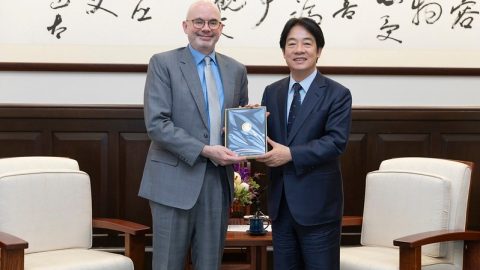
On August 27, President Lai Ching-te (賴清德) met with Japan-Taiwan Exchange Association Chairman Ohashi Mitsuo. The association represents Japan’s interests in Taiwan. Lai said he hoped “Taiwan, Japan, and other democratic partners will work together to jointly support the democratic umbrella to advance democracy, peace, and prosperity around the world.”
Two weeks prior to that, Lai met with parliamentarians from Japan’s National Diet and discussed security issues. Japanese House of Representatives Member and former Minister of Defense Ishiba Shigeru said that the most pressing need at present is to prevent what is happening in Ukraine happening in East Asia.
3. Europe: German Navy Transit, Czech Semiconductor Cluster
Two German Navy ships passed through the Taiwan Strait — the body of water between Taiwan and China — last week, the first time they have done so since 2002. China’s People’s Liberation Army Eastern Theater Command said “Germany’s actions have increased security risks and sent wrong signals.”
After British Foreign Secretary David Lammy and U.S. Secretary of State Antony Blinken met in London last weekend as a part of the U.K.-U.S. Strategic Dialogue, a joint statement said they “restated the importance of peace and stability in the Taiwan Strait as indispensable to the security and prosperity of the international community and called for the peaceful resolution of cross-Strait issues.”
Minister of National Development Council Liu Chin-ching (劉慶中) visited the Czech Republic and Lithuania last month to discuss deepening economic cooperation. Days later, National Security Council Secretary-General Joseph Wu (吳釗燮) said Taiwan planned to build a “semiconductor cluster” in the Czech Republic over the next three to five years.
4. India: Migrant Worker Meeting Coming Soon
On September 6, Labor Minister Ho Pei-shan (何佩珊) announced Taiwan will soon invite Indian officials to discuss the details of bringing Indian migrant workers to Taiwan. The two signed a memorandum of understanding on labor force cooperation in February.
5. Diplomatic Allies: China Pressure Caught on Camera
The Pacific Islands Forum — an organization that aims to facilitate cooperation among countries and territories of Oceania — removed mention of Taiwan from its final leaders’ communique after pressure from China was caught live on camera. Cook Islands Prime Minister Mark Brown, who is the forum chairman, was seen telling China’s Ambassador to the Pacific, Qian Bo (錢波), “we’ll remove it” before the communique was taken down from the forum’s website and replaced with a new version that did not mention Taiwan.
Former Taiwan ally the Solomon Islands, which now recognizes China instead, is believed to have tried to block Taiwan’s future attendance at the forum — on Beijing’s instruction. Taiwan sent a delegation this year, and the Marshall Islands, Tuvalu and Palau — who recognize Taiwan — blocked the proposal. Taiwan’s Deputy Minister of Foreign Affairs Tien Chung-kwang (田中光) said Taiwan may face “difficulties” when the Solomon Islands hosts the forum next year.
Eswatini, the only African country to recognize Taiwan, is “quietly warming” to China, according to members of its business community speaking to a journalist at Semafor. In their latest article on the topic, Semafor reported Eswatini as “gradually pivoting towards Beijing.”
6. Additional Developments: Taiwanese Influencers Invited to Xinjiang
Taiwan’s government has said it is aware of reports that online influencers have been invited to Xinjiang to make content that shows it in a favorable light. Taiwan’s Mainland Affairs Council said if content created false information, it could breach the Anti-Infiltration Act.




Leave a Reply