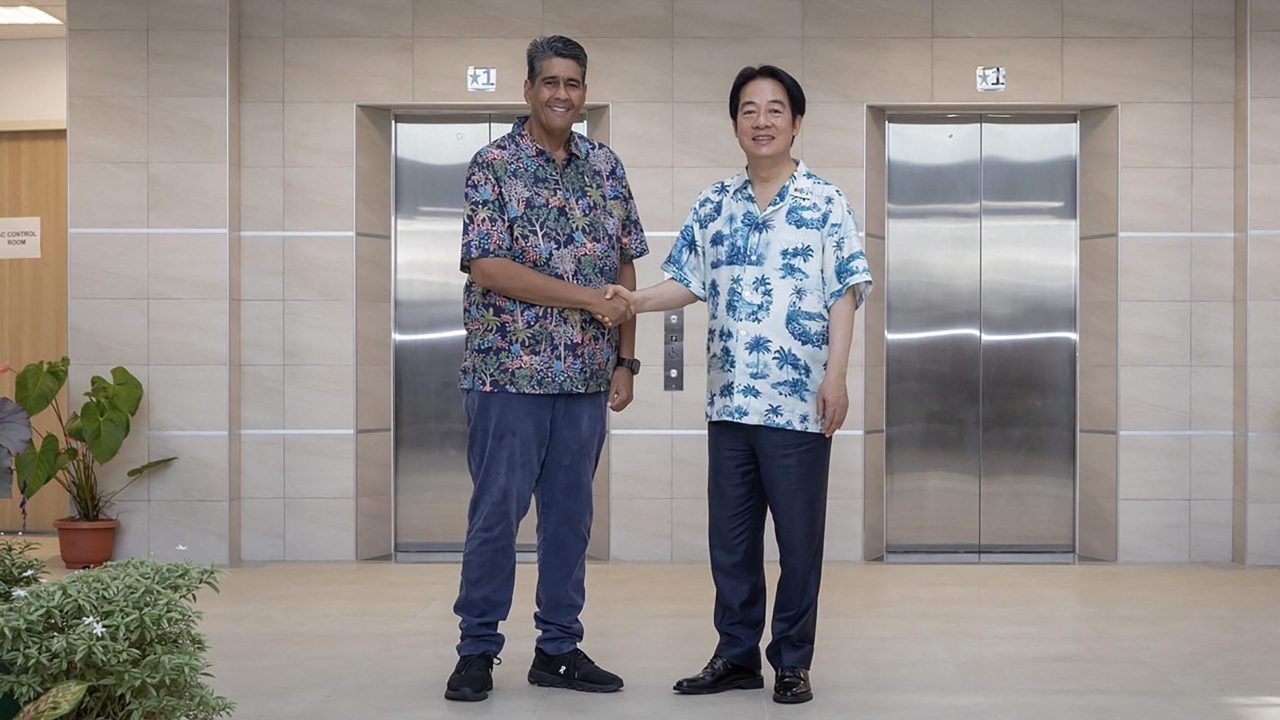
1. U.S.: Taiwanese President Visits Guam and Hawaii, Taiwan Officials Hold Discussions With Trump Administration
Taiwanese President Lai Ching-te (賴清德) held phone calls with members of the U.S. Congress during his trip to Guam last week. Lai said he discussed security and economic cooperation with Republican House Speaker Mike Johnson and House Democratic leader Hakeem Jeffries.
Prior to his trip to Guam, Lai stopped over in Hawaii. On meeting Lai, Hawaii’s governor, Josh Green, said it was a “momentous occasion” and highlighted Taiwan and Hawaii’s shared values of resilience and collaboration.
Taiwanese officials have contacted officials from the incoming Trump administration about buying up to $15 billion (around $486 billion New Taiwan dollars) in military hardware, according to the Financial Times.
The first batch of M1A2T Abrams tanks purchased from the U.S. is expected to arrive in Taiwan this month. The deal for the tanks was initially agreed in December 2019 and includes 108 tanks worth $2 billion (around $65 New Taiwan dollars) in total, although the first batch will only involve the delivery of 38 tanks.
Taiwan received the first batch of High Mobility Artillery Rocket Systems (HIMARS) at the start of November, according to military sources who spoke to Taiwan’s Central News Agency.
Taiwan is a priority partner for producing defense equipment, according to American Institute in Taiwan Director Raymond Greene. “Taiwan has quite an advanced defense industrial base already” and the U.S. is “looking at a variety of partners around the world — especially countries like Japan where we have long-time defense-industrial relationships,” Green said in an interview at the end of October.
Chinese President Xi Jinping (習近平) is unlikely to make a decision to invade Taiwan during Donald Trump’s second term as president of the U.S., as long as Trump does not change Taiwan policy “in a big way,” according to a group of scholars speaking at a symposium in Taipei last week.
2. Japan: Xi’s Talks With Ishiba, Nansei Islands Weapon Systems to Protect Taiwan
Xi Jinping told new Japanese Prime Minister Ishiba Shigeru he hoped he would “properly handle” history and Taiwan issues at the Asia-Pacific Economic Cooperation summit in Peru last month. Ishiba visited Taiwan in August, saying that only “standing shoulder to shoulder to demonstrate the strength of deterrence” can the region maintain peace and stability.
A U.S. plan to deploy HIMARS and other weapons to Japan’s Nansei Islands is mainly aimed at protecting Taiwan from Chinese warships, according to analysts cited by Voice of America.
In a meeting with Japan Innovation Party lawmakers last weekend, Democratic Progressive Party (DPP) Secretary-General Lin Yu-chang (林右昌) said he hoped for closer Taiwan-Japan ties.
3. Europe: Taiwan Transfers Weapon System to Ukraine
Taiwan’s MIM-23 Hawk medium-range surface-to-air missile systems were transferred indirectly to Ukraine, according to former Raytheon official Tony Hu (胡振東), speaking in an interview at the start of November. Hu said the transfer was facilitated by a U.S.-managed system called the “Worldwide Warehouse,” which allows countries to transfer equipment among themselves with U.S. authorization.
On November 28, the U.K.’s House of Commons unanimously passed a motion rejecting the idea that U.N. Resolution 2758 has any bearing over Taiwan’s sovereignty or future participation in the U.N. It came after the European Parliament passed a resolution saying the same thing.
4. India: Taiwan-India Dialogue Held, Semiconductor Cooperation
The Taiwan-India Dialogue was held on November 14 in Taipei. Attendees included Taiwan’s Deputy Foreign Minister Tien Chung-kwang ( 田中光), Taiwan-Asia Exchange Foundation chair Hsin-huang Michael Hsiao (蕭新煌), Observer Research Foundation President Samir Saran and Manharsinh Yadav, director-general of the India Taipei Association. In an opening speech, Tien called for the Indian government to resume direct flights between Taiwan and India.
Cooperation between India, Japan and Taiwan could create something “potentially important” in the semiconductor industry, according to Subrahmanyam Jaishankar, India’s external affairs minister, speaking at the India-Japan Forum in New Delhi last month.
5. Diplomatic Allies: Paraguay Commits to Taiwan, Solomon Islands Prime Minister Faces No-Confidence Vote
Taiwanese President Lai Ching-te completed his first overseas tour last week by visiting the Marshall Islands, Tuvalu and Palau.
As Paraguay has been looking to gain Chinese market through a trade deal between China and the South American Common Market, its foreign minister, Ruben Dario Ramirez Lezcano, has said it cannot come at the expense of relations with Taiwan. “Paraguay is open to establishing diplomatic, consular or commercial relations with China without conditions,” Ramirez Lezcano said, but “We are still committed to supporting the Taiwan government, and we don’t accept any condition to break our relations with Taiwan.”
Paraguay kicked out a visiting Chinese envoy who skipped a UNESCO meeting he was supposed to be attending to travel to Paraguay’s Congress and lobby for Paraguay to switch its diplomatic relations to China.
The Solomon Islands’ China-friendly Prime Minister Jeremiah Manele is set to face a no-confidence vote in parliament this week. Earlier this year, the Solomon Islands tried to block Taiwan’s future attendance at the annual Pacific Islands forum — on Beijing’s instruction. The Solomon Islands terminated diplomatic relations with Taiwan in 2019.
Palaun President Surangel Whipps Jr. won a second term in the country’s November 5 election. Under Whipps, Palau has increasingly pivoted away from China.
6. Additional Developments: Former Taiwan President Visits Canada, U.K. Parliament Resolution
Last week, Taiwanese rapper Chen Po-yuan (陳伯源) claimed China’s United Front Work Department gave him templates for news statements and asked him to produce a song criticizing the Democratic Progressive Party (DPP).
On November 6, Canada’s House of Commons unanimously adopted a motion rejecting the idea that U.N. Resolution 2758 has any bearing on Taiwan’s sovereignty or future participation in the U.N.
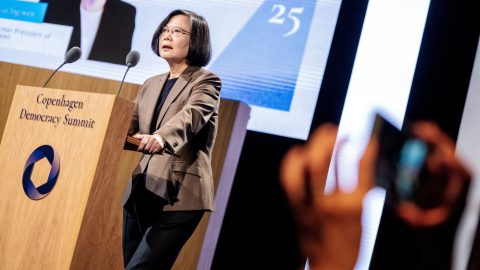
After her European tour in October, former Taiwanese president Tsai Ing-wen (蔡英文) traveled to Canada in November to attend the Halifax International Security Forum.
In November, a Taiwanese government billboard was cut down by the Chinese delegation in Peru for the Asia-Pacific Economic Cooperation (APEC) summit. Taiwan’s Ministry of Foreign Affairs has filed a lawsuit against a Peruvian contractor responsible for the billboard.
South Africa has pulled back from its demand that Taiwan move its representative office out of its capital city, Pretoria, by October 30. Negotiations about the future of bilateral relations are still ongoing.
Taiwan’s foreign ministry has complained to Malaysia’s representative office in Taipei and its foreign ministry after its flag was seen taped over at Kuala Lumpur International Airport. The sign was at an expedited immigration gate, which Taiwanese citizens have been allowed to use since an arrangement in June.




Leave a Reply