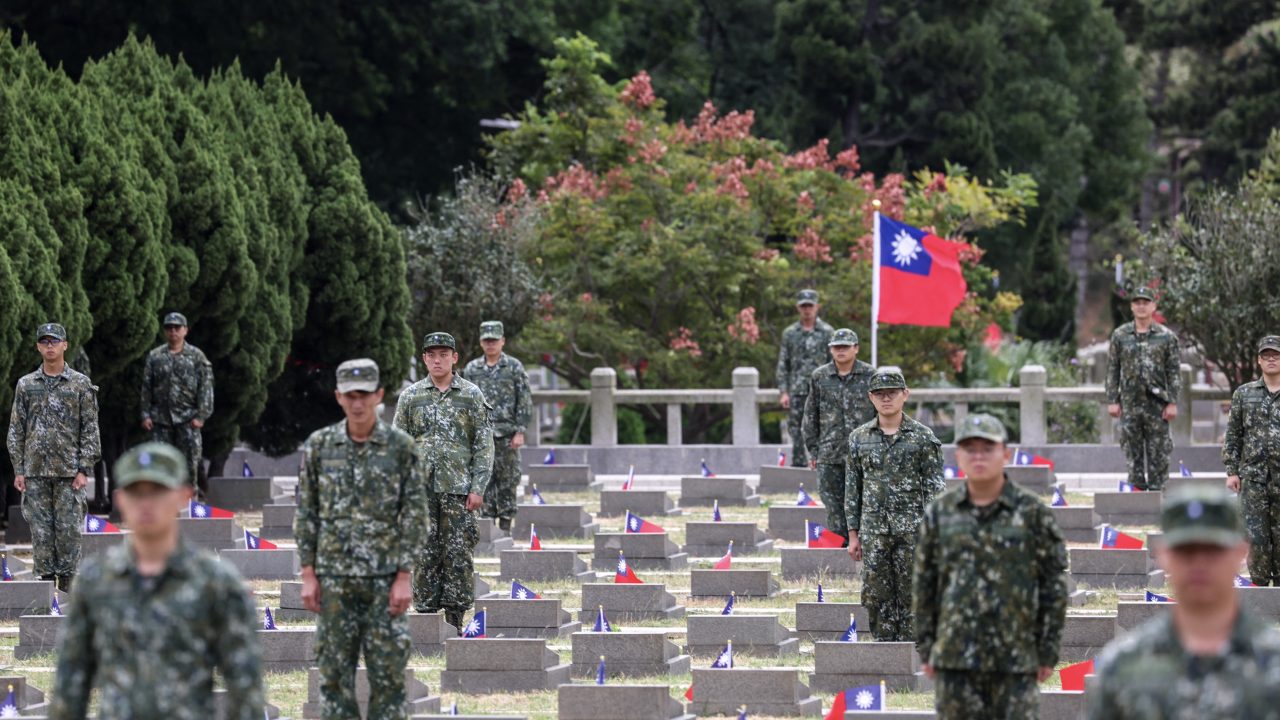
1. U.S.: Security Assistance Deal, Trump on ‘Stolen’ Semiconductors
This week, the U.S. approved a $2 billion (64.1 billion New Taiwan dollars) arms sale to Taiwan, including an advanced surface-to-air missile system for the first time.
In a separate arrangement, U.S. President Joe Biden approved a $567 million (18.2 billion New Taiwan dollars) aid package at the end of September, almost double the previous year’s equivalent aid package. The security assistance deal will be used to fund training, anti-armor weapons, air defense and multi-domain awareness, according to a U.S. official.
Chinese President Xi Jinping (習近平) pressed U.S. President Joe Biden to change U.S. language around Taiwan at their meeting in San Francisco last year, according to Reuters sources. “China wanted the U.S. to say ‘we oppose Taiwan independence,’ rather than the current version, which is that the United States ‘does not support’ independence for Taiwan,” Reuters reported.
Former president Donald Trump reiterated his position that Taiwan “stole” the U.S.’s semiconductor technology during an appearance on the popular Joe Rogan podcast.
At a G7 meeting on the sidelines of the United Nations General Assembly in New York, foreign ministers expressed support for Taiwan’s participation in international organizations that do not require statehood and observe status in those that do.
A delegation of drone experts from the U.S. traveled to Taiwan for meetings at the end of September, aiming to discuss the goal of creating supply chains that do not run through China.
In his first interview since becoming its director, American Institute in Taiwan’s Raymond Greene said Taiwan was entering a new technological “golden age.”
The U.S.-led Indo-Pacific resilience partnership held its first meeting on October 10. The partnership will build on existing decisions to co-produce missiles with Japan and fighter jet engines with India, and Taiwan is said to be set for a key role. Taiwan’s Vice Defense Minister Hsu Yen-pu (徐衍璞) attended the first meeting.
2. Japan: New Prime Minister’s Words on Taiwan, Public Support for Taiwan Independence
A Japan Maritime Self-Defense Force vessel sailed through the Taiwan Strait at the end of September, at the direction of outgoing prime minister Fumio Kishida.
On October 1, Taiwan’s President Lai Ching-te (賴清德) congratulated new Japanese Prime Minister Ishiba Shigeru on taking up the role.
Ishiba visited Taiwan in August, saying that only “standing shoulder to shoulder to demonstrate the strength of deterrence” can the region maintain peace and stability.
Seventy percent of Japanese people see Taiwan as an independent country, according to the Indo-Pacific Strategic Think Tank, which worked with the Japanese Sankei Shimbun’s polling company. Three thousand people were polled.
3. Europe: European Parliament Resolution, Tsai Ing-wen European Tour
On October 24, the European Parliament passed a resolution saying it “condemns China’s continued military provocations against Taiwan and firmly rejects any unilateral change to the status-quo in the Taiwan Strait.” It also “rejects China’s attempts to distort history and international rules and underlines that U.N. resolution 2758 does not take a position on Taiwan.”
Former Taiwan president Tsai Ing-wen (蔡英文) went on a European tour this month, visiting a forum in the Czech Republic, the French Senate and the European Parliament in Brussels. The British Foreign Office, though, asked for a visit to be “deferred” so as not to anger China ahead of Foreign Secretary David Lammy’s visit to China.
Deputy Secretary-General of Taiwan’s National Security Council Lin Fei-fan (林飛帆) appeared at the opening of European Values Summit in Prague at the end of September.
On September 12, the Dutch House of Representatives passed a motion saying U.N. Resolution 2758 did not rule the People’s Republic of China has sovereignty over Taiwan or pass judgment on Taiwan’s participation in the U.N.
4. India: Taiwanese Firms Relocating, New Diplomatic Mission
Taiwanese firms are pulling out of China and relocating to India, according to a Center for Strategic and International Studies report that found 57 percent of 610 Taiwanese companies surveyed last year were interested in or already moving away from mainland China.
This month, Taiwan opened its third diplomatic mission in India. It is located in Mumbai and will provide services such as business travel, visa processing and document authentication.
5. Diplomatic Allies: Assassination Attempt in Eswatini, U.N. Resolution Support, Palau Pressure
Mlungisi Makhanya, the leader of Eswatini’s main opposition party, was subject to an alleged assassination attempt last month. Eswatini, the only African country to recognize Taiwan, is “quietly warming” to China, according to members of its business community speaking to a journalist at Semafor.
At the U.N. General Assembly, Taiwan’s allies Paraguay, the Marshall Islands, Palau, Saint Vincent and the Grenadines, Eswatini, Tuvalu, Saint Kitts and Nevis, Saint Lucia and Belize said U.N. Resolution 2758 should not preclude Taiwan from being involved in the U.N. Resolution 2758 enabled the People’s Republic of China to take China’s seat at the U.N., but does not mention the position of Taiwan.
The pro-Taiwan ex-premier of the Solomon Islands’ largest island, Malaita, has been arrested on three counts of unlawful assembly. The Solomon Islands switched its recognition to China in 2019.
Kiribati’s China-leaning President Taneti Maamau won a third term this month. Kiribati terminated diplomatic relations with Taiwan in 2019.
Palau’s President Surangel Whipps said this week that he was offered increased tourism from China in exchange for switching recognition away from Taiwan.
6. Additional Developments: Dispute With South Africa, Korean Day Celebration Praise
At a Korean National Day celebration on September 30, South Korean representative Lee Eun-ho praised the country’s ties with Taiwan, saying a double taxation agreement that came into effect this year would create growth and business opportunities.
Taiwan has agreed to engage in bilateral negotiations over the future of its relations with South Africa after the South African government asked it to move its representative office outside of the city of Pretoria. South Africa’s Department of International Relations and Cooperation had initially said “you cannot have a liaison office in the capital city that is the preserve of political and diplomatic relations,” but denied China had applied pressure.
Last week, the Australian Senate passed a motion saying U.N. Resolution 2758 did not rule the People’s Republic of China has sovereignty over Taiwan or pass judgment on Taiwan’s participation in the U.N.





Leave a Reply