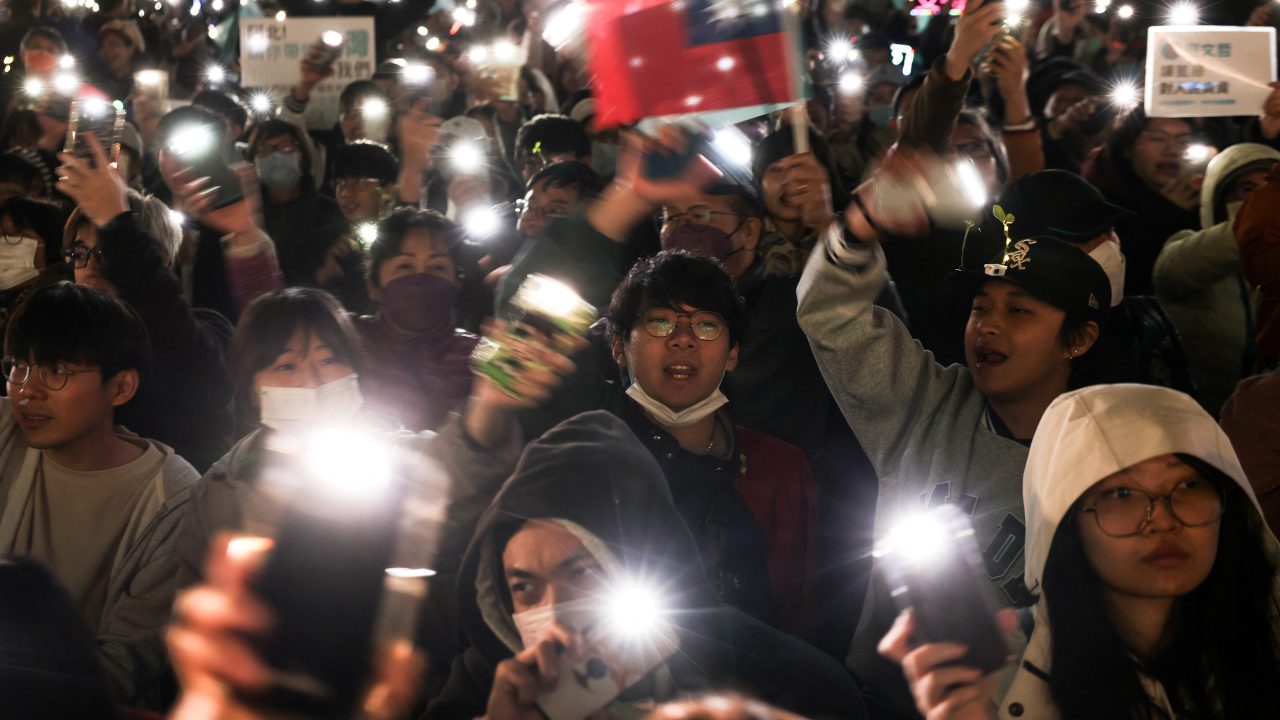
“We’ll go out and interview some normal people on the streets of Taiwan to see what people are thinking ahead of the election.” This is, actually, not as easy as it sounds. Because it turns out when you walk around Da’an Park on a Thursday lunchtime and try to interview people, you run into a number of problems. Firstly, the majority of people will say no and look extremely skeptical about talking to journalists. Secondly, some dogs definitely don’t like journalists. Thirdly, more people than you might think are actually tourists from Hong Kong and South Korea, and they disappointingly aren’t willing to take a stab at discussing Taiwanese politics. And finally, Taipei is so full of personnel from the international media right now that you will end up coming this close to interviewing a news presenter by mistake (and as we all know, there is nothing more tedious than journalists talking to other journalists).
Despite a significant number of incidents that can be filed under “life experience,” we persevered and spoke to half a dozen people about Saturday’s election. Of that half a dozen, three said they intended to vote for Lai Ching-te (賴清德) of the ruling Democratic Progressive Party (DPP), two said they intended to vote for Hou Yu-ih (侯友宜) of the Chinese Nationalist Party (KMT) and one said they would prefer to not to say. But the details of why they were voting were most interesting.
Little Mao (小貓), a 50-year-old kindergarten teacher (who preferred to use a nickname), told us that she would support Hou Yu-ih because she didn’t see much progress during the current DPP president Tsai Ing-wen’s eight-year term. She said she used to support the DPP but this time would support the KMT in the hope there would be some major change. If Hou wins, she believes there will be more Chinese tourists visiting Taiwan and spending money, and that cross-strait relations will be smoother. If the DPP wins, she believes it will hurt Taiwan’s economy, and the relationship with China will be even tenser than it is now. She added that she pays close attention to the Israel-Hamas conflict and was focused on Taiwan avoiding the chance of war.
In the other direction, Su (蘇), a 35-year-old designer, told us she supports Lai Ching-te and his vice presidential running mate, Hsiao Bi-khim (蕭美琴). She said this was based on the issue of national sovereignty and later added that under Lai and Hsiao the country would be on the way to becoming more free and democratic. On domestic issues, she said she felt the current Tsai administration had already placed Taiwan on a good path. She said that although some say Taiwan’s economy has been on the decline, she sees other countries experiencing the same decline and therefore doesn’t believe it’s the leader’s fault — although there is room for improvement. On foreign policy, she said that although some say Taiwan will lean toward the U.S. under Lai and Hsiao, she thinks Taiwan will be more connected with the world. And rather than connecting with China, Taiwan will move towards global democratic values. Should her preferred choice lose, Su said she still takes pride in Taiwan’s freedom and democracy, and thus will respect the result, but pay closer attention to what the winners do and say in government. She said she will not think it’s “over” for Taiwan, unless China does something drastic.
Some of these views were echoed by Fan Keng-wei (范耕維), a 39-year-old law professor. He also said he supported Lai and Hsiao on the basis they would “better manage Taiwan’s external relations and defend Taiwan’s sovereignty,” though he first said they offer “relatively better governance and a clear direction of development for Taiwan as a country.” If Lai wins, he said the relationship with China will still be tense, but Taiwan’s domestic affairs will remain stable, and the administration will be more capable of coping with sudden events like disasters. Diplomatically, Taiwan will continue to try to develop externally and secure its sovereignty. On the other hand, he said a victory for Hou would make him worry about the reemergence of an overly close connection with China, while victory for third-party Taiwan People’s Party candidate Ko Wen-je (柯文哲) would make him worry about the lack of a team with enough governance skills (in terms of having enough talent or manpower). He also said he worried about both of Hou and Ko’s ability to handle international relations.
Offering a more impressionistic take was Tiger (a nickname), a 60-year-old designer, who supports Hou Yu-ih (and who had just finished a game of basketball when we spoke to him). He said he dislikes Lai and Hsiao and Ko Wen-je and his running mate Cynthia Wu (吳欣盈). He didn’t feel there would be any major change — for better or worse — in Taiwan’s future, but said he hoped that there would be less corruption in politics and government. If Lai wins, he said he thinks corruption will get worse. If Ko wins, with the TPP being young and lacking manpower and talent, he said he thinks iit will be hard for them to manage the state.
A similarly impressionistic take, in the opposite direction, came from Liu (劉), a 37-year-old stay-at-home mom. She said she supports Lai because she likes his manner: how he talks, his presentation. She said if he wins she believes less will change. If either of the opposition candidates wins, she said she felt like there might be more friction with China.
Finally, we spoke to Esther (a nickname), who is 65 years old and retired. She didn’t want to say who she would be voting for, but said she felt the candidate she planned to vote for had a strong team to back them up, and that if they win, she thinks cross-strait tensions will be reduced. If a different candidate wins, she thinks it will be a “disaster” for Taiwan.
Some tentative conclusions from these conversations: Firstly, even in the period directly before an election, and even with canvassing and rallies in full flight, it would be a mistake to imagine that everyone lives in a constant state of ideal democratic engagement. And an even bigger one to imagine that international media can easily get access to what everyone is thinking. Secondly, there are things that chime with broader trends in what these people said: The DPP supporters focused on national sovereignty; the KMT supporters expressed fears about the consequences of that. Both sides appeared to trust their candidates with the economy more. But in the details, no one is an exact representation of a statistic, and public opinion looks a lot less static and predictable up close.
Photo: I-Hwa Cheng/AFP



Leave a Reply