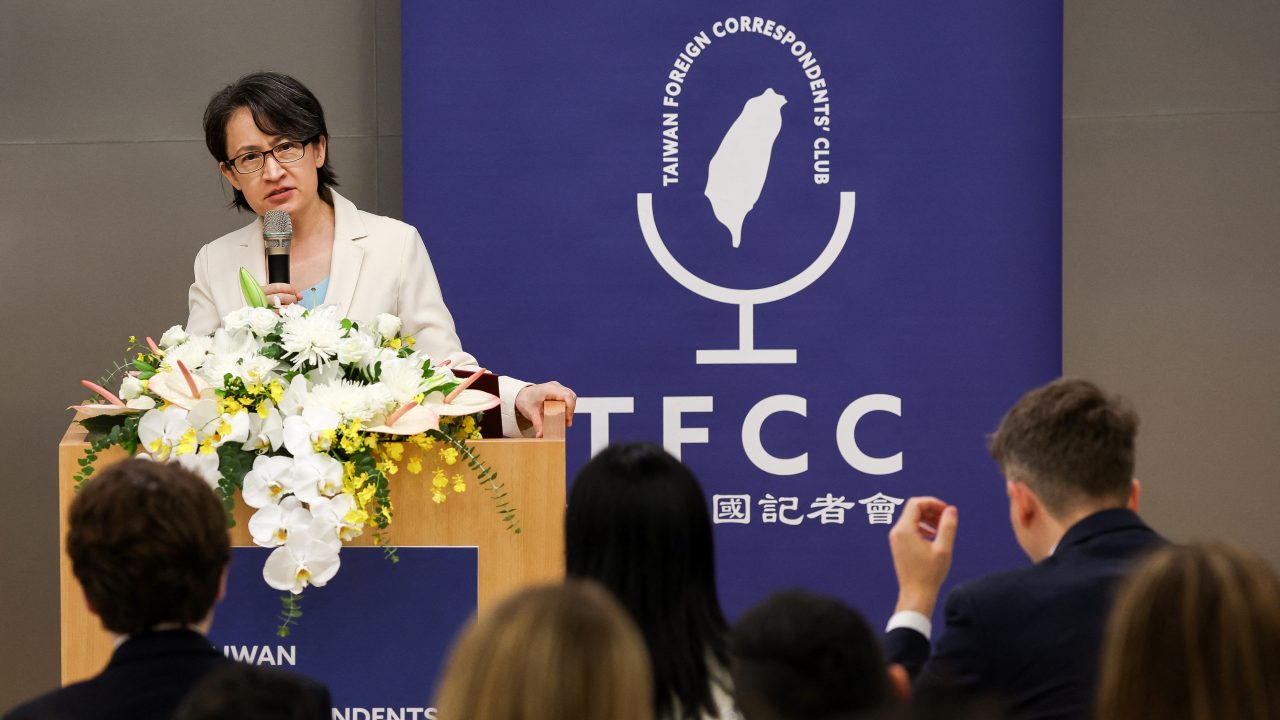
Taiwan launched a charm offensive in Europe this week, with two of its top stateswomen making keynote addresses on threats to Taiwan’s democracy and its resilience against China.
Taiwanese Vice President Hsiao Bi-khim (蕭美琴) shocked the world on Friday when she appeared in the European Parliament building in Brussels, and addressed the attendees of the annual summit Inter-Parliamentary Alliance on China, or IPAC, a group of parliamentarians from democracies around the world, including many from Europe.
Only days later, former President Tsai Ing-wen (蔡英文) spoke at the Berlin Freedom Conference, which marks the anniversary of the falling of the Berlin Wall, an event she contrasted with Taiwan’s own road to democracy.
Hsiao’s appearance at the IPAC summit marked a diplomatic milestone — it appears to be the first time in recent memory that a Taiwanese vice president entered a foreign parliament building that didn’t belong to one of the countries that recognize Taiwan. It’s not unheard of for a Taiwanese vice president to visit a country that Taiwan doesn’t have diplomatic ties with — then-Vice President Lai Ching-te (賴清德) visited Japan in 2022 to represent Taiwan at Shinzo Abe’s funeral. But it is uncommon enough to be noteworthy by itself, even without the appearance in the parliament building.
Although Hsiao didn’t address the European Parliament, she was still meaningfully hosted by the EU. IPAC told Taiwanese media CNA that the president of the European Parliament, the European External Action Service and the Belgian Ministry of Foreign Affairs were all aware of Hsiao’s visit prior to it happening and gave assistance. On her return to Taiwan, the vice president thanked “Foreign Minister Lin, Taiwan Representative to the EU and Belgium Ambassador Shieh Jhy-wey (謝志偉), Taiwan Representative to the U.K. Ambassador Vincent Chin-hsiang Yao (姚金祥), and colleagues from various overseas missions, as well as the National Security Council and other national security teams” for their coordination efforts.
However, despite the above list of coordinators, the secret was closely held. Taiwanese media CTS reported that IPAC members did not know she would attend, and Hsiao herself only found out in the pre-trip briefing that she received from Foreign Minister Lin Chia-lung (林佳龍) and President Lai. Prior to this she thought she would be giving a pre-recorded video address.
The Chinese mission to the EU put out a statement indicating that they had been aware of the visit prior to Hsiao’s arrival and had attempted to stop it. The Taiwanese representative to the EU and the director general of IPAC released photos on social media showing that Hsiao had a Belgian police escort, a level of official security that isn’t always granted to Taiwanese politicians when they travel abroad.
Hsiao visited Prague in March 2024, after the presidential election but before she was inaugurated as vice president. In June this year it emerged that a Chinese diplomatic vehicle had followed her car and police escort and was stopped by police for running a red light. Czech media Irozhlas also reported that the Czech director of Military Intelligence, Petr Bartovsky, confirmed “an effort by the Chinese civil secret service to create conditions for the implementation of a demonstrative kinetic action against a protected person, which, however, did not go beyond the preparation phase.”
It is understood that this means the military section of the Chinese embassy planned to cause a car crash involving Hsiao, but did not go through with it, possibly due to preventative efforts by Czech authorities. According to Irozhlas’s reporting, the red light running incident was not an attempt to carry out this action.
Hsiao was accompanied by Lin, the foreign minister, making his third visit to Europe in the last two months. In September he went to Czechia, the Netherlands, Italy and Austria, and at the end of the month returned to Europe to speak at a conference in Poland. It was reported he went to France as well, but the dates for that unconfirmed leg are unclear. All told, Lin and Hsiao’s trip to Brussels caps an extraordinary period of Taiwanese diplomacy.
The part of IPAC in this deserves examination. In 2024 IPAC held its summit in Taipei for the first time. At the end of the meeting, the delegates adopted a “model resolution” on U.N. General Assembly Resolution 2758, the document that effectively kicked Taiwan out of the United Nations. The IPAC model resolution was basically a draft text that parliamentarians could take home to their legislature and attempt to pass. The resolution stated that 2758 didn’t mention Taiwan and shouldn’t exclude Taiwan from the U.N. That draft resolution has been passed by houses and assemblies around the globe. It’s been, by its own measure, a huge success. Taiwanese delegates joined IPAC at the end of the Taipei summit.
To then have IPAC be the key facilitating party to bring Taiwan’s vice president to the center of the European stage is a testament to the power of the body that has been built up in five short years.
In her speech, Hsiao outlined the threats that “open societies” everywhere face, and the steps that Taiwan is taking to address them. The threats she mentioned were: military pressure and gray-zone coercion; cyberattacks and disinformation campaigns; economic leverage used to extract political compliance; infrastructure sabotage-physical and digital; and foreign interference targeting unity and public trust.
In response, Hsiao said that Taiwan is boosting its “defense investment” to 5% of GDP by 2030, as well as focusing on “whole-of-society resilience.” She also called upon IPAC members to help collaborate with Taiwan i said resilience as well as three other areas: trade and tech cooperation; inclusion in global institutions; and securing peace in the Taiwan Strait. “These aren’t favors,” Hsiao said, “They’re constructive partnerships.”
In closing, Taiwan’s vice president told the audience: “A few months ago in Taipei, IPAC members gave me a calligraphy gift with the Chinese words ‘得道者多助,’ which is an axiom from the ancient philosopher Mencius (孟子), literally meaning ‘Those who take the right way get a lot of help.’”
Taiwan will certainly be hoping that proves to be the case.
On Saturday, Tsai flew to Berlin to speak at the World Freedom Conference. After the ending of her two-term presidency, Tsai has started to establish herself as a roving stateswoman. This visit to Berlin is the third such trip Tsai has made since she retired from the presidential office. Previously, Tsai attended the Forum 2000 Conference in the Czech Republic in October 2024 and the Copenhagen Democracy Summit in May 2025.
Her visits are not consistently recognized as official engagements. The German foreign ministry made that clear last week. But Tsai is still able to behave like a diplomat on these trips. At the Forum 2000 Conference last year, Tsai met with Czech president Petr Pavel. During her trip to London following her time in Denmark, Tsai visited the House of Parliament and met with Lindsay Hoyle, the Speaker of the House of Commons. This meeting demonstrated “to a wider world, which obviously includes China, that he recognizes [Tsai’s] status as president of Taiwan,” Domino Theory quoted Baroness Frances D’Souza, a member of the House of Lords, as saying.
In Berlin, Tsai spoke in broad strokes, first drawing historical comparisons between the fall of the Berlin wall and Taiwan’s democratization following decades of authoritarian rule. She addressed current threats to democracy like cognitive warfare and military intimidation and the importance of deepening cooperation amongst like-minded democracies to counter these threats. “Much of the destabilizing tactics Taiwan has faced in recent years tend to find their way to Europe eventually,” Tsai said.
Tsai’s speech was more reflective than Hsiao’s, but less granular on the actions Taiwan is taking to strengthen its resilience. Yet, for the most part, their speeches seemed to be cut from the same cloth. Tsai ended on a similar “help yourself by helping Taiwan” message. “Taking a clear and united stance in support of Taiwan’s security is in itself a meaningful form of deterrence against authoritarian expansion,” she said.
“While today, Taiwan is on the frontline of the defense of democracy; tomorrow it could be any one of us.”



Leave a Reply