The last time Japanese company ispace tried to land on the Moon the mission ended sharply and suddenly after the spacecraft lost its bearings due to a software error and plummeted to the lunar soil.
Now ispace is trying again with HAKUTO-R Mission 2. This time there is a Taiwanese instrument on board, called the Deep Space Radiation Probe, developed by a team at the Department of Space Science and Engineering of National Central University, in Taoyuan.
The second mission is planned to launch on January 15, but this date could still shift. However, because it will follow a low energy trajectory to the moon, it will be four to five months before the lunar landing is attempted.
HAKUTO-R Mission 2 is using the same spacecraft model as Mission 1. The lander is named Resilience. Future ispace lunar missions will fly on different hardware with much larger payload capacity. Atsushi Saiki, executive fellow at ispace, said Mission 2 is receiving no government funding. Instead, they make revenue from selling payload slots directly to customers. National Central University is one of those customers, and the university is paying for the slot itself.
The Department of Space Science and Engineering at NCU is the leading academic center for space science research in Taiwan. The department has been at the forefront of the country’s space exploration and satellite development initiatives, playing a crucial role in advancing Taiwan’s aerospace capabilities, and training young generations of engineers and scientists.

The key purpose of the Deep Space Radiation Probe is to measure the background radiation as the lunar mission travels to and around the moon, before ultimately landing on it. This is important for two reasons. Firstly, radiation degrades flight hardware over time, especially for electronic systems. Secondly, background radiation above a certain level has serious health implications for humans, and humans will soon be returning to the Moon on the American Artemis program, which has heavy international involvement and counts Japan as a key partner.
This radiation dose is not something that can be determined remotely. You have to go out there with a sensor and measure it directly. The measurements that the Deep Space Radiation Probe will make were first made during the 1960s and the Apollo program that first landed on the moon. The Taiwanese effort will make these measurements with up-to-date sensors, which matters, but as important is the fact that it is a “Taiwanese” effort. The instrument was built by Taiwanese scientists and student-scientists, who are gaining and demonstrating vital skills and experience in constructing and operating spacecraft.
National Central Univerity’s Loren Chang (張起維) is the principal investigator for the Deep Space Radiation Probe, the Taiwanese instrument flying on HAKUTO-R Mission 2. He explained the technical details of the device.
Chang explained that this experience building is what drove the choice of instrument when National Central University was offered the opportunity of a payload slot on Hakuto-R Mission 2. In 2021 Taiwan launched IDEASSat, a very small satellite that studied the Earth’s ionosphere. However, IDEASSat didn’t make it past three months of its intended six-month lifespan before contact with it was lost for good. The team determined that the most likely cause of the loss of the spacecraft was radiation damage.
For this reason, the new instrument will also make another very specific measurement: the Single Event Upset Count. A single event is when a cosmic ray or charged particle hits part of the operating system of the spacecraft and “flips a bit” in the memory. In effect, it rewrites one letter of the programming code of the spacecraft. Typically, this will not be too serious, but there is a chance that it could be catastrophic, and this outcome is completely random. The first single event could kill the satellite, or you could experience thousands of them with no impact.
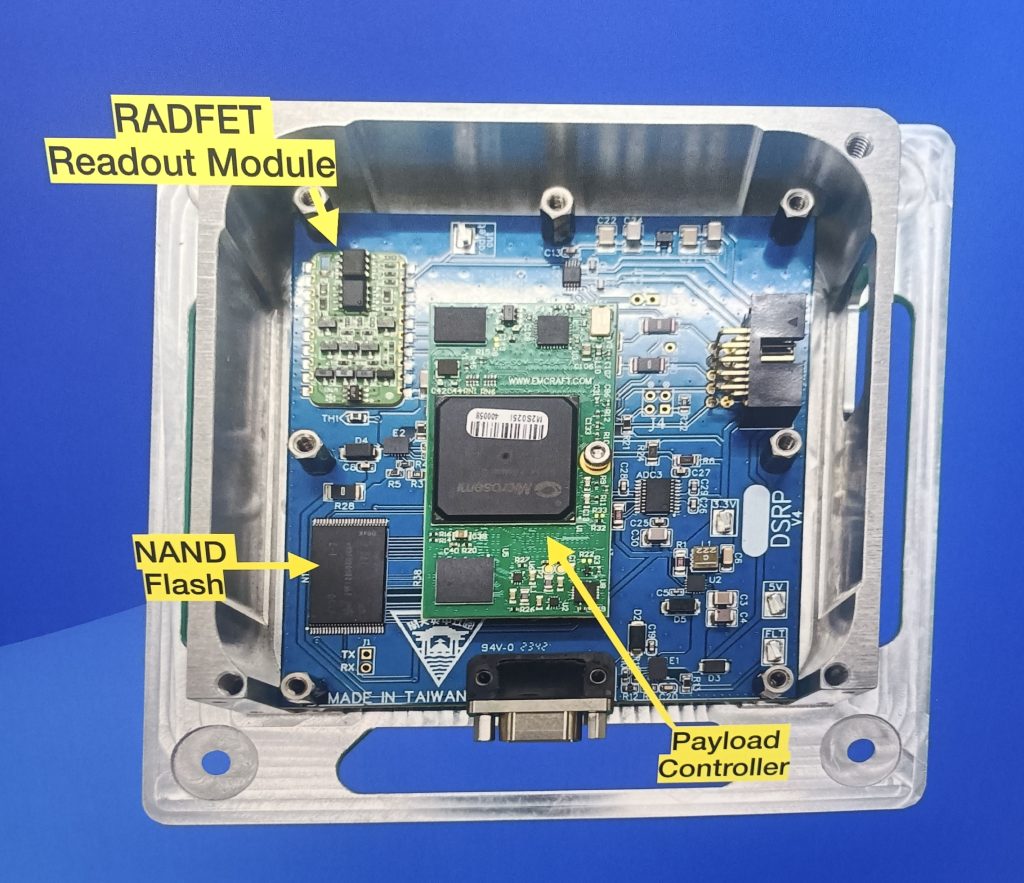
After the loss of IDEASSat, the team at National Central University redesigned their basic model of how a satellite’s computing system works to make it more resilient to single event effects. The Deep Space Radiation Probe will count single events by carrying a NAND flash drive with a dataset full of “zeroes.” Periodically the spacecraft will read this dataset and by counting the “ones” can determine how many single events the spacecraft has experienced. It’s an elegant design.
National Central University is paying ispace an undisclosed fee for the payload slot on the mission. This is being funded by the university’s endowment fund, as well as through some private fundraising. Chang pointed out that the Space Science department at NCU brings in large sums in grant funding every year for the university, which he credits with their willingness to fund this mission.
Masayuki Urata, senior manager of the business development division at ispace, said it’s impressive that Taiwanese education has the budget for these trips. He emphasized that National Central University lets students do the actual work and also sends them to Japan to visit ispace and the spacecraft integration site in Tsukuba.
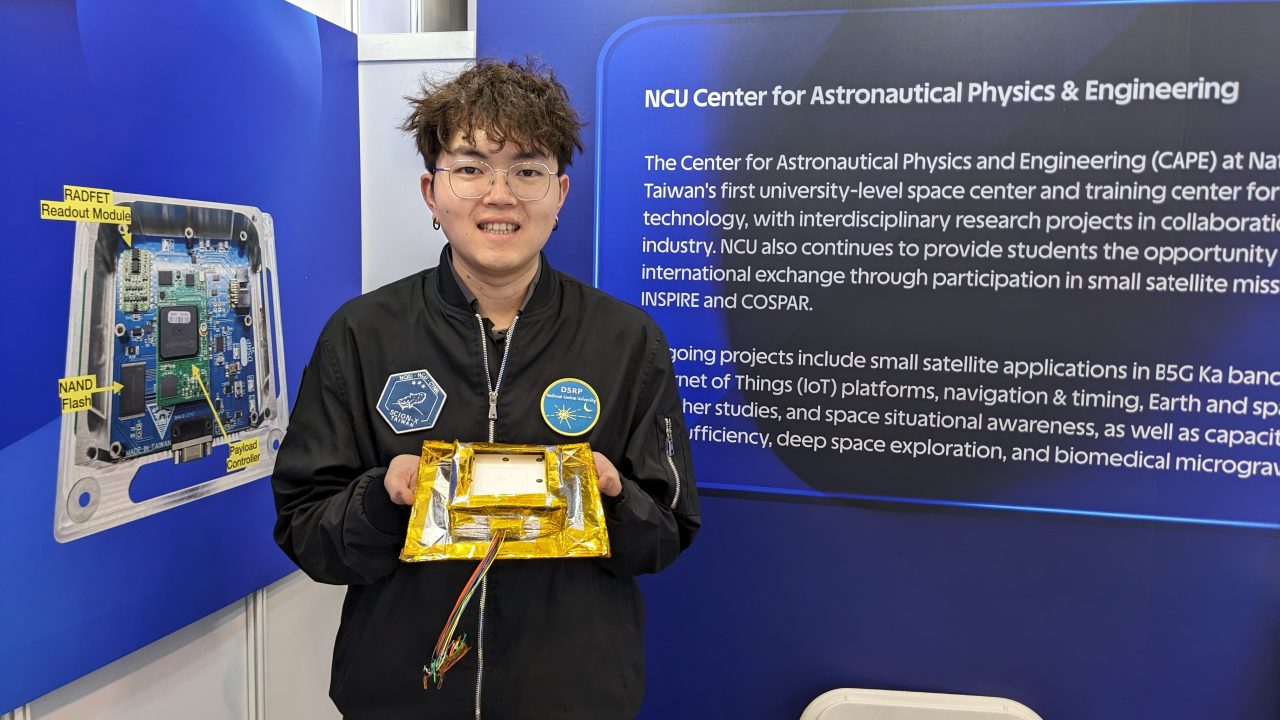
Both ispace and National Central University had booths at the Taiwan International Assembly of Space Science, Technology and Industry in Kaohsiung last December. Launched in 2023 by the National Science and Technology Council (國科會) and coordinated by the Taiwan Space Agency. National Central University displayed a non-flight model of the Deep Space Radiation Probe at the forum.
When HAKUTO-R Mission 2 attempts to launch on Wednesday, it will carry not only the physical instrument built by Taiwan’s young space scientists, but also their hopes and dreams.






Leave a Reply