
The incoming Taiwanese president’s best strategy to stop China from seizing the self-ruled island will likely be to bolster an agile defensive “porcupine” approach by spending more on missiles and drones.
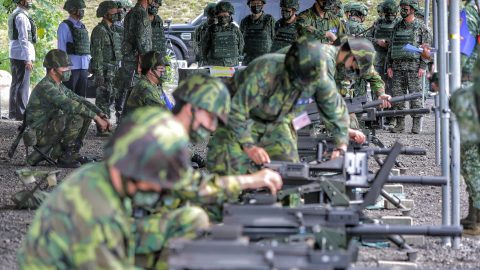
Lessons learned from Russia’s war in Ukraine about how rapidly developing drones can outfox traditional heavy weaponry suggest that Lai Ching-te (賴清德) will boost Taiwan’s production of modern military technology after he takes over as president on Monday (May 20).
“Taiwan is taking the Chinese military threat more seriously,” said Raymond Kuo (郭泓均), Taiwan Policy Initiative director at RAND Corporation.
“It has ramped up its production of anti-ship missiles, tested new anti-air missiles, and is on track to manufacture several thousand military drones,” he said.
“I would expect those efforts to continue [under Lai] alongside purchases of U.S. equipment and development of large platforms like the indigenous submarine.”
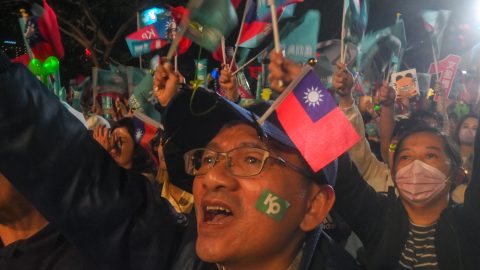
Lai, a vocal supporter of preserving the island’s sovereignty, swept to power in January elections despite warnings from Beijing that he would bring “war and decline” to Taiwan.
Beijing has vowed to eventually take control of Taiwan, by force if necessary.
Lai’s victory secured an unprecedented third term for the Democratic Progressive Party (DPP), which rejects China’s claim to Taiwan.
Lai will succeed Tsai Ing-wen (蔡英文), who angered Beijing during her eight years in power by boosting military spending, developing Taiwan-made equipment such as submarines and ships, and strengthening ties with the United States.
Washington switched diplomatic recognition from Taipei to Beijing in 1979, but it has remained Taiwan’s most important partner and biggest arms supplier.
‘Light, Agile and Lethal’
Beijing maintains a near-daily presence of fighter jets, drones and naval ships around the island in what experts call “gray zone” actions — tactics that fall short of an act of war.
U.S. Secretary of State Antony Blinken asked Beijing during a visit to China in April to avoid “provocative” measures during Lai’s inauguration on Monday.
Taiwan authorities have detected dozens of Chinese aircraft near the island in recent days.
Beijing, which regards Lai as a “dangerous separatist,” is expected to intensify that military pressure in the coming years, underscoring the security challenges facing his administration.
“This reality means that a key measure of success of the Lai administration will be how far he can push forward the necessary reforms to improve Taiwan’s ability to defend itself and deter Chinese aggression,” Amanda Hsiao (蕭嫣然) of the International Crisis Group told AFP.
Washington approved a huge military aid package for Taipei last month in the face of an increasingly assertive China, including $1.9 billion for replenishing its military equipment and training.
Another $2 billion will be used for “foreign military financing” for countries in the region.
Taiwan is under pressure to increase its own defense spending and adopt a “porcupine” strategy to deter an attack from China, said Richard Hu (胡瑞舟), a military expert at National Chengchi University.
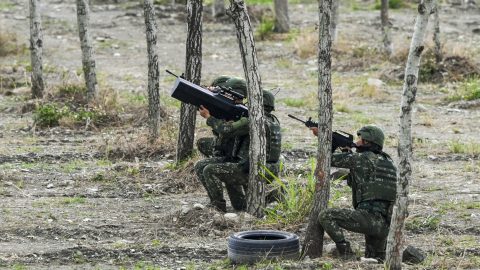
“With lessons learned from the Russian-Ukraine war, the defense ministry will try to switch from buying expensive and heavy weapons systems to some light, agile and lethal arms and equipment, such as battle-tested UAVs [drones] and Javelin missiles,” Hu said.
Lai has appointed National Security Council chief Wellington Koo (顧立雄), a lawyer with no military rank, to head the defense ministry and oversee the transformation, but there has been pushback, said Hsiao.
“Not everyone in the relevant government agencies is convinced of this strategy,” Hsiao added.
‘Xi Is Deadly Serious’
The rift between China and Taiwan dates back to China’s civil war, which erupted in 1927 between communist and nationalist forces.
Defeated by Mao Zedong’s communists, the Chinese Nationalist Party (KMT) of Chiang Kai-shek (蔣介石) fled to Taiwan in 1949 and claimed rulership of all of China — just as the mainland claimed Taiwan.
Chinese military pressure on Taiwan escalated during Tsai’s presidency, with Beijing holding its largest military drills around the island in 2023.
However, Taiwan has seen a shift in China’s actions in recent months.
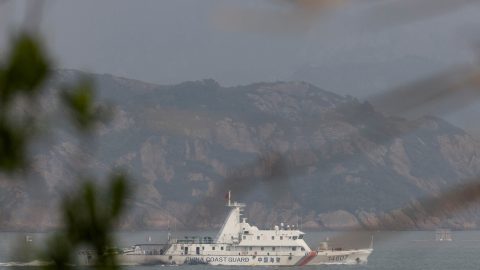
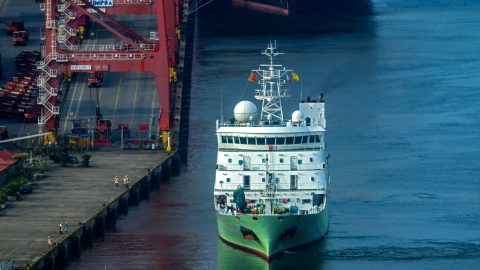
Aerial incursions have decreased but Taiwan’s outlying island of Kinmen has seen a pickup in regular patrols by Chinese coast guard and other vessels.
“China’s use of gray zone tactics is shifting from military brinkmanship to more law enforcement,” political scientist Wen-ti Sung (宋文笛) said.
That may “involve more direct contact between civilian personnel from both sides and carry more complicated potential for political escalation.”
China’s goal of eventually seizing Taiwan remained the same, said Steve Tsang (曾銳生), director of the London-based SOAS China Institute.
“[President Xi Jinping] is deadly serious about taking Taiwan and is building up the capacity to do so,” Tsang said.
“Taipei, the U.S. and others concerned must use the time to work to preempt or deter a Chinese attack.”
Leave a Reply