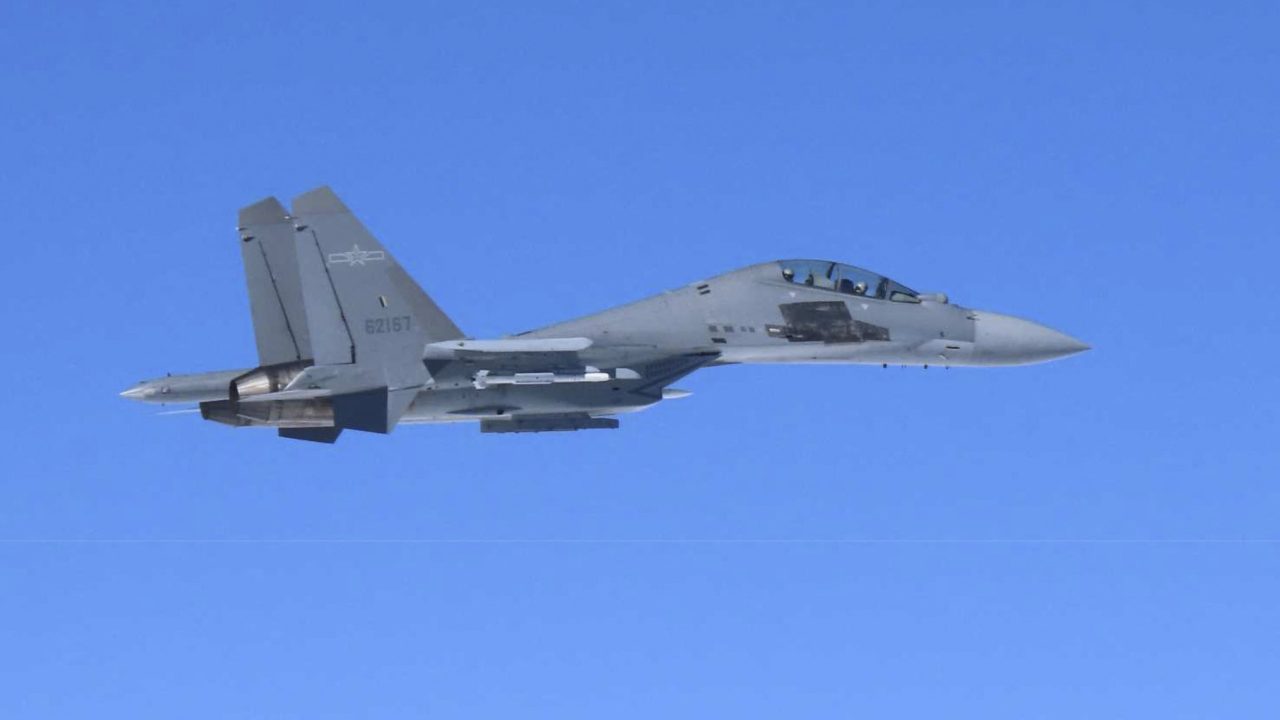
Over the past two weeks, Taiwan’s Ministry of National Defense has detected an unusually low number of Chinese military flights around Taiwan.
The reduction in sorties has coincided with the “two sessions,” China’s largest annual political meeting in Beijing. This has led Brian Hart, a China military expert at the Center for Strategic and International Studies, to dismiss the hype surrounding the dip.
“This isn’t mysterious,” he wrote in a post on X last week. “PLA air incursions into Taiwan’s ADIZ drop to/near zero around the time of the annual ‘two sessions’ every year.” PLA is the acronym for the People’s Liberation Army, China’s military.
But most experts think that there is something significant and unusual going on.
Nathan Attrill, who writes the State of the Strait newsletter for the Australian Strategic Policy Institute, has argued that the drop in sorties is most likely due to uncertainties in the global energy market brought on by the war in Iran. “If Chinese leaders assess that global oil supplies could tighten, particularly as conflict disrupts shipping through key routes such as the Strait of Hormuz, it would be logical to conserve resources where possible,” he said.
China has spent years building up the fuel reserves necessary to withstand a global supply shock. Tristan Tang (湯廣正), a nonresident fellow at the National Bureau of Asia Research, an American think tank, said that if the time does come for China to ration its fuel consumption, the military won’t be the first place they look.
“It would be odd for me to imagine that civilian life would still have sufficient fuel,” while the military was forced to ration, he said.
Tang’s preferred theory is that the present lack of sorties is the result of a long-term evolution in the Chinese military’s training behavior. He says it traces back to November 2020, when Chinese President Xi Jinping (習近平) announced a major reform aimed at improving the PLA’s joint operations capacity, or the ability for different branches of the military to work together.
Developing that joint operations capacity requires a level of experimentation that could result in less observed activity near Taiwan. “Because they are exploring a lot of new maneuvers and maybe some new tactics,” he says, “it will be proper for them to also shift their operation area away from foreign countries for safety.”
Other analysts have speculated that Xi’s recent purging of the highest ranks of the PLA may explain the pause. But Drew Thompson, senior fellow at the S. Rajaratnam School of International Studies in Singapore, finds that explanation unconvincing.
“I don’t think the demise of these two senior officers is a causal factor for the reduction in flights,” Thompson said last week in a post on Substack, referring to Zhang Youxia (張又俠) and Liu Zhenli (劉振立), two of the most high-profile recent PLA purge victims. “PLA missions around Taiwan have increased steadily despite the persistent purge of the PLA’s top ranks since Xi came to power in 2012.”
Thompson finds another popular theory — that China has paused flights near Taiwan to buy goodwill from the U.S. ahead of next month’s planned Trump-Xi summit in Beijing — equally unconvincing. “I would be shocked if Beijing is reducing military missions around Taiwan to influence President Trump,” he said. “PLA missions around Taiwan are a message to Taipei, not Washington.”
Dennis Wilder, a former director for China on the National Security Council, gives that theory more credit. “I can’t help but think this is related to the Trump summit,” he wrote on LinkedIn on Tuesday. “Xi trying to show his reasonableness on the Taiwan question.”
February also saw a significant drop in U.S. land-based reconnaissance sorties over the South China Sea, according to the South China Sea Strategic Situation Probing Initiative, a Chinese think tank. That phenomenon has inspired similar speculations — tying it to the Middle East on the one hand, and the preparations for the Trump-Xi summit on the other.
If a consensus among experts does exist around the decrease in PLA sorties, it’s that there is not enough evidence to know for sure what is going on.
According to Ming-Shih Shen (沈明室), an associate professor at Tamkang University in Taiwan, further clues to the source of the pause could emerge in the coming days and weeks. The timing of the PLA’s resumption of regular flights around Taiwan, if and when that happens, would be one key indicator, he said. China’s reaction, or lack thereof, to the potential end of the war in Iran could be another.
But like most analysts, he’s not pretending to know what’s going on. “These reasons may exist individually or in combination,” he said. “But only China truly knows the real reason.”


Leave a Reply