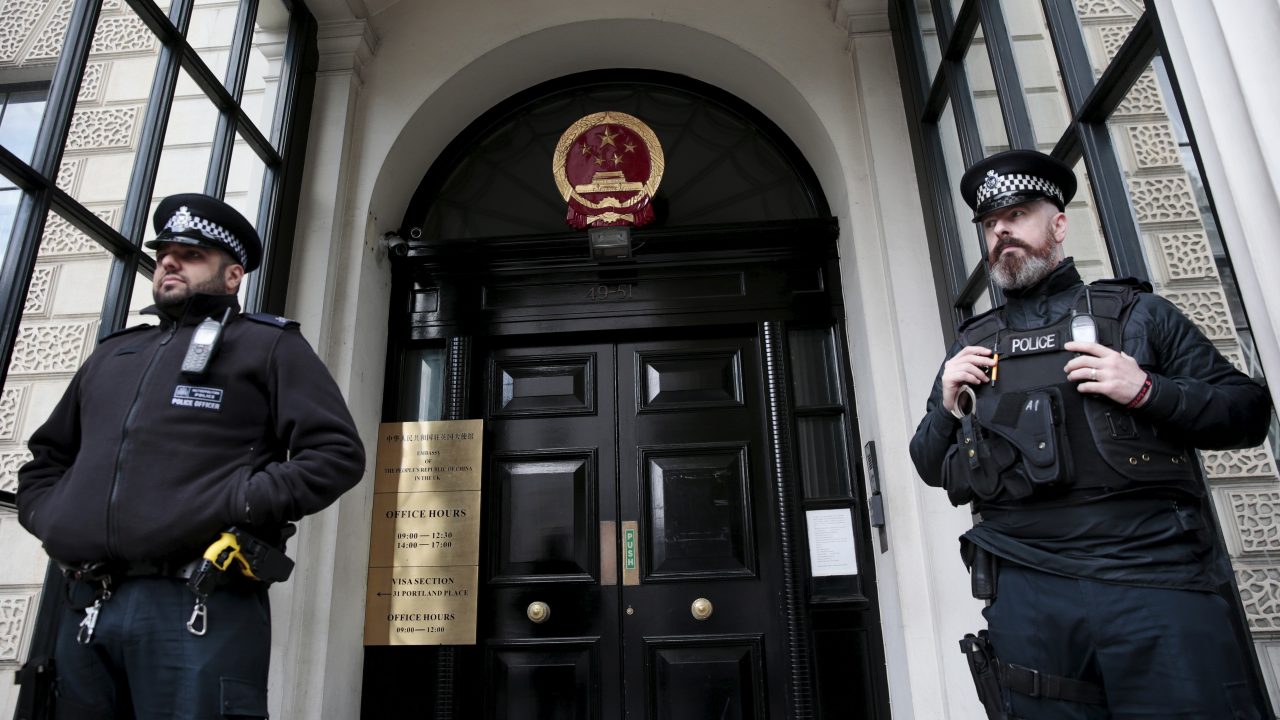
China’s five-acre property at the old Royal Mint site in London could become the largest embassy in Europe. And a potential political powder keg for Prime Minister Keir Starmer.
British intelligence experts previously told Domino Theory that while the proposed Chinese embassy would pose risks to national security, those risks can be mitigated. But the reality for Starmer is that this decision is about more than national security.
“If the intelligence agencies say, yes, there’s a risk, but we can mitigate that risk just as we’re mitigating the risk of their current location, then the government may go ahead, but it may still decide to block it for wider political reasons,” said Sir Mark Lyall Grant, former national security advisor to David Cameron and Theresa May.
The prospect of a giant embassy in one of London’s most historic areas is indeed a highly political issue. For Starmer, it would be a political risk to approve the embassy and trigger backlash from the opposition, Hong Kong dissidents and Washington. It would also be a political risk to deny the embassy, upsetting the U.K.’s relationship with China at a moment when there is much London desires from Beijing. Complicating this calculus is the reshuffle happening in Starmer’s government at the moment, including Yvette Cooper replacing David Lammy as foreign secretary just a few weeks ago.
“A huge status symbol embassy in a prestigious London location would represent a geopolitical victory for Xi,” said Luke de Pulford, executive director of the Inter-Parliamentary Alliance on China, referring to China’s president, Xi Jinping (習近平). “If they can bully the U.K. into submission over this embassy, it will be highly symbolic both in terms of what [it] projects about CCP power and the U.K.’s global standing.”
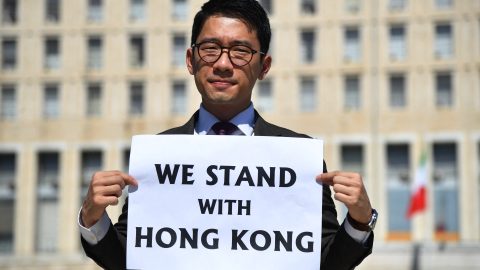
Hong Kong dissidents in London have said that the scale of the new embassy could bolster China’s surveillance and intimidation of dissident groups. Beyond this, the symbolic victory that the embassy would represent for Xi is alarming. “At this critical time, if the government is granting them the largest embassy in Europe, which is in various historical sites, I think that really emboldens the message of the PRC,” said Hong Kong democratic activist Nathan Law (羅冠聰).
The Labour government would also certainly receive backlash from China skeptics in parliament. Baroness D’Souza, a crossbench member of the House of Lords, wrote in an email that the planned embassy “would be a dangerous precedent and adversely affect the security of the U.K. and certainly all those who express concern about PRC policies. To agree to the embassy in the midst of the city of London would reflect a supine attitude and one which will encourage further espionage and criminal action on the part of the PRC.”
In August, then-Housing Minister Angela Rayner asked the Chinese embassy to explain grayed-out areas in the architectural plans it had submitted for the new embassy. Those areas had become a point of concern, with the tabloid press referring to them as “spy dungeons.” However, two weeks later, representatives acting on behalf of China said that “the applicant does not consider that, as a matter of principle, it is necessary or appropriate to provide full internal layout plans.” Rayner subsequently delayed the deadline for the final decision to approve or not.
“It’s a big thing for the U.K. Government to essentially be seen as being bullied over,” said Howard Zhang (張晧宇), an advisor at UK-China Transparency. If the Chinese ultimately refuse to disclose any of the grayed-out areas, and the U.K. government still approves the embassy, “it would give oppositions and other people lots of ammunition,” said Zhang.
Max Dixon, a Ph.D. candidate at the University of Portsmouth who is researching the U.K.’s foreign policy towards Taiwan, said the real challenge for the Labour government could come from U.S. intervention into the decision. Under intense U.S. pressure in 2020, Boris Johnson’s government reversed its decision to allow Huawei to build 5G networks in the U.K. Still, Dixon thinks massive U.S. intervention here is unlikely. “This has been going on for a long time. We haven’t seen that much blowback from Washington,” he said.
There are also political risks to rejecting China’s proposal to build its new embassy at the Royal Mint site. “One has to be cautious here, because there is a reciprocity issue. And of course, in the U.K. case, the U.K. is trying to rebuild its embassy in Beijing,” said Nigel Inkster.
“If China wants to get the best out of Britain, it has to allow Britain to have facilities that are fit for the moment we’re living in. Right now they are not,” said Peter Kyle, the business and trade secretary, during a trip to Beijing a couple of weeks ago.
The diplomatic tit-for-tat doesn’t necessarily have to occur within the same domain. “If we limited the number of diplomatic staff, China might say, well, we’ll cancel next week’s economics and trade dialogue,” said Tim Law, deputy director of UK-China Transparency and former British defense attache in Beijing.
Perhaps the most obvious reason that the Starmer government might approve China’s application is because of the potential for increased trade and investment, which could bolster the U.K.’s struggling economy. “Giving this prime real estate … to a massive embassy for China feels like in poor taste. However, I also understand why there is support from a Labour government that’s desperate for growth above all else,” said Dixon.
While the Labour Party has received some criticism for seeming to prioritize economic interests over national security ones — particularly when it comes to China — there is a parallel with the Theresa May government allowing China to buy the Royal Mint site in 2018. Dixon said that at the height of the Brexit negotiations, the Conservative Party was looking for an economy outside of Britain to justify their position. Denying the sale of the Royal Mint to China in 2018 in this context would have been a “hard sell.”
“In the midst of those brutal negotiations over what kind of Brexit you’d have, I think there would have been very little resistance at the time to say, well, you know, we’ll give China this site,” said Dixon. “A lot of Conservatives would have been hinging the success of Brexit on the U.K. and Asia. And China would have been a key part.”
With Rayner having resigned as deputy prime minister and housing minister, the decision over the embassy ostensibly passes to her replacement in the latter role, Steve Reed. Reed has not been shy of criticizing China in the past. But he is not the only one who has moved jobs.
Cabinet Reshuffle
The most obvious move is that Cooper, who was interior minister, has become foreign minister. She replaced Lammy, who had spent years building up an intellectual underpinning for Labour’s foreign policy he called progressive realism. “The government has conducted its China audit. It is unlikely that the arrival of a new foreign secretary will alter the fundamentals established by this review,” said Gray Sergeant, a research fellow in Indo-Pacific Geopolitics at the Council on Geostrategy, a British think tank.
Sergeant said that because Cooper had previously served in the Home Office, she will be “familiar with the national security challenge posed by China.” However, he said it’s unclear if this would influence her approach because at the end of the day, “most ministers stand where they sit, and Cooper now sits at the top of the Foreign Office.”
Cooper has “no track record of any kind of interest in foreign policy or China,” said Dixon. He thinks the new foreign minister will follow the platform she was left with by Lammy, and said “she’ll follow Starmer. She’ll follow [Chancellor Rachel Reeves], follow the way that her approach to China has been, which is the economy first, security second.”
De Pulford echoed this: “We have long witnessed the slow ‘treasurization’ of U.K. politics, with officials in the Treasury running the show. The U.K.’s desperation for trade and investment is driving China policy.”
One person who wasn’t moved in the reshuffle could have the biggest impact of all if he were to go. Morgan McSweeney, Starmer’s chief of staff, has been under increasing pressure. Seen as one of the key players responsible for Labour’s huge electoral win last year, McSweeney is now carrying part of the can for the party’s poor performance in office.
Zhang said that McSweeney was responsible for much of the Starmer government’s strategy, including resetting EU relations, resetting U.S. relations and resetting China relations. A change at this position would be likely, though not guaranteed, to impact China policy.
Whether any such change would come soon enough to affect the final embassy decision is another question.





Leave a Reply