
Ukraine has had great success in sinking Russian navy ships in the Black Sea using drone boats filled with explosives. At the Taiwan International Boat Show in Kaohsiung earlier this month, several examples of these drone boats, or unmanned surface vehicles, or USVs, were on display. Taiwanese companies are increasingly keen to enter this new market, but the Taiwanese government hasn’t ordered any yet.
The idea using suicide boats to destroy enemy ships is an old one. English fireships were an important part of the defeat of the Spanish Armada in the 16th century. Closer to home, the Japanese prepared to use shinyo motorboats to defend Taiwan from a U.S. invasion during the second world war. That invasion never came because the Americans decided an amphibious operation against Taiwan would be too difficult, but the remains of shinyo bunkers can still be found on Taiwan’s coast.
In “The Boiling Moat,” a “how to guide” for Taiwan to deter a Chinese invasion, American defense analyst Ivan Kanapathy called for Taiwan to develop lethal expendable uncrewed sea drones instead of building more manned submarines. A report by the Center for a New American Security in June said that Taiwan should acquire a combination of kamikaze drone boats and underwater drones, noting that Ukraine has used the synergy between USVs and anti-ship missiles to deny Russian control over parts of the Black Sea. The same month, U.S. Admiral Samuel Paparo told The Washington Post that the plan is to turn the Taiwan Strait into a “hellscape” of uncrewed systems.
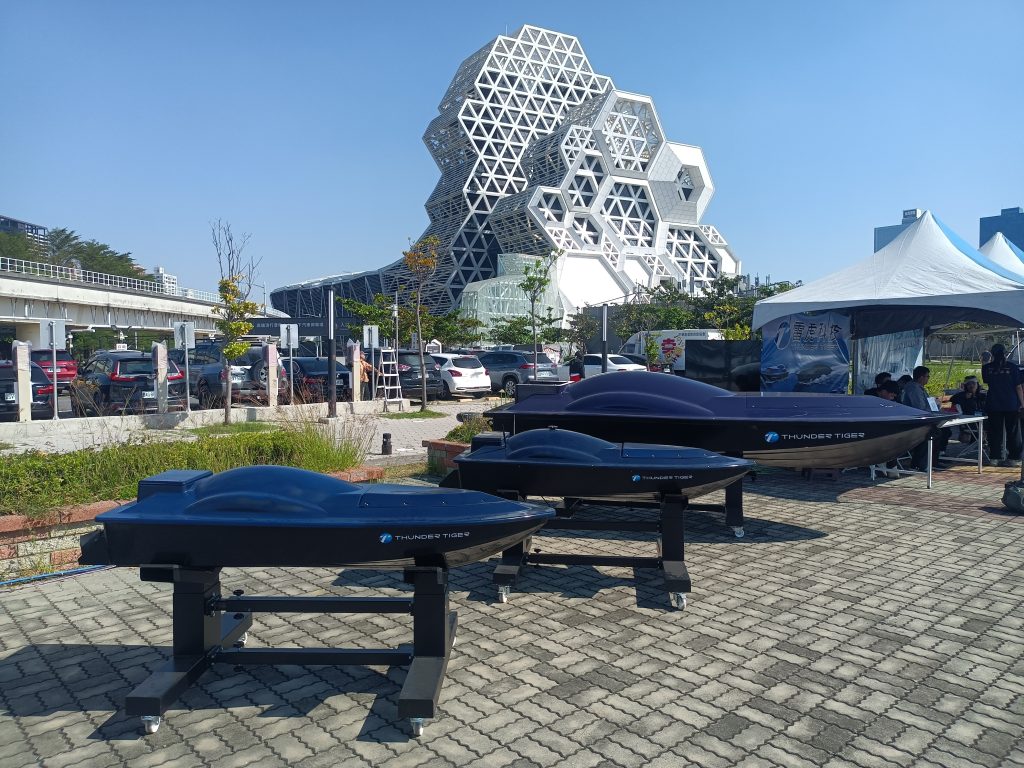
Thunder Tiger is a well-known player in the Taiwanese drone industry. They had two different models on display in Kaohsiung: the Tigershark 200 and its big brother the Seashark 400. The 2.3-meter-long Tigershark 200 has a range of 30 kilometers and a payload of 80 kilograms. The 4.3-meter-long Seashark has a range of 150 kilometers and a payload of 150 kilograms when powered by electric motor and 250 kilograms when powered by combustion engine. These numbers are sourced directly from Thunder Tiger’s product catalog.
Thunder Tiger told Domino Theory the USVs can be powered by using either electric or combustion engines. They could even be adapted to house outboard engines. Similarly, the models displayed do not have guidance systems fitted. Readers should be able to discern a panel at the front of the craft; this is a modular section where cameras and other sensors would be mounted.
Thunder Tiger started out making remote control vehicles for hobbyists and transitioned into producing drones. In September, Thunder Tiger acquired Morningstar, a Taiwanese company that has expertise in building the larger aluminium hulls that Thunder Tiger’s USVs use. Thunder Tiger said its supply chain is “China free” and there are no choke points in the design that would prevent further scaling or subcontracting of production to other boatyards, of which Taiwan has many. The company currently has capacity to produce 20 USVs per month but could scale this to 100 per month if given sufficient orders.
The other USV on display at the boat show was the much larger Piranha 9, built by Corum Yachts in Taoyuan. The 9-meter-long Piranha 9 has a payload capacity of 850 kilograms and has a low radar and infrared cross section. In other words, it is a stealth boat. Intriguingly, not only could it be used in an expendable attack mode carrying a large warhead, it is also designed to be able to launch up to four loitering munitions or suicide drones. Corum also lists reconnaissance and surveillance and patrol as possible applications for the USV. There is no range listed for the Piranha 9, but Corum says its speed exceeds 55 knots.
Taiwanese media The Liberty Times reported in March that the Taiwanese army and navy are interested in acquiring USVs and that the army estimates it could use up to 200. Further reporting states that Chungshan Institute of Science and Technology, the Taiwanese state-owned defense corporation, will develop these drone boats under a two-year project, basing the design on an existing uncrewed prototype. The Liberty Times also reported in June that Jong Shyn Shipbuilding Company displayed a USV with a length of 16.5 meters and a theoretical range of 550 kilometers.
In “The Boiling Moat,” the authors call for Taiwan to acquire more than 1,000 USVs and UUVs (uncrewed underwater vehicles). In 2023, Scott Savit, a senior engineer at U.S. think tank RAND, said that at the Ukrainian cost of $250,000 per USV, Taiwan could buy 1,000 at “a little over one percent of the $20 billion it expends annually for defense.” These figures are clearly achievable for Taiwan with its current spending and industrial base, and Taiwan’s coast has more than 200 small fishing harbors that such USVs could sally out of in wartime.
What does the P.R.C. think? The South China Morning Post quoted Chinese military analyst Shao Yongling (邵永靈) on state media CCTV as saying that “Taiwan probably wouldn’t have a chance to use” its USVs, because the Chinese military would be able to target them in the first wave of strikes. This is something that China’s partner Russia has been notably unable to do to Ukrainian USVs.






Leave a Reply