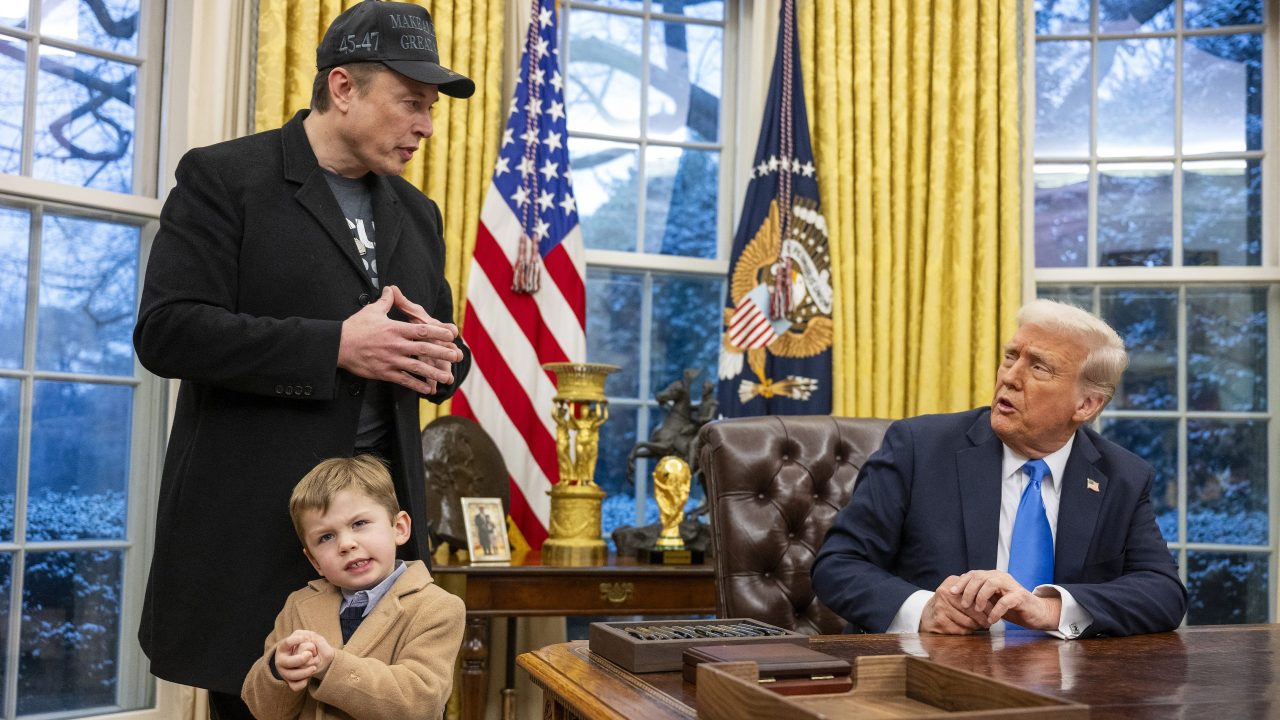
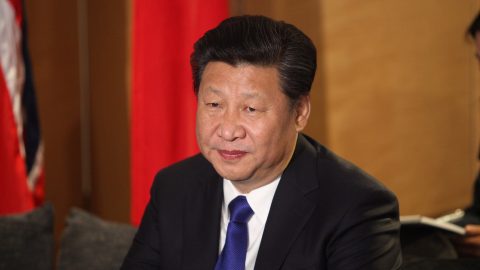
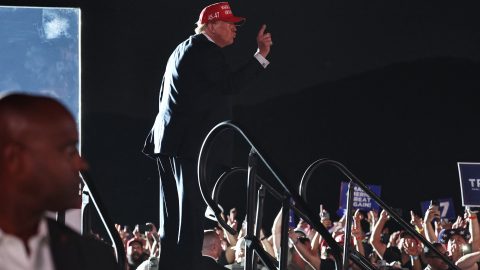
U.S. President Donald Trump and Chinese President Xi Jinping (習近平) have gathered their tech posses. Xi convened his group of powerful men in tech earlier this week at a private enterprise symposium held in the Great Hall of the People. Trump awarded tech leaders prime seating during his inauguration and gave Tesla CEO and owner of X, Elon Musk, significant latitude to cut bloat in the American bureaucracy.
The relationships Trump is developing with his tech posse feel casual. Footage from official press briefings in the Oval Office show Musk’s son playing around Trump’s desk as his dad stands over the president. A couple of days ago, Musk and Trump sat side by side for an interview with Fox’s Sean Hannity, during which Hannity remarked that the pair seemed like brothers.
In contrast, a glance at pictures of Xi’s private enterprise symposium conveys a formal and prescribed relationship between government and business. The attendees were seated in such a way that communicated the Chinese Communist Party’s priorities and who is “in” versus “out.” Technology giants occupied the most important seats at the table directly opposite Xi. Representatives from traditional industries like agriculture were also present but seated on the periphery.
Huawei and BYD’s executives sat directly opposite Xi, underscoring the party’s commitment to self-sufficiency in technology. Huawei has advanced its semiconductor and smartphone technology despite the constraint of U.S. export controls on advanced chips. And BYD’s success in electric vehicles has helped China transform from a net importer to a net exporter of automobiles. Liang Wenfang (梁文鋒) is a sensation following the release of DeepSeek, but he is new so he was seated at the far end of the table. Baidu executives were absent from the meeting — the markets perceived this as the company being on the outs with the CCP, which led their market value to plummet.
Commitment — or perhaps more appropriately, “deference” — to the CCP was both symbolically and explicitly communicated during the meeting. Official pictures of the meetings capture the backs of the business executives but the faces of Xi and other party officials. Videos show executives taking careful notes while Xi spoke. While Xi’s speech encouraged growth in the “non-public” sector and promised to “improve policy precision” in order to facilitate this, he also called on the group to “unify our thinking” toward common prosperity and the betterment of the nation. “I will remain steadfast in my confidence for industrial development, keep the original aspiration of entrepreneurship, maintain a strong sense of national responsibility, and dedicate myself to strengthening the real economy,” said one executive following the symposium.
The Chinese and U.S. contexts are not so different. Despite their more casual (and sometimes hostile) public interactions with U.S. political leadership, American tech leaders are also constrained by politics. On the Lex Fridman podcast, Marc Andreessen, an American venture capitalist, said that companies can withstand most forms of pressure but not government pressure: “When your government comes for you … any CEO who thinks that they’re bigger than their government has that notion beaten out of them in short order.”
Case in point is Stargate, a $500 billion project to expand infrastructure for artificial intelligence in the U.S. that Trump announced on January 21. Widespread reporting implies that Stargate is Trump’s project. Trump’s announcement might have given that impression, but it is not the case. The project is a joint venture primarily financed by OpenAI, SoftBank, Oracle and MGX. And it has been underway for quite some time — construction on the first data center began in June 2024. Nevertheless, Trump’s endorsement is important because the project needs regulatory approvals, land and energy, all things that Trump can facilitate.
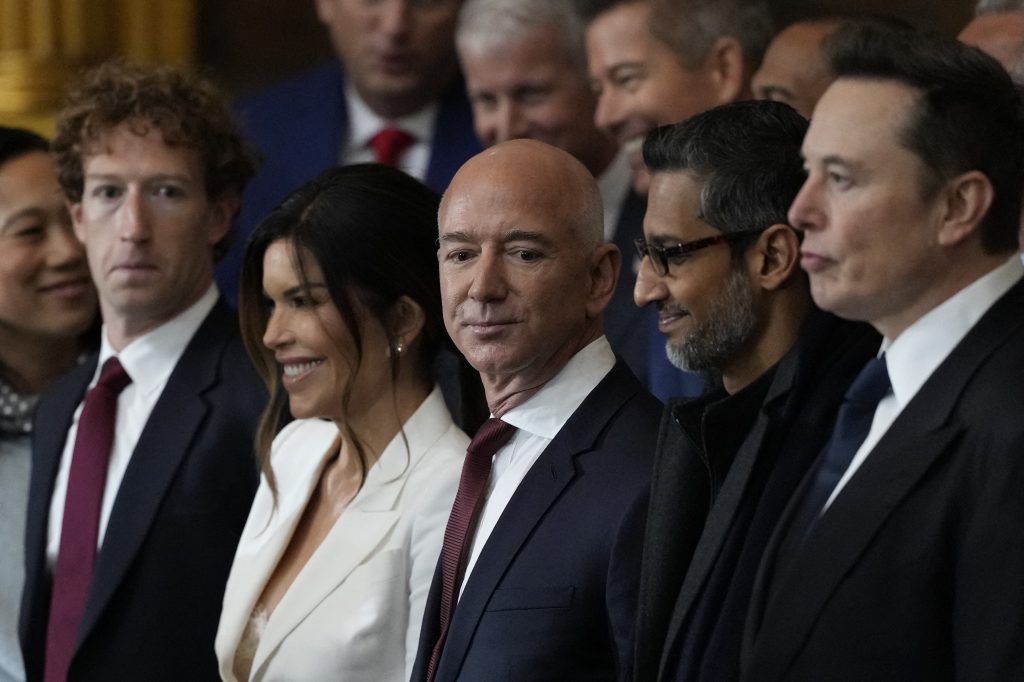
Mark Zuckerberg, CEO of Meta, has been trying to smooth over his previously rocky relationship with Trump. Trump included Meta in his vocal rejection of “woke” media and platforms that he believes censor conservative perspectives, even threatening to commit Zuckerberg to life in prison in his 2024 book “Save America.” In a drastic shift in its content moderation policy, Zuckerberg shut down Meta’s third-party fact-checking program shortly before Trump’s inauguration, parroting some of Trump’s keystone rhetoric on liberal censorship in his reasoning. “The fact checkers have just been too politically biased and have destroyed more trust than they’ve created, especially in the U.S.,” he said.
Both Zuckerberg and Sam Altman, CEO of OpenAI, have expressed displeasure at the Biden administration’s hostility toward big tech. Altman mentioned in an interview that it had previously been difficult to make progress on AI infrastructure due to regulatory hurdles, calling Trump a “breath of fresh air.” And on the Joe Rogan podcast, Zuckerberg recently criticized the breadth and frequency of the Biden administration’s censorship requests, particularly during the Covid-19 pandemic.
Trump certainly promises deregulation and a pro-business approach. But the conservative agenda also seeks to limit the overextension of big tech, and this could create problems for Zuckerberg, Altman and company. For example, lawmakers like Senator Josh Hawley are advocating for a “Trust-Busting Agenda for the 21st Century” that would break up tech giants seeking to dominate in multiple sectors. And the Federal Trade Commission (under Trump’s direction) is investigating censorship by tech platforms, the outcome of which could introduce new regulatory burdens for tech companies and make them vulnerable to legal exposure. Federal Communications Commission head Brendan Carr has advocated for Section 230 reforms so that internet companies “no longer have carte blanche to censor protected speech.”
Xi and Trump’s relationships with their respective tech posses are strikingly similar at this current moment. Xi and Trump have a mandate to regulate — and a desire for deference — but they also need to promise a favorable business environment for the tech giants that will determine the outcome of U.S.-China technology competition. In both cases, we are seeing a rebalancing in the dynamic between the government and the private sector — in the coming months and years we will see who still has a seat at the table.




Leave a Reply