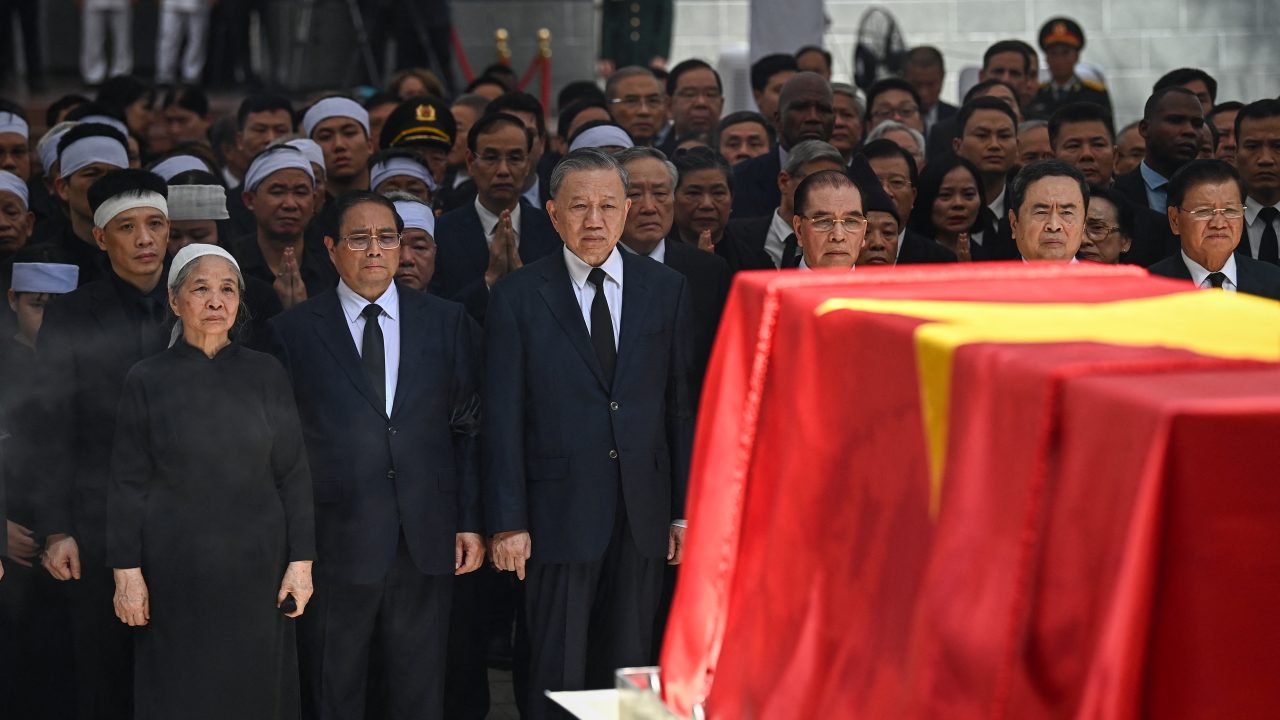
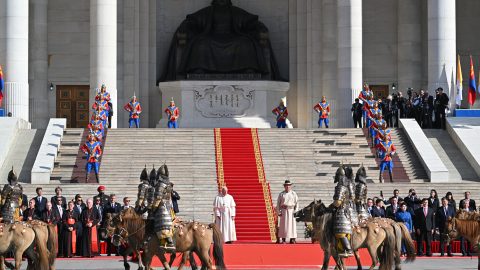
The state funeral of the Communist Party of Vietnam’s General Secretary Nguyen Phu Trong was held on Thursday July 25, 2024. His potential successor, President To Lam, is more authoritarian and his rivals and peers are being purged from the party. Lam is also seen as close to China. How will this affect Vietnam’s international relations?
General Secretary Trong died on July 19. The period before his death was marked by extraordinary turmoil and turnover. In the last two years, many members of the Communist Party of Vietnam’s Politburo were forced to resign. Two of them were president at the time. This marks a stark break from the stability that had previously typified the rule of the party.
On December 30, 2022, Deputy Prime Minister Pham Binh Minh was removed from office. Weeks later in January 2023, President Nguyen Xuan Phuc resigned. One year later in March 2024, his successor President Vo Van Thuong also quit. In April National Assembly Chair Vuong Dinh Hue left office. Finally, in May Truong Thi Mai, the head of the Central Organization Commission, resigned.
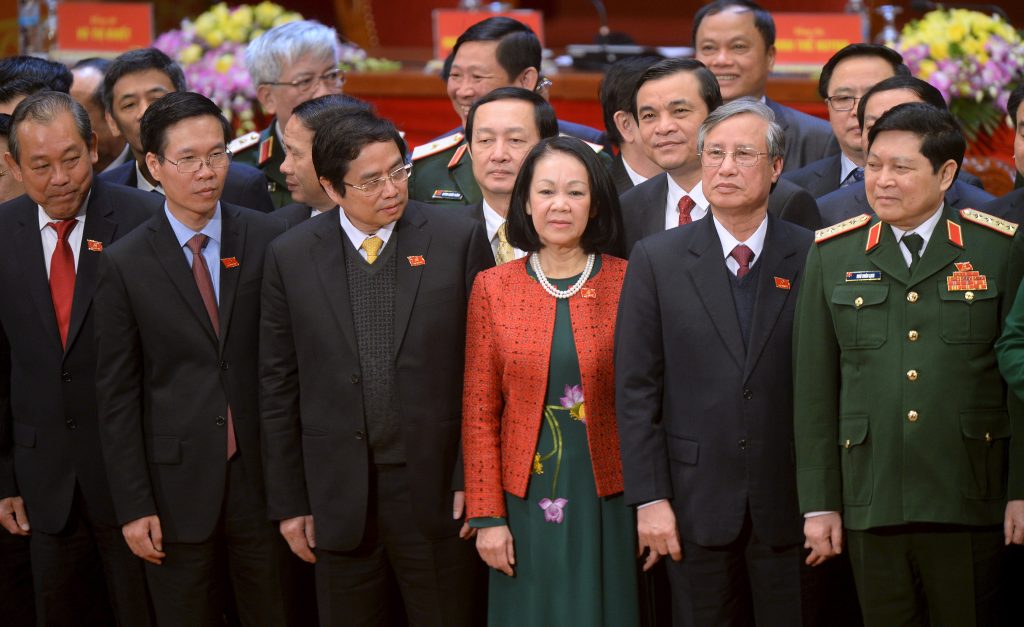
Describing the spate of resignations, Nguyen Khac Giang, a political scientist from Victoria University of Wellington and currently a visiting fellow at the ISEAS-Yusof Ishak Institute, said no leader had resigned in the previous 60 years. The current carnage would have previously been seen as impossible.
Huynh Tam Sang, a visiting scholar at National Taiwan University from Vietnam National University, Ho Chi Minh City, said these resignations are driven by the “burning furnace,” the name of Vietnam’s anti-corruption drive, which has “no forbidden zones.”
Sang explained why he thinks the burning furnace has been raging so high. Firstly, it’s because more cases of corruption are being discussed on social media than before. Secondly, the impact of corruption on construction has led to projects stalling. Thirdly, he said it’s related to the rising power of certain officials.
Corruption is a huge issue in Vietnam. For local government workers salaries are too low, so low-level corruption is completely endemic. At a high level, the sums involved can be astronomical: Truong My Lan, who was recently sentenced to death for fraud, is estimated to have cost Saigon Joint Stock Commercial Bank $27 billion. Zach Abuza, a professor at the National War College in Washington D.C., told me that all forms of corruption are present in Vietnam, including kleptocracy. He also said that recently-deceased General Secretary Nguyen Phu Trong saw corruption as an “existential threat” to the party.
General Secretary Trong was one figure who had sat above all of this carnage. Another is To Lam, the new president who replaced Vo Van Thuong. Lam has drawn attention because he comes from a police background. Furthermore, before he was president he was minister of public security. Nguyen Khac Giang said that although there is no way to be certain, Lam appears to have played a crucial role in the removal of President Thuong and National Assembly Chair Hue. As minister of public security he had the unique power to bring prosecutions, not only against those individuals but also to drive the cases against Thuong’s former subordinates in Quang Ngai province. He has also elevated some of his staff, police generals, from the Public Security Ministry to higher ranks, now that he is president.
After the death of General Secretary Trong, there are only two possible candidates to replace him due to rules about having spent two terms in the Politburo. They are To Lam and Pham Minh Chinh, the current prime minister. Lam took over as acting General Secretary the day before Trong’s death. Trong was due to retire in 2026, at the next party congress.
No one said this to me, but if it’s correct that Lam orchestrated the downfall of the others, Chinh must be sitting quite uncomfortably right now.
What does the rise of President To Lam mean for Vietnam’s foreign relations?
Vietnam has long practiced what the late General Secretary Trong called “bamboo diplomacy.” Vietnamese foreign policy tries to find a balance between multiple great powers, as well as medium powers. In recent years that has meant hedging between the U.S. and China, but historic ties to Russia are still strong, and Vietnam has also engaged at a strategic partnership level with India, Korea, Japan and Australia.
In a piece for Chatham House, journalist and author Bill Hayton argued that the rise of Lam and the police generals shows that Vietnam is making a turn toward repression and control. He suggested this would in turn lead to Vietnam turning toward China and Russia on the international stage and slightly away from democratic countries. The impact on the geostrategic balance in the Indo-Pacific region, where the U.S. and other democracies have courted Vietnam as an ally and partner, would be significant.
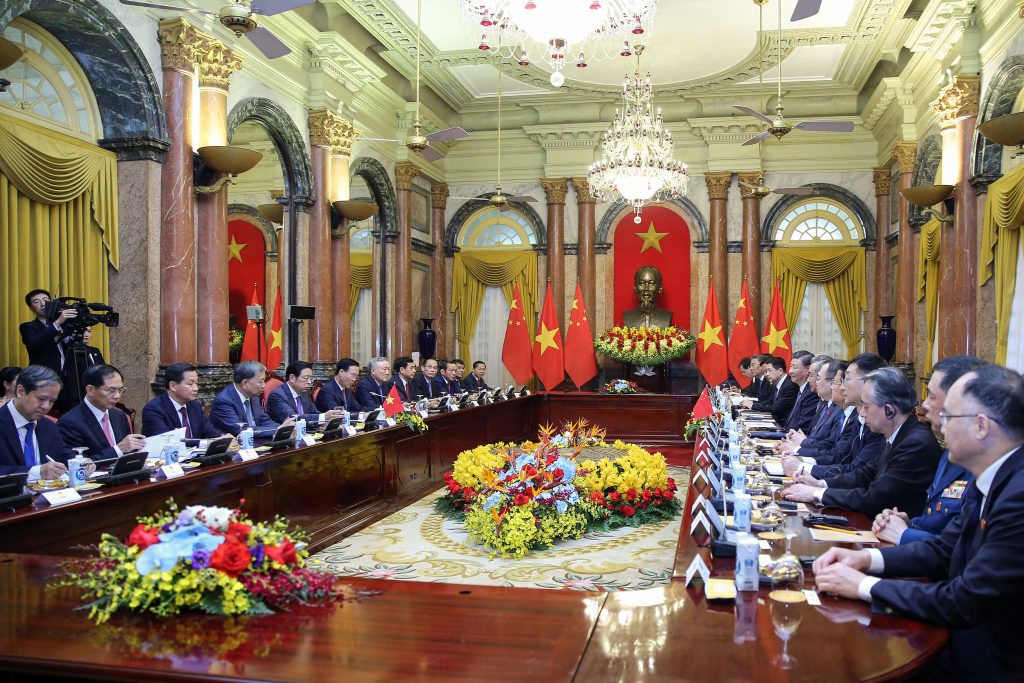
However, others are not so sure. Alexander Vuving, professor at the Daniel K. Inouye Asia-Pacific Center for Security Studies, agreed that Vietnam is turning toward authoritarianism domestically, looking more like China. However, he said this will have no impact on its international stance. Vuving also said China poses a territorial threat to Vietnam in the South China Sea, but the U.S. is a threat to the domestic rule of the Communist Party.
Zach Abuza also disagrees that Vietnam will drift towards China, but this is because he thinks they are already there. “The leadership of Vietnam is pretty pro-Chinese anyway. They share a similar worldview.” Abuza thinks that the West tends to overstate the importance of the South China Sea issue as a wedge between China and Vietnam. He also emphasized that Vietnamese leadership fears regime change and color revolution — these are issues where cooperation with China is natural and long-standing. Even so, Abuza reiterates that Vietnam is studiously neutral in practice.
Vietnam’s foreign policy is the product of a long-term consensus among leadership; both Nguyen Khac Giang and Huynh Tam Sang emphasized this. They don’t think it’s feasible for a new leader to divert from it toward China in a serious way. Giang noted that just before National Assembly Chair Hue was ousted, he went on a visit to Beijing. It’s quite possible that Chinese President Xi Jinping (習近平) will have taken some offense at the timing of that. He sees that as evidence that these domestic changes are not transferring to the international stage.
There are second order consequences of this leadership purge for Vietnam’s foreign relations. International businesses won’t like the uncertainty it produces, nor the fact that officials currently don’t want to sign any contracts due to fear they would be used against them in the future, according to Sang. Furthermore, the crackdown on mid-level officials has not only directly reduced the number of technocrats in Vietnam’s Ministry of Foreign Affairs, Giang told me, it’s also led to 100,000 public officials across all sectors leaving their roles since 2021.
Alexander Vuving left me with a very different ending scenario. He thinks that bamboo diplomacy could collapse, but in the opposite direction, with Vietnam making a sudden turn away from China. He outlined two scenarios. The first is a serious flare-up in the South China Sea over features that Vietnam controls. Hanoi is watching what happens around the Second Thomas Shoal very closely.
The second scenario is over Cambodia. This is in part due to the Chinese presence at Ream Naval Base, but especially the Funan Techno Canal, which is financed by China. Vuving says Vietnam has concerns about the ecological and agricultural impact of the canal on the Mekong Delta, the so-called Rice Bowl of Vietnam. More than this, he pointed to what Vietnamese see as a “break in reciprocity” between Cambodia and Vietnam over the construction of the canal, where one has not consulted and considered the other when pursuing their interest over the river the two share. He said eventually it could come to a point where Vietnam feels enough is enough.
In the short term, many will be watching Hanoi to see how the party responds to the death of Trong. Will any more big names resign? After that, and especially after 2026, careful analysis might be needed to see which way the wind is blowing. Or alternatively, it might be very obvious





Leave a Reply