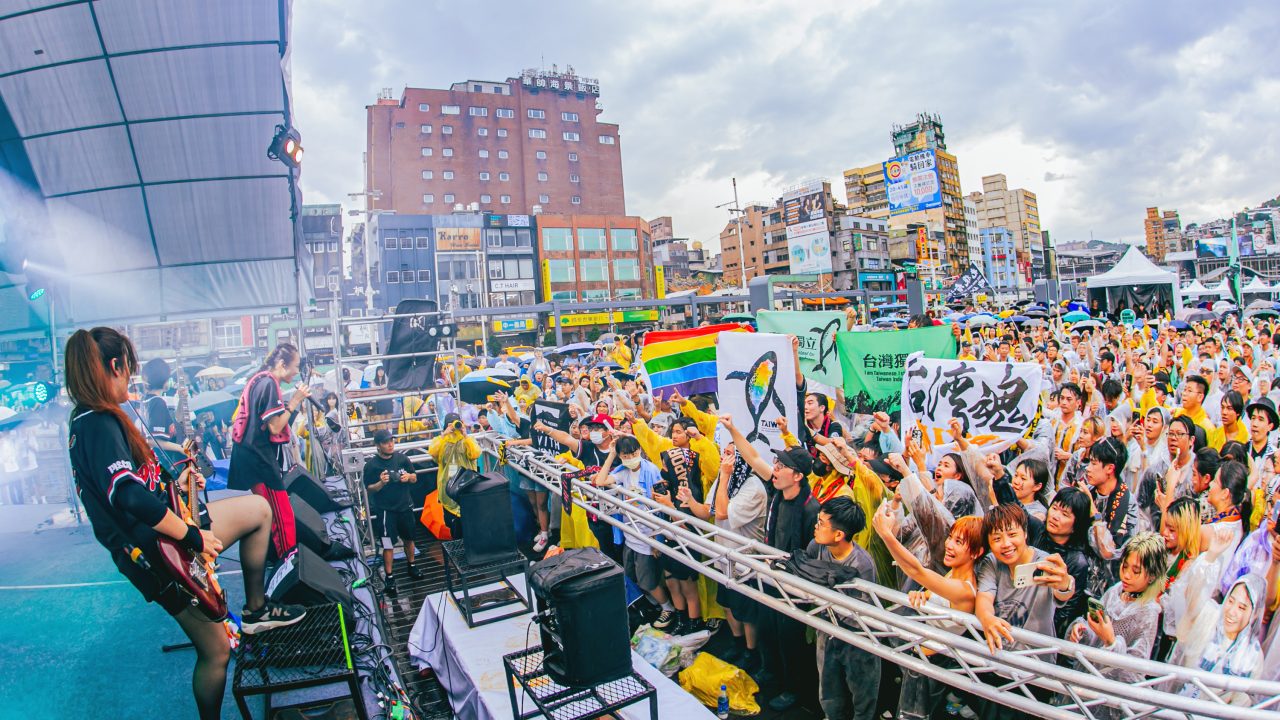
On the small stage of the Formoz Festival in 1997, Taiwanese band Mayday (五月天) made their first public appearance as a group of young and energetic indie musicians. Almost three decades later, they would become one of Asia’s most popular Mandarin-speaking bands.
Many long-term Taiwanese fans were shocked to learn that during Mayday’s concert at Beijing National Stadium this summer, lead singer Ashin (阿信) referred to himself and the band as “Chinese people.”
Ashin: “We Chinese people must eat roast duck when we come to Beijing!”
“At first I thought it was a misunderstanding, but then I saw the full video clip and had to believe it,” said Tseng Kai Lin (曾鍇璘). Now 32, Tseng has been a fan of Mayday for over a decade. She identifies as Taiwanese and was especially disappointed because Ashin uttered his “we Chinese” statement around the peak of the Blue Bird Movement (青鳥行動), a protest in Taiwan in response to a series of controversial parliamentary reform bills, for which Tseng had donated food and supplies in a show of support.
During the Blue Bird Movement, protesters could hear the song Island’s Sunrise (島嶼天光) playing on every corner. The song was written a decade ago by Taiwanese indie band Fire EX. (滅火器) for the student-led Sunflower Movement, a protest against a cross-strait services trade agreement that the protesters believed would have made Taiwan more vulnerable to Beijing. Even though this was not the first time indie bands have lent their voices to social issues, Fire EX. has since become an important figure in Taiwanese activism. Rachel (芮秋), head of the band P!SCO, cited outspoken musicians like Fire EX. as her role models. As a transgender woman, she is an advocate for LGBTQ+ rights and Taiwanese sovereignty, but she has noticed a change in attitude among younger musicians. “Ten years ago, if you went to a music festival, almost every band would be talking about social issues on stage,” she said.
The line between mainstream and indie music has only become more blurred over the last two decades. In most countries, that might mean more interesting collaborations between mainstream and indie musicians, but in Taiwan, there’s another layer to it: the potential to break into China’s huge market. Musicians must now consider how to appease Chinese fans and authorities.
Mainstream or indie, there has always been an appetite for Taiwanese music in China. According to Xiaodaomusic (小島音樂速報), a Chinese blogger who writes about Taiwanese music, around 120 Taiwanese artists performed in China in 2023, the highest number since 2018. Among these artists, Taiwanese indie band The Chairs (椅子樂團) performed the most in China, 54 times in the same year. The allure of the Chinese market is difficult to resist, but it is not without its risks. The authorities can cancel shows at the last minute without giving a clear reason, and an honest mistake such as saying “we’re happy to be in China for the first time” can get a band boycotted by their co-performers. “It’s almost impossible for indie bands to only operate in Taiwan and still make a living, not without a side gig,” Chang Achino (張瀚中) said. He is now a seasoned keyboardist who has been touring in China with popular singers for more than a decade. He stressed that he is still involved in indie music in Taiwan — he’s one of the frontmen for the band Nighteentael (十九兩樂團), among other roles — but most of his income now comes from playing the keyboard for other artists.
Olivia, an indie band agent who asked to use her real name, makes plans for her artists to break into the Chinese market when they first join her label. The first band she represented toured in China last year. While she used to be more political on social media, she started posting less and less after becoming an agent. “I don’t believe this is self-censoring, this is to ensure the safety of myself and my colleagues,” she said. She said she still holds the same beliefs, but instead of talking about them openly, she only shares them with friends and family. Lin Chenyu (林真宇), a lecturer at the School of Journalism, Media and Culture at Cardiff University, describes such hesitations as a “complicated version of freedom.” She stressed that even though Taiwanese musicians don’t face harsh repercussions at home for their political stances, their artistic expression is often limited due to the unique nature of longstanding business practices between Taiwan and China.
Nonetheless, some Taiwanese indie musicians are still trying to find ways to survive without China. The band Sorry Youth (拍謝少年) is on China’s blacklist. In 2019, they participated in a concert to support the pro-democracy protests in Hong Kong. Soon after, they found out that their music had been pulled from all Chinese platforms. Shawn Hsu (許瀧尹), Sorry Youth’s agent, noticed that many Chinese fans discovered their music using VPNs after the pandemic. They enthusiastically messaged the band on Facebook, asking when they would visit China. “They probably didn’t know there was a reason why they couldn’t find us within the Great Firewall,” he said. Lin, the media lecturer, explained that forgoing the market in China is not an easy path. Touring outside of the Mandarin-speaking circle means that not only do they have to overcome the language barrier, but also the cost of touring increases. “People might see musicians [who gave up the Chinese market] and think it’s great that they’re so free and brave, but they probably wouldn’t envy the lifestyle,” she said. Taiwanese musicians need to walk a fine line between cross-strait tensions quite early on in their careers. Olivia expressed similar concerns. She said if she signed a band that wanted to talk about politics on social media, she would try and talk them out of it. “You never know what will happen in the future,” she said, before giving examples of people whose online presence led them to be labeled as “pro-independence” by Chinese netizens.
“It’s not just in this industry. I believe it’s probably the same for others as well,” Olivia said. “This is part of being Taiwanese. I can only try to accept that.”
Many see this phenomenon as a generational difference rather than a problem that only the music industry faces. “I can understand why younger generations wouldn’t want to take a stand on social issues,” Rachel (芮秋) said, while admitting that she would also find the opportunity to perform in China appealing. “But I can’t stay silent. The more people choose to shy away from this, the more reason for me to keep talking.”
Younger generations of Taiwanese people are not so anxious about China anymore, Shawn Hsu, Sorry Youth’s agent said of the Bluebird Movement. Instead of seeing young students, he mostly saw people around his age, who described themselves as the “Sunflower Movement generation.” But he chose to see the age demographics at the protest in a positive light. “I see it as a good sign. This means this generation is more comfortable than before. They can make music that’s purely for entertainment without worrying that [their country] might be annexed.”
He paused for a second. “But for me, I can’t get used to that type of music. My favorite is still rock.”
This article was updated on January 6, 2025 to correct information in the second-to-last paragraph that was omitted due to an editing error. The sentence: “Younger generations of Taiwanese people are not so anxious about China anymore, Shawn Hsu, Sorry Youth’s,” was corrected to: “Younger generations of Taiwanese people are not so anxious about China anymore, Shawn Hsu, Sorry Youth’s agent said of the Bluebird Movement.” The correction was made to complete the attribution for Shawn Yu and to indicate who Yu was speaking about.




Leave a Reply