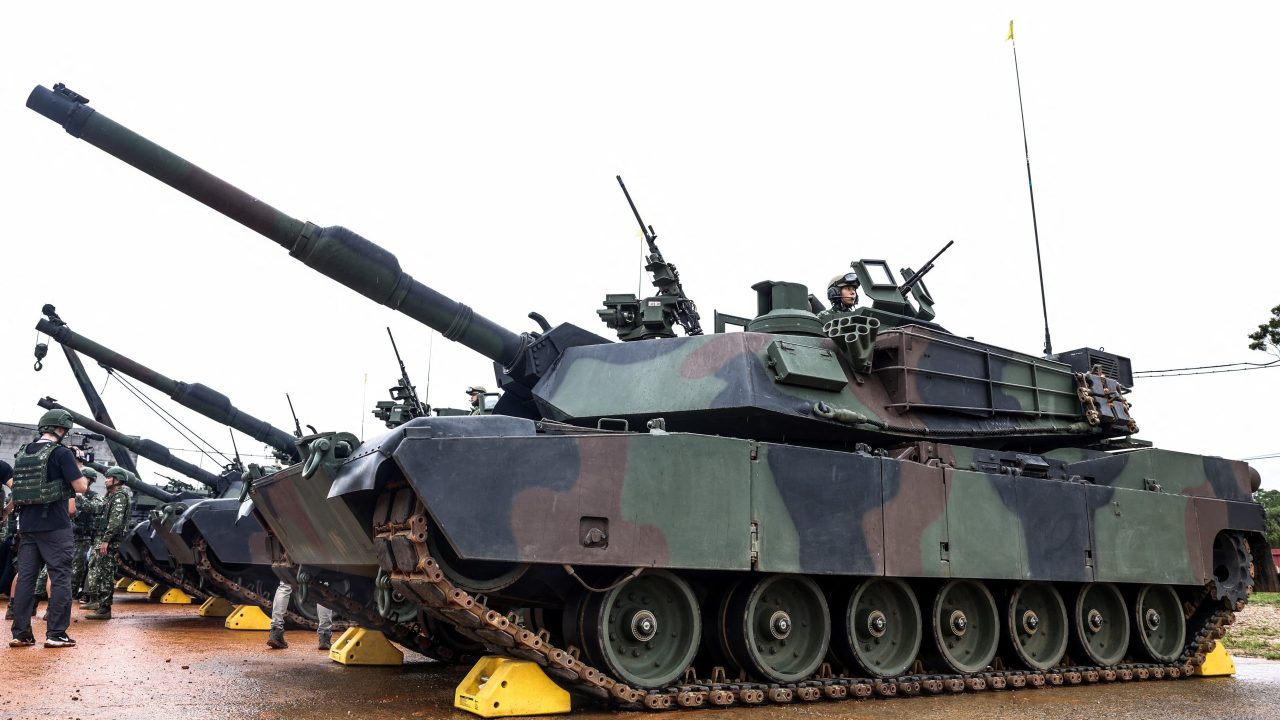
Taiwanese society is heavily divided on one of its hottest political topics: increasing defense spending.
New public opinion polling by the Election Study Center at National Chengchi University found that while 40.7% of respondents support increasing the defense budget, 41.1% would rather maintain it at its current level, and 10.5% favor decreasing it.
Thus, while decreasing military spending is deeply unpopular, there is no majority support for the government’s policy to increase the defense budget from 2.38% to 3.32% of GDP this year.
The Taiwanese public are not sure about the consequences of increasing defense spending, said Tsai Chia-hung (蔡佳泓), who presented the still-unpublished results at the 2026 East Asia Democracy Forum in Taipei yesterday. Tsai, an expert on Taiwanese electoral politics at National Chengchi University, thinks respondents cautiously preferred perceived middle-ground options in the questions presented.
For this survey, Tsai conducted 1,333 telephone interviews with Taiwanese residents aged 20 and above. The interviews were conducted between November 25 and November 30 last year. Those dates are significant, because November 25 was the day that President Lai Ching-te (賴清德) published an editorial in The Washington Post announcing a planned $40 billion special defense budget. Coverage of that announcement was thus developing during the sampling period of this poll.

Apart from the topline figures about support for increasing, maintaining or decreasing the defense budget, the breakdown in the numbers in Tsai’s presentation contained a lot of interesting, more granular results.
Public opinion on this defense spending is highly polarized by political affiliation. Increasing the defense budget polled at higher than 80% among “green” respondents, who either identify with Lai’s Democratic Progressive Party (DPP) or other pro-Taiwanese identity parties. But a spending increase got less than 20% support among “blue” respondents, those who favor the Chinese Nationalist Party (KMT) or other pro-Chinese identity parties. For Taiwan People’s Party (TPP) supporters, the “increase defense spending” figure sits just below 25%.
What will concern supporters of the defense spending increase, which includes most of Taiwan’s international partners and friends, are the numbers for independents, those Taiwanese respondents who in theory are undecided. Only a little over one-third of them support an increase to the defense budget.
For blue, TPP and independent respondents alike, maintaining the budget at its existing level substantially outperformed decreasing it. And among all three, a preference against taking a stance can be seen. When asked to express their support for increasing or decreasing the budget on a sliding scale from zero to 10, the most popular option for TPP and independent respondents was the “neutral” five.
Blue respondents were more likely to select the neutral option when asked about decreasing the budget, but did show preference for opposing an increase. In contrast, for green respondents there was a strong preference to oppose a decrease in defense spending and support an increase.
Two other interesting findings: There was less opposition toward a spending increase among young people, and more than 75% of respondents disagreed with the idea that decreasing the defense budget reduced the risk of war.
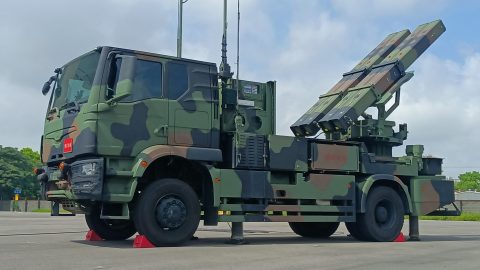
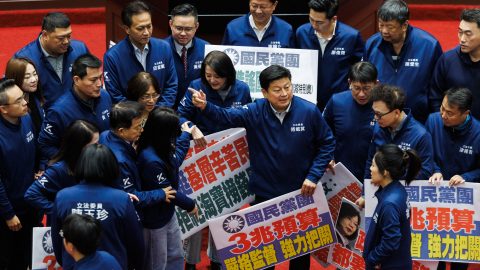
Lai’s administration announced last year that Taiwan would increase defense spending to 3.32% of GDP in 2026, and continue to increase it to 5% by 2030. The $40 billion special defense budget that Lai announced last year would have been spread over eight years as part of these increases. But that special budget was effectively blocked by Taiwan’s legislature, controlled by a coalition of the KMT and TPP. After a protracted debate, as much internal to the KMT as it was external to legislators from different parties, the legislature passed a reduced $24.8 billion special defense budget last month.
All major parties in Taiwan support some increase in defense spending. The disagreement has been around how much. These findings may challenge that and invigorate those in the KMT who oppose any increase.
There is a sharp domestic political ceiling for any sitting Taiwanese administration to increase defense spending, Tsai argued at the East Asia Democracy Forum yesterday. “Pushing for massive, rapid budget spikes risks severe domestic political backlash” those who prefer a steady state, he wrote on one slide that was briefly available to the audience.
The data suggest Taiwan’s partners should “focus less on publicly pressuring Taiwan to increase raw budget numbers, and more on maximizing the efficiency of the existing budget,” Tsai concluded. That will be a hard sell in Washington, where Elbridge Colby, Trump’s undersecretary of defense for policy, has said that Taiwan should increase defense spending to 10% of GDP.
Domino Theory received a copy of Tsai’s presentation slides to assist with this article, but no access to the underlying data.



Leave a Reply