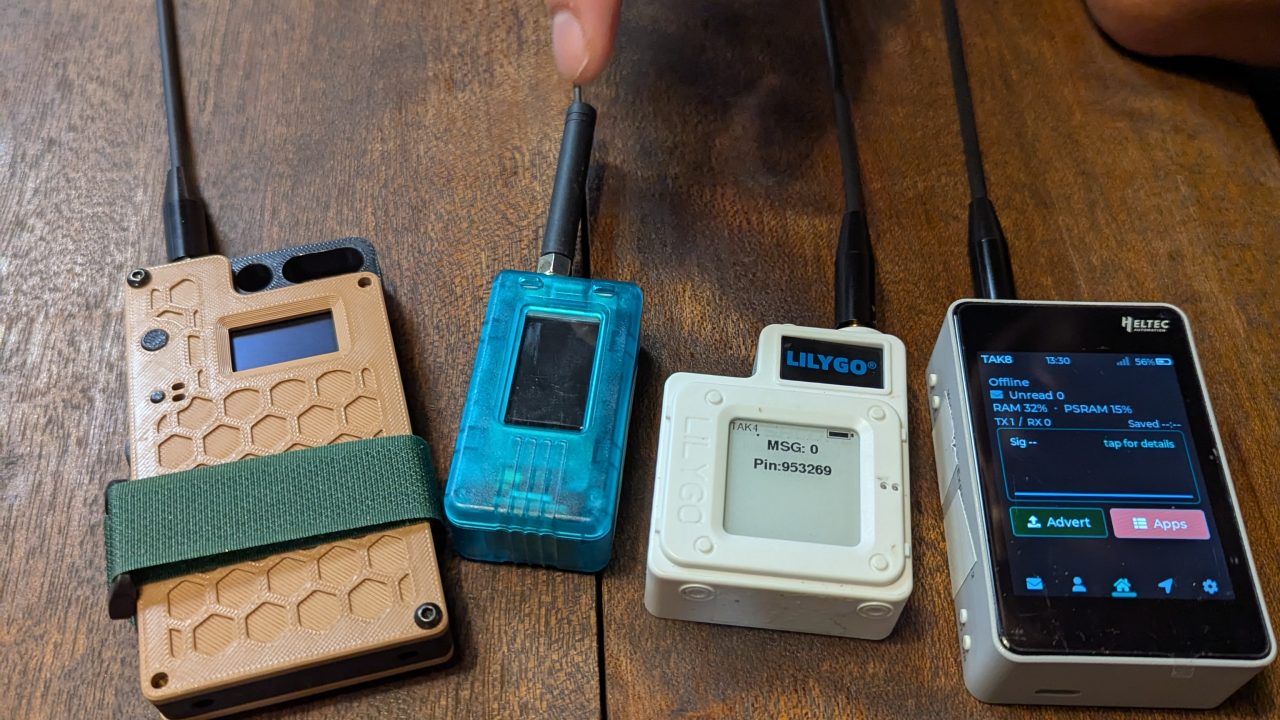
When mobile connections in parts of Taiwan were throttled to text-only speeds during urban resilience drills earlier this month, local officials in Yunlin County tested a backup, a decentralized network built on an open-source protocol that could keep essential messages flowing without relying on cell towers or the internet.
Yunlin County officials said the drills marked the first time a Taiwanese government agency has deployed the open-source protocol, called Meshtastic, at scale as part of a resilience drill, indicating a growing interest in cheap, off-the-grid communication tools as Taiwan prepares for scenarios ranging from natural disasters to a Chinese blockade or invasion.
Meshtastic is a low-power, long-distance wireless technology that enables small, smartphone-sized devices to transmit encrypted text messages and GPS coordinates. To create a network, users pair a low-power radio node with a smartphone via Bluetooth using a dedicated app, allowing them to communicate without relying on cell service or the internet. In Taiwan, these devices typically operate on a low-frequency radio band that does not require a license.
T.H. Schee (徐子涵), a crisis response expert and radio operator who has been demonstrating Meshtastic devices to journalists and civil defense groups, said he learned about Meshtastic through contacts in Ukraine after the Russian invasion and decided to promote it in Taiwan after discovering a growing local community of enthusiasts.
Schee said hikers have set up Meshtastic nodes on mountains to track group members’ locations, monitor trail conditions and maintain contact in areas without cellular service.
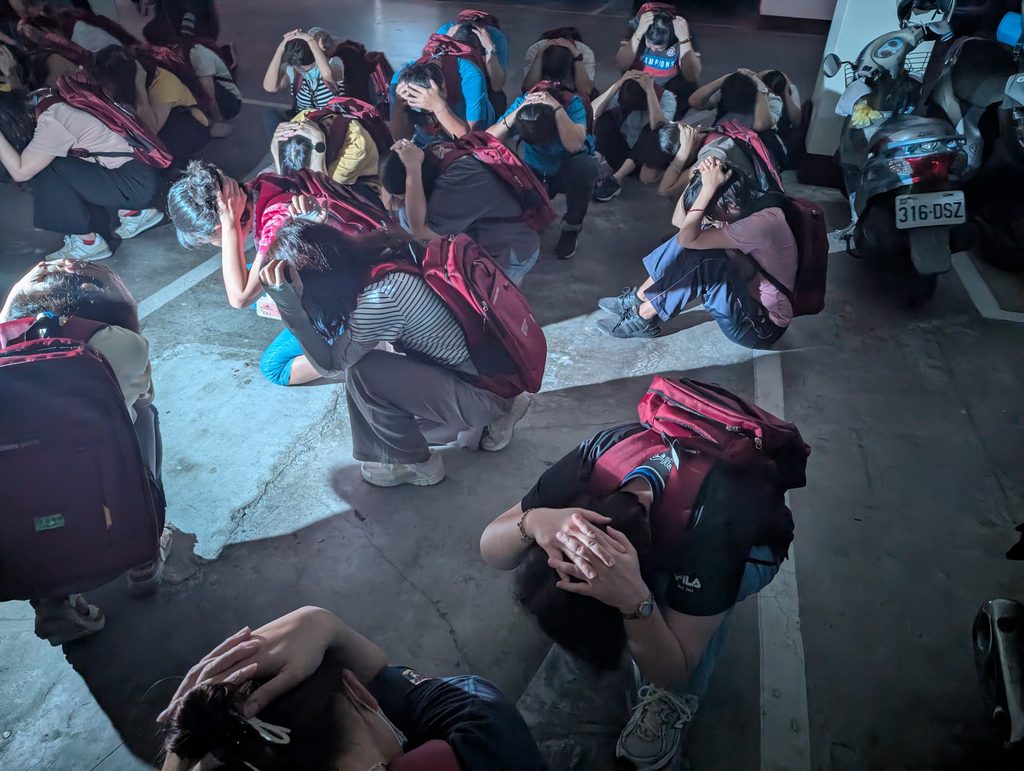
Yunlin County’s Police, Health and Education Department jointly operated 118 Meshtastic devices during Taiwan’s first network slowdown drill on August 10. The county said it worked with Meshtastic enthusiasts and the open-source hardware community to source devices outside China’s supply chain.
Liu Yu-hsi (劉玉皙), an associate professor at Shih Hsin University, said Yunlin County’s deployment of Meshtastic was significant because it showed that some local governments are becoming actively engaged in resilience planning and are working with civil society in unprecedented ways.
“Do civil servants know how to use Meshtastic? Of course not. So they worked with civilian groups to help them set it up,” said Liu, who is also a member of the Presidential Office’s Committee on All-of-Society Defense Resilience. “In the past, this was very rare. The Ministry of National Defense would exclude civilian participation. But this time, there were many invitations for civilians to participate in the drills.”
“It took them only a few weeks to decide and implement the system.”
Ching Fu-hsiang (荊輔翔), a drone engineer who has given talks on Meshtastic at civil defense events, said his entry into decentralized networking was driven by technical curiosity rather than national security.
“I want to be clear, I didn’t start using Meshtastic for civil defense,” said Ching, who set up two Meshtastic devices at his old company’s factory in rural Chiayi. “I found this technology while trying to solve communication problems for sensors and thought it was fun. The fact that it became part of the civil defense conversation is just coincidental. I’m just doing what I find interesting.”
Ching said the technology has significant limitations. In open terrain with clear line-of-sight, low-power radio devices can relay text messages dozens of kilometers without cell towers or the internet. In dense cities, the same devices struggle to reach beyond 200 meters.
“I don’t think we will ever [fully] depend on it,” said Ching. “But having an extra option is never a bad thing.”
Use of Meshtastic in Taiwan has grown through informal networks and occasional workshops. The Meshtastic Taiwan Community Facebook group grew from about 50 members in early 2024 to nearly 22,000 users today.
Civil defense organizations including Ganghu Civil Defense Group, Kuma Academy and Forward Alliance offer Meshtastic training as part of disaster preparedness courses.
Over 1,000 Meshtastic devices are actively operating across Taiwan as of June; one device installed in Taipei 101 provides wide signal coverage across the capital. Ching estimates coverage now extends to 80% of the island.
Liu, the professor at Shih Hsin, sees Meshtastic being used for a civilian radio communication network with relay stations hosted by non-profit organizations such as churches, as communication networks run by the government would, of necessity, prioritize military and emergency communications over civilian needs during crises.
“Meshtastic and the government’s system should be two parallel tracks that don’t interfere with each other,” Liu said.






Leave a Reply