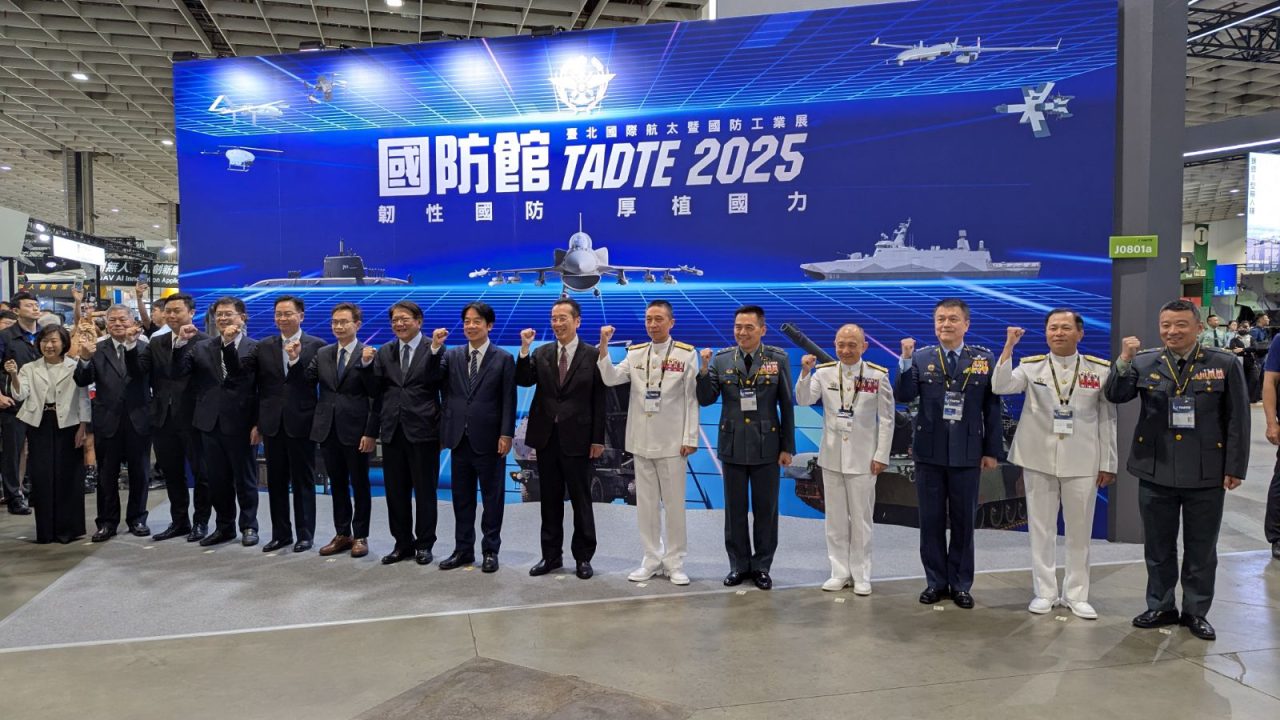
The Taipei Aerospace & Defense Technology Exhibition, or TADTE, will run through Saturday. Defense companies from Taiwan and around the world are showing off their latest tech, with space and drone startups taking center stage.
We’ll be on site all three days, searching for the most interesting new equipment and capabilities. Check back here for more highlights to come.
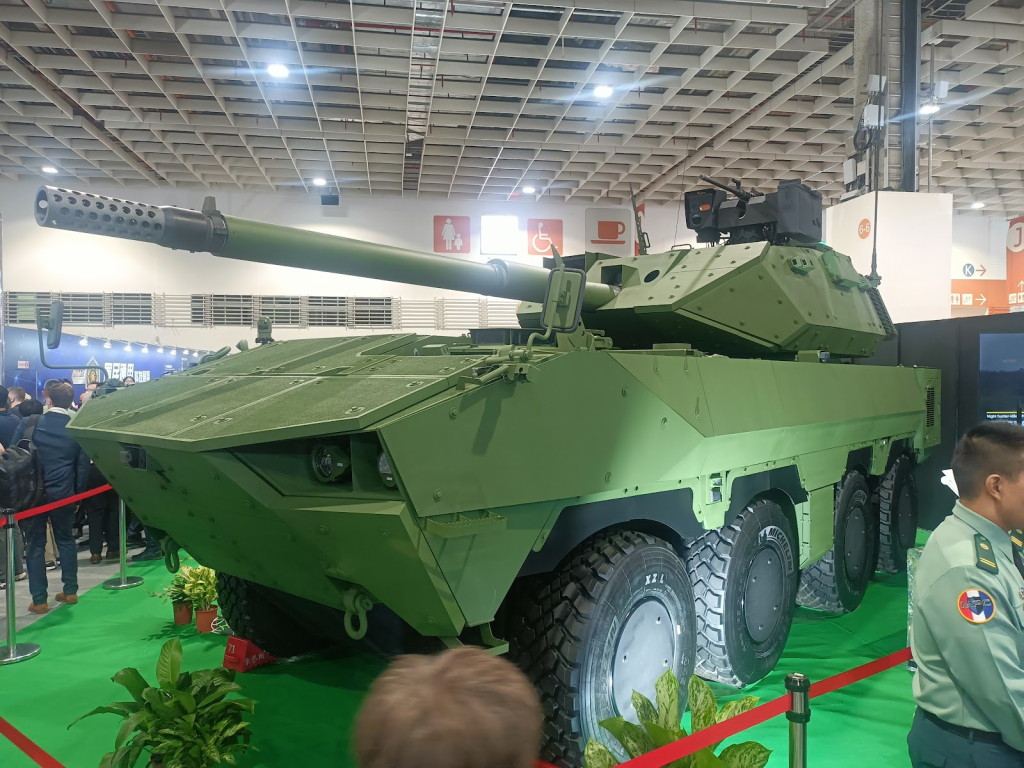
105-Millimeter Mobile Assault Gun
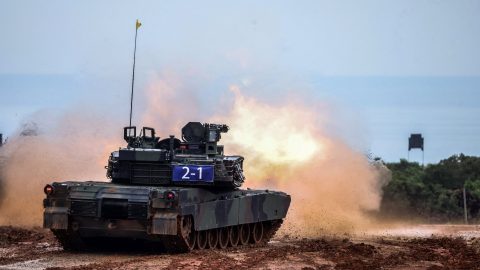
The Clouded Leopard variant with a 105-millimeter main gun that Taiwan had announced it was not moving forward with is back. The new D3 prototype is shorter, with a height of 3 meters instead of 3.3.
The D3’s main gun can penetrate 50 centimeters of armor, using a sabot round. The D2 prototype was criticized for not having a powerful enough gun. It is unclear if the thinking within Taiwan’s military has changed or whether this prototype will also not win the favor of the army, which has not ordered it yet.
Strong Bow
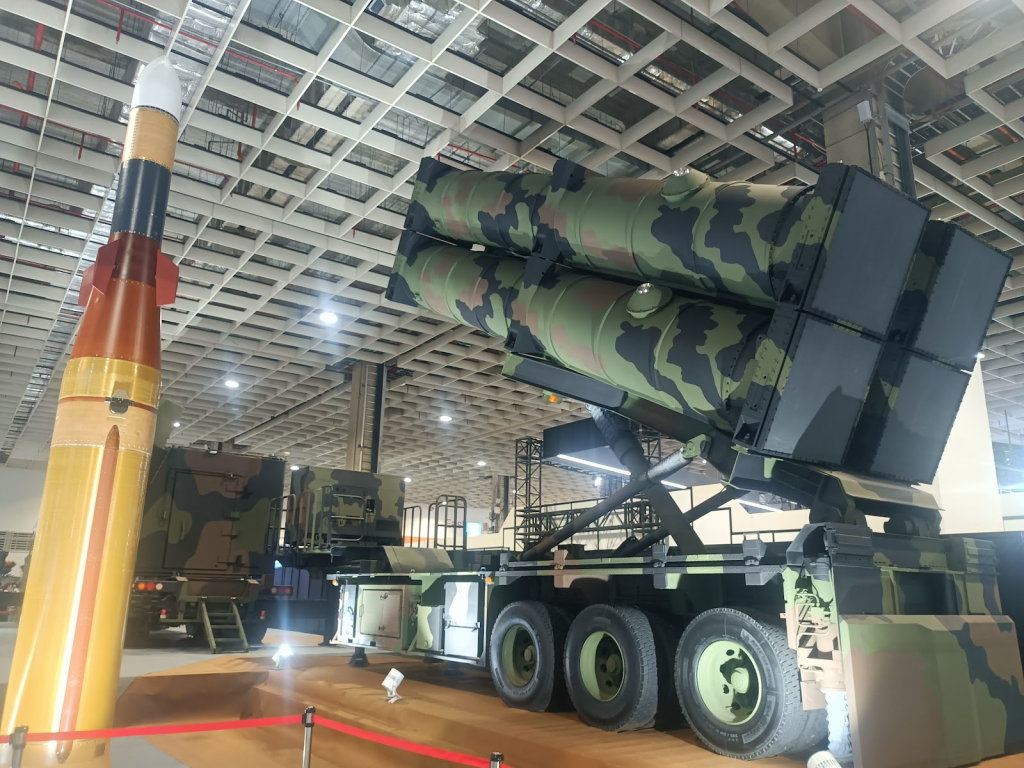
TADTE gives attendees the first views of the new Chiang Kung (強弓), or “Strong Bow,” air defense system. Domino Theory was explicitly told it will not be called Tian Kung IV (天弓四). Chiang Kung is a mid-level anti-ballistic missile system, with the ability to intercept incoming missiles at an altitude of 70 kilometers. In this respect it would substantially outperform the anti-ballistic Patriot variants Taiwan currently fields. Its horizontal range was not disclosed. Its active electronically scanned array, or AESA, radar is substantially more powerful than those currently in service, but when operational it will be networked so that all missile systems can receive data from all radars.
The Chiang Kung missile and launch canister is visually much larger than the Tian Kung III and Tian Kung II, Taiwan’s current indigenous long-range air defense system.
It is a two-stage rocket with active homing, meaning it can track its target itself, and thrust vector control, meaning it uses its rocket motor to maneuver in its terminal phase. The Chiang Kung does not have attitude control motors.
The missile has a warhead rather than being hit-to-kill. The warhead is selective, meaning the missile can decide whether to focus the blast forward or fragment in all directions, based on where the target is.
Chiang Kung is projected to be more expensive than Tian Kung III and cheaper than Patriot.
Mighty Hornet III
Mighty Hornet III is an anti-armor uncrewed aerial vehicle, or UAV, designed to be effective against main battle tanks on land and against amphibious assault vehicles on land and in the water. It has an X- wing design which allows for lateral movement in flight, and can take off and land vertically. This is intended to allow operations without dedicated launch infrastructure. The range is 50 kilometers and the endurance is 40 minutes. The Mighty Hornet III’s main structural components are 3D printed for cost and speed.

Barracuda 500
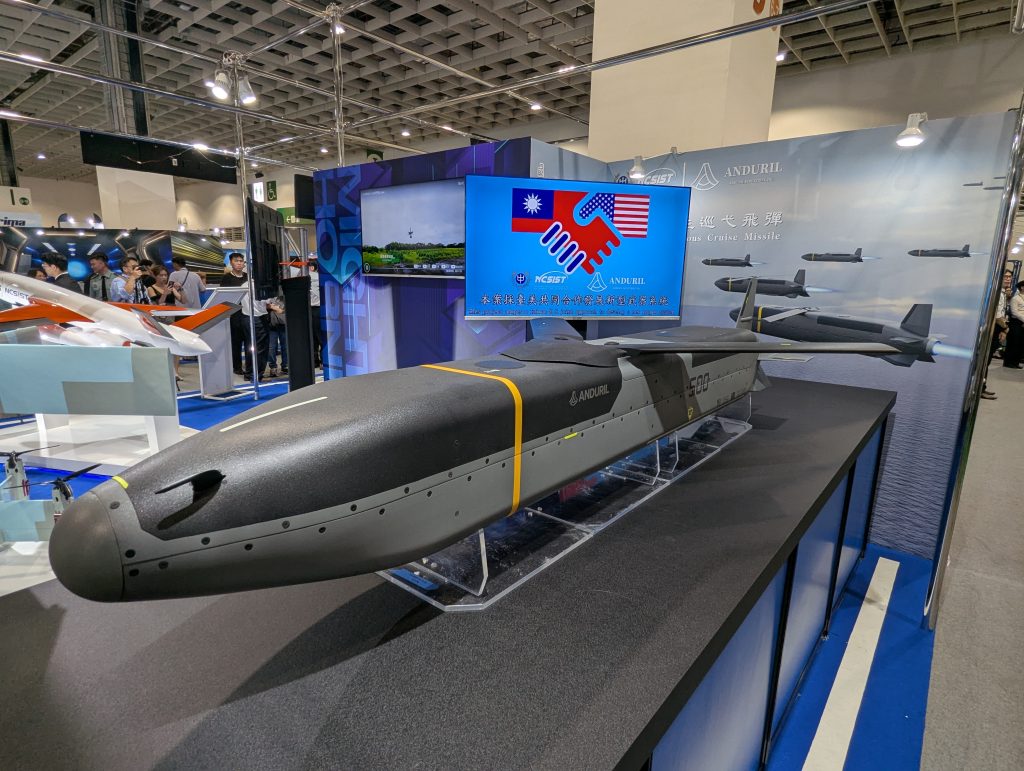
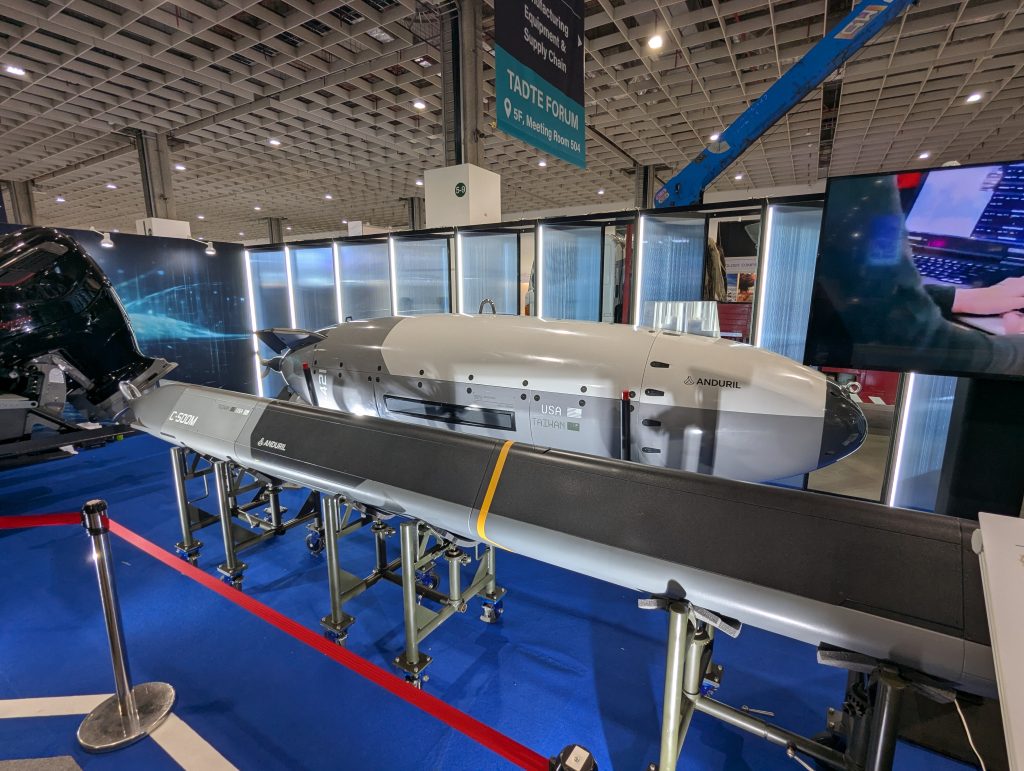
The Barracuda 500 is the largest variant in Anduril’s newly unveiled Barracuda family of low-cost, modular, air-breathing autonomous air vehicles, or AAVs, essentially software-defined cruise missiles designed for mass production and rapid upgrades. Introduced in September 2024, the Barracuda series emphasizes affordability (30% cheaper than competitors), hyper-scale manufacturing (using fewer than 10 tools per unit and 50% fewer parts), and adaptability via swappable subsystems for easier export and ally integration.
The Taiwan-U.S. collaboration on the Barracuda missile system highlights four key aspects: modular production for rapid and cost-effective manufacturing, large-scale deployment for enhanced battlefield effectiveness, a ship-launched variant tailored to Taiwan’s needs for concealable and flexible operations, and autonomous cooperative swarm attack capabilities for mission-oriented targeting. With a target cost of NT$6.5 million (around $215,726), significantly lower than typical cruise missiles, the project is in the planning phase, with the U.S. having approved export permissions and ongoing reviews of technical agreements. Anduril, valuing Taiwan’s chip manufacturing strength and cooperative capabilities, aims to produce the system locally, to meet Taiwan’s military needs and possibly export to markets like the U.S. or Europe in the future.
A Baltic Innovation for Sea Mines
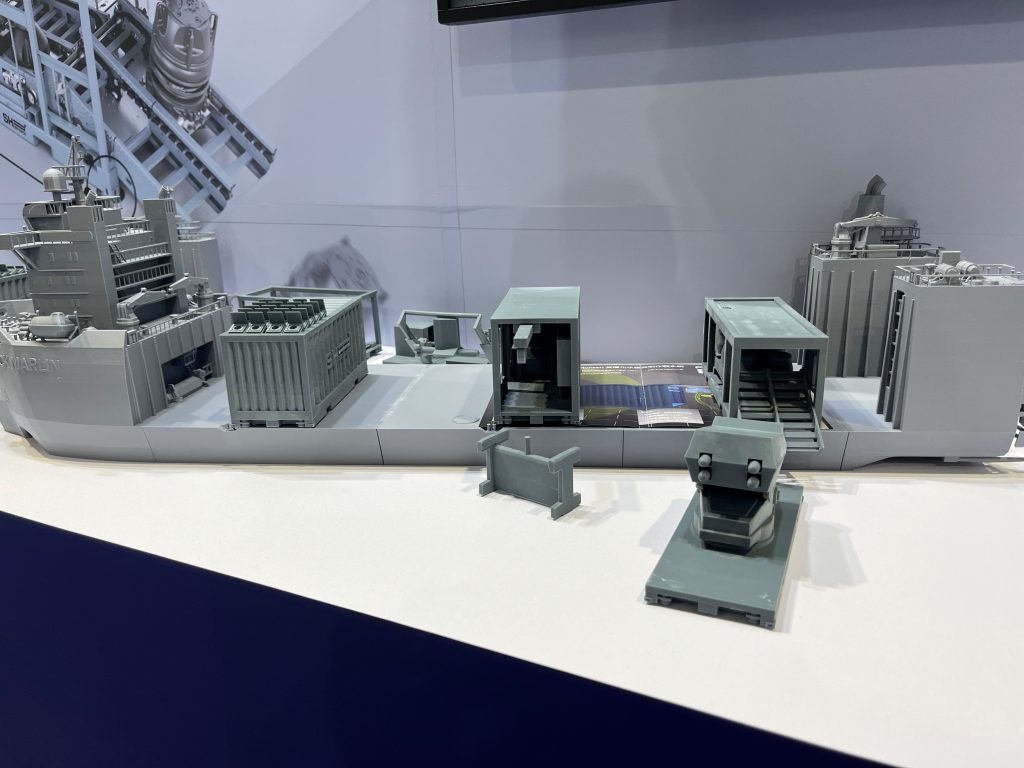
Twenty years ago, Denmark’s mine-laying ships were some of the most advanced in the world. Now, most of them have been decommissioned. “Nobody can afford to make single-use ships anymore,” says Peter Liisberg, sales director at SH Defense, a Danish company occupying a modest stall at TADTE.
SH claims to have found a solution: a modular system that can transform any ship into a mine-layer. Liisberg says mine-laying is still relatively uncommon in the Indo-Pacific, but he expects it to start accelerating by next year.
Domino Theory asked Liisberg why, after years spent in the oil and gas industry, SH started working on mine-laying. “We had a troublesome neighbor,” he said.
A Squeaky Clean Supply Chain
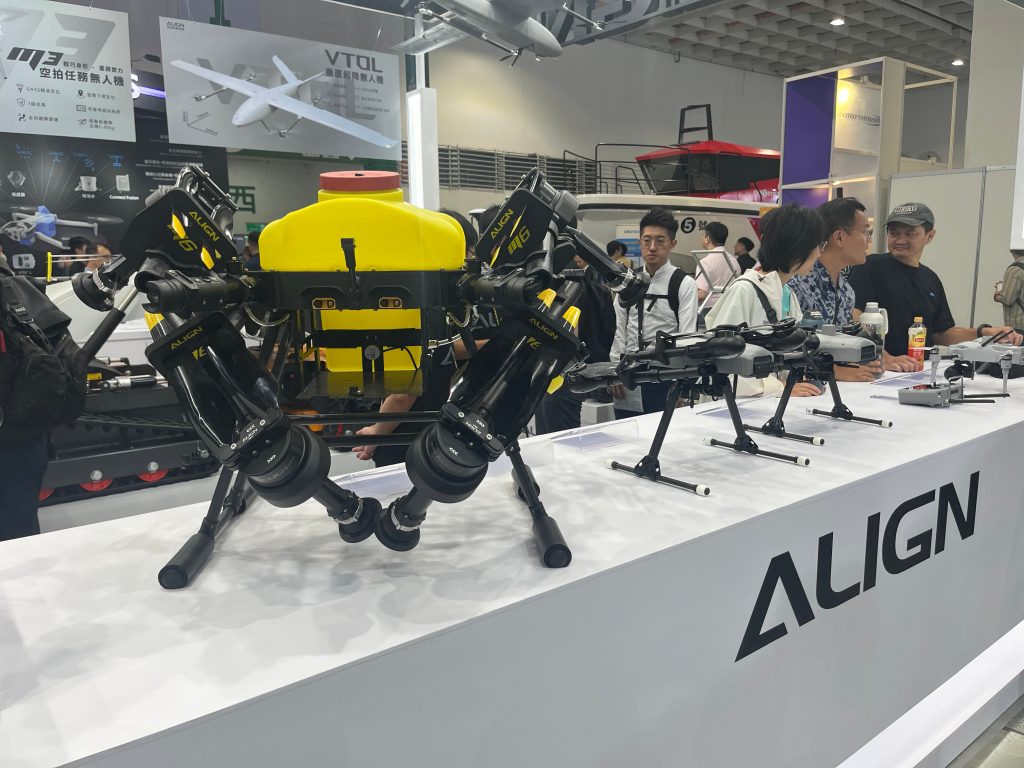
What do vacuum cleaners have to do with national defense? Align started manufacturing motors for them in 1987. Today, their experience making small components helps them build drones that meet the Taiwanese government’s demand for a “red-free” supply chain.
China dominates the market in battery manufacturing, but Align makes their own batteries too. Having so many components made in-house is a crucial advantage for Align, says Katrina Tu (杜怡德), who designed the posters at the company’s booth.
Most of the company’s business is still in the civilian market, but as many companies at TADTE have realized, the transition to military application can be surprisingly simple. An aerial drone designed for putting out fires can be rigged with an explosive that starts them. The body of a ride-over lawnmower can be repurposed for military bulldozing.
But not without first giving it a new coat of camouflage paint.
Big Drone or Big Brother?
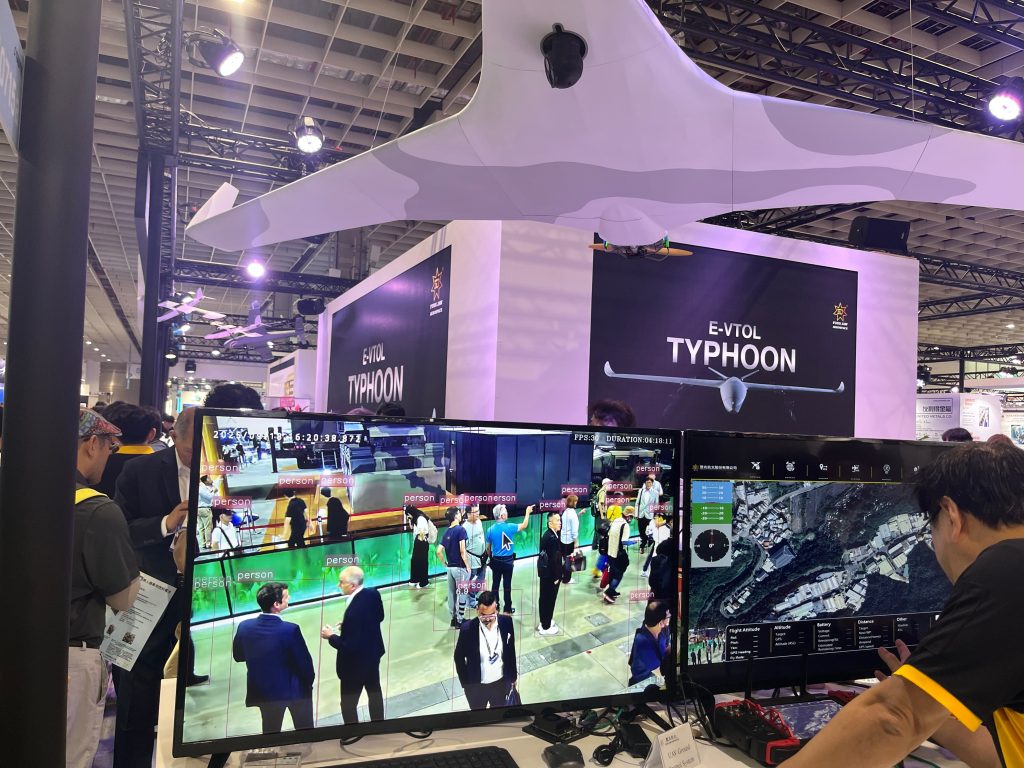
One common sight at TADTE are demonstrations of surveillance equipment on the expo’s visitors. At Fong Jaw Aerospace’s booth, a monitor tracks people in real time using image recognition. Overhead, Domino Theory spots the culprit: a sleek, white aerial drone with a camera strapped to its underbelly.
So far, it’s only labeling humans, but Jack Li (李承晨), one of Fong Jaw’s AI engineers, says the algorithm can track all sorts of things. Dogs? Yep. Cars? Yep. Missiles? No, not this one, Li says. Our military division is over there.
He grabs the mouse and clicks on the image of a man behind us, who is now framed by a red rectangle as he walks away.
DIVE-LD and Copperhead
The Dive-LD autonomous multi-purpose underwater vehicle features a modular design with integrated sensors, measuring 5.8 meters in length and 1.2 meters in width. Its compact size allows for rapid 3D-printed manufacturing and customizable payload adjustments. Performance details indicate it can operate continuously for 10 days and dive to a maximum depth of 6,000 meters, making it highly capable for tasks such as seabed mapping, inspecting underwater cables and offshore wind power infrastructure, and supporting deep-sea rescue and recovery missions.
The Copperhead autonomous mine builds on existing smart mine technology, integrating the company’s autonomous underwater vehicle capabilities. Powered by artificial intelligence, it aims to deliver flexible deployment, multi-sensor integration, and an open command-and-control architecture for enhanced underwater attack capabilities. Beyond functioning as a mine, it also possesses torpedo-like combat features, offering dual-purpose functionality that strengthens underwater warfare strategies, boosts overall combat effectiveness, and enhances deterrence.
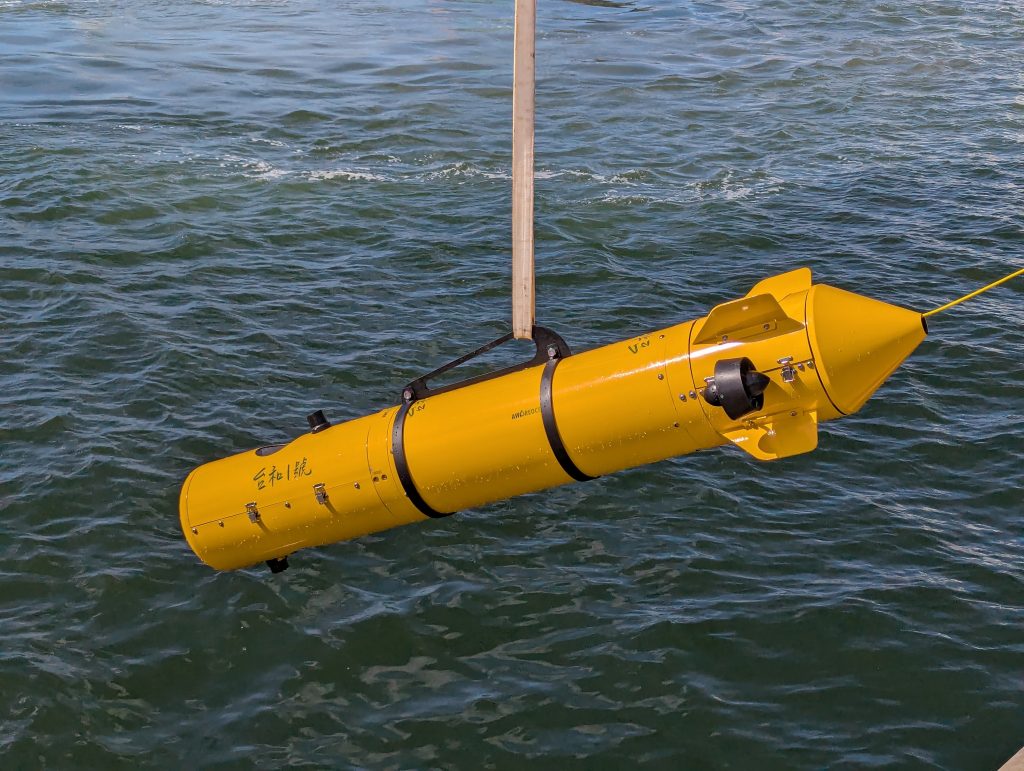
ROV Delphin (台和1號)
Awareocean Technology (知洋科技) showcased its ROV Delphin (台和1號) underwater unmanned mine-hunting vessel at Taiwan Shipbuilding Corporation’s Keelung facility. Company founder Hsiang-Chih Chan (湛翔智) told us the underwater vessel features three modular variants: Module A (Reconnaissance) uses imaging and scanning sonar to detect tethered mines; Module F (Flagship) enhances bottom mine detection with side-scan sonar; and Module B (Countermeasure) neutralizes mines using explosives, either directly or via acoustic fuzes. Over half its components, like the hull and battery, are Taiwan-made, offering production flexibility.
Chan said underwater vehicles rely less on China’s supply chain because China has not yet caught up to the West in the sector, though it is advancing rapidly. China has a growing marine sector, but for reliability and domestic production, Chan said Taiwanese companies “prefer European and U.S. components.”
Chan also told Domino Theory that his company is currently using a U.S.-made motor to comply with “red-free” supply chain requirements, but plans on switching to domestically produced or custom-developed motors to improve propulsion power and efficiency, which is a key focus of their next project phase.
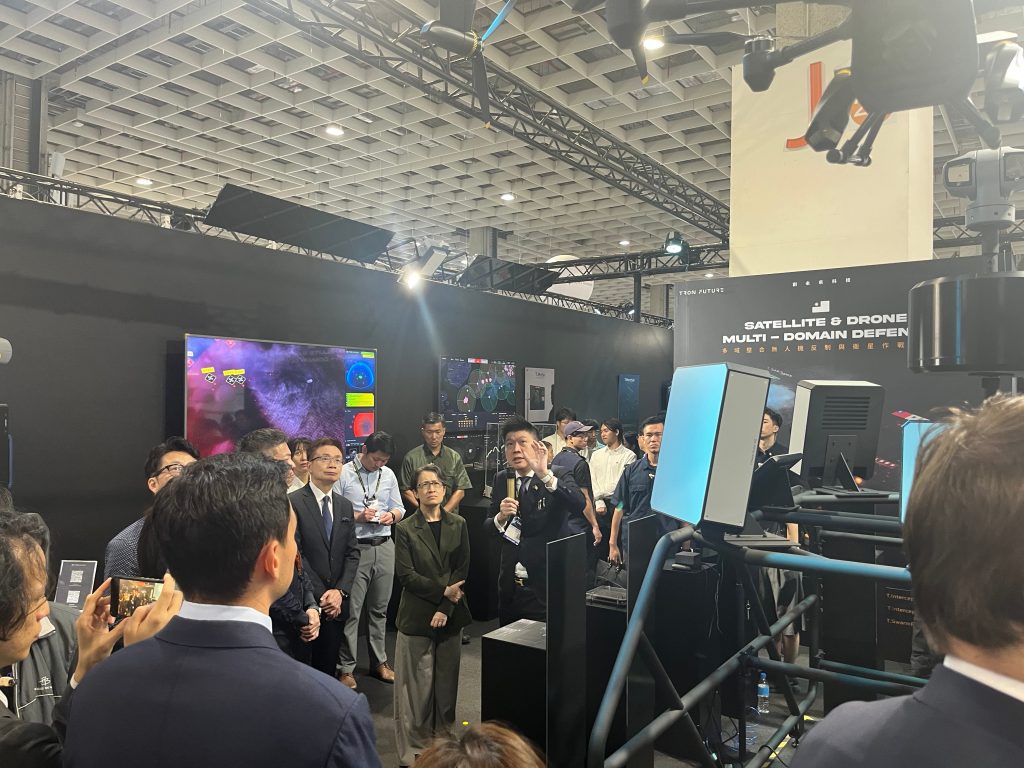
Vice-President Hsiao Bi-khim Makes the Rounds
Taiwan’s Vice-President Hsiao Bi-khim (蕭美琴) has made her way through the exhibition hall, pausing at several different booths to learn about the latest tech. Her route started at Taiwan’s Space Agency and continued through the booths for private sector firms.
The Lai administration recently released the proposed defense budget for 2026 — spending is projected to rise from 2.38% to 3.32%. However, that increase includes some existing spending on the coast guard and pensions. The budget will need to pass the Taiwanese parliament next January, which is controlled by the opposition party.
TADTE has installed metal detectors at entrances today. President Lai Ching-te (賴清德) is expected to make an appearance later this afternoon.
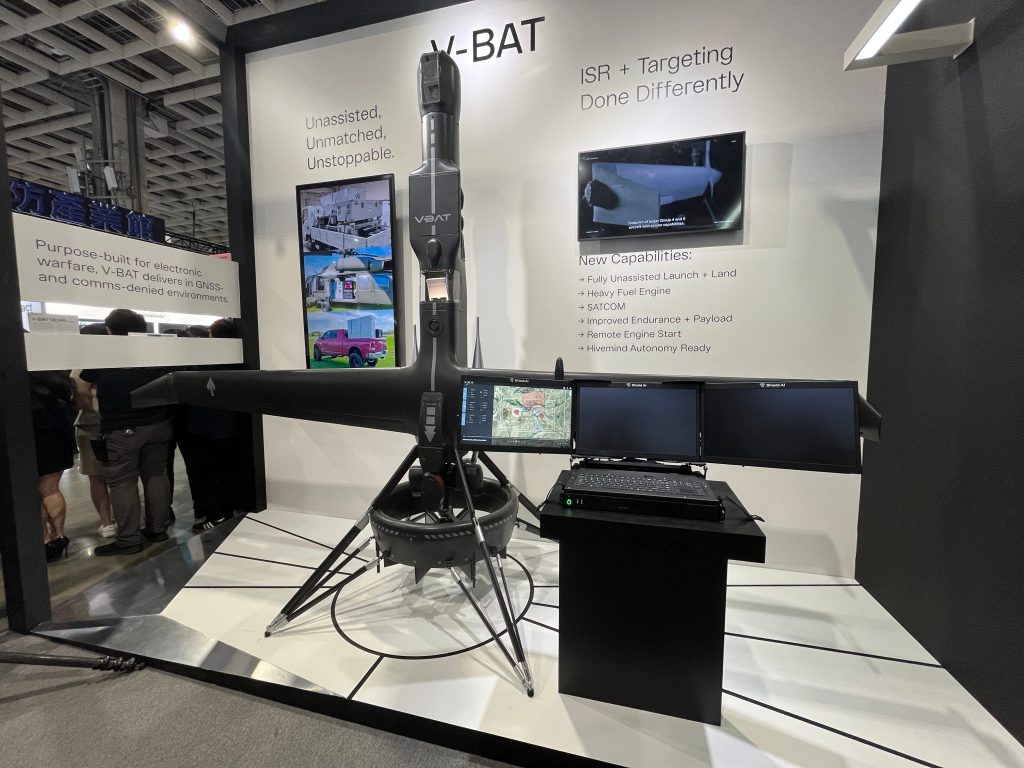
“Microsoft Office” for Drones
The TADTE floor is full of flashy gadgets, but there’s just as much energy around the software that will coordinate them. U.S. firm Shield AI is displaying its V-BAT, a vertical take-off and landing drone that the company has been working on for a decade. Recently, they’ve been working on a software platform they say can become the “Microsoft Office” for drone coordination. Right now, it’s like everyone is using their own typewriters, Shield says.
This is Shield’s first time at TADTE. According to Reuters, exhibitors at the expo have nearly doubled since it was last held two years ago.
A common catchphrase for software makers is “drone agnostic.” Many of these companies — including Tron Future, which has become a leader in anti-drone systems — are also making drones. But they want other drone-makers to use their tech, too. PowerPoint still works even when it’s running on a Mac, Shield says.
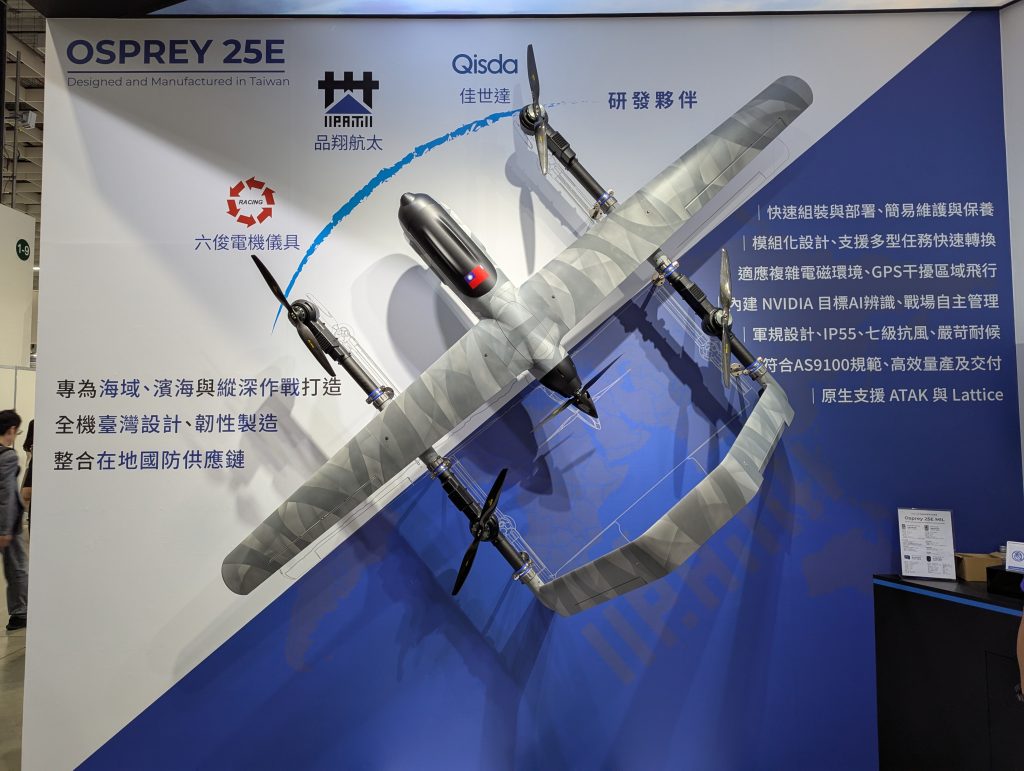
Dragonfly and the “Made in Taiwan” Osprey 25E
Taiwanese drone company Dragonfly (翔隆航太) debuted its Osprey 25E, a vertical take-off and landing, or VTOL, aircraft that is 90% “made in Taiwan,” according to sales director Kevin Chiang (姜兆民).
To build the Osprey 25E, Qisda (BenQ’s parent company) provided the electronics and Racing Electric Instrument provided the motors. The payloads and communications vary by client needs, Chiang said, with options like Israeli or domestic payloads for military use or Sony cameras for commercial tasks. Rare earths and magnets are sourced directly from Australia or Myanmar “to ensure a non-China supply chain, especially for military clients requiring 100% de-Sinicization.”
Chiang said “achieving 100% domestic production is feasible but costly — our drones are significantly more expensive than DJI’s.” Foreign technologies are more mature, but “Taiwan’s capabilities have grown rapidly, and in two to three years, we’ll close the gap in price and performance with competitors, including China.” Taiwan’s strength lies in its electronics ecosystem, exemplified by the U.S. Skydio drone, where “70% of components are made in Taiwan.”
The newly unveiled Osprey has secured U.S. military orders, with domestic orders pending.
Light Frigate Armament Update
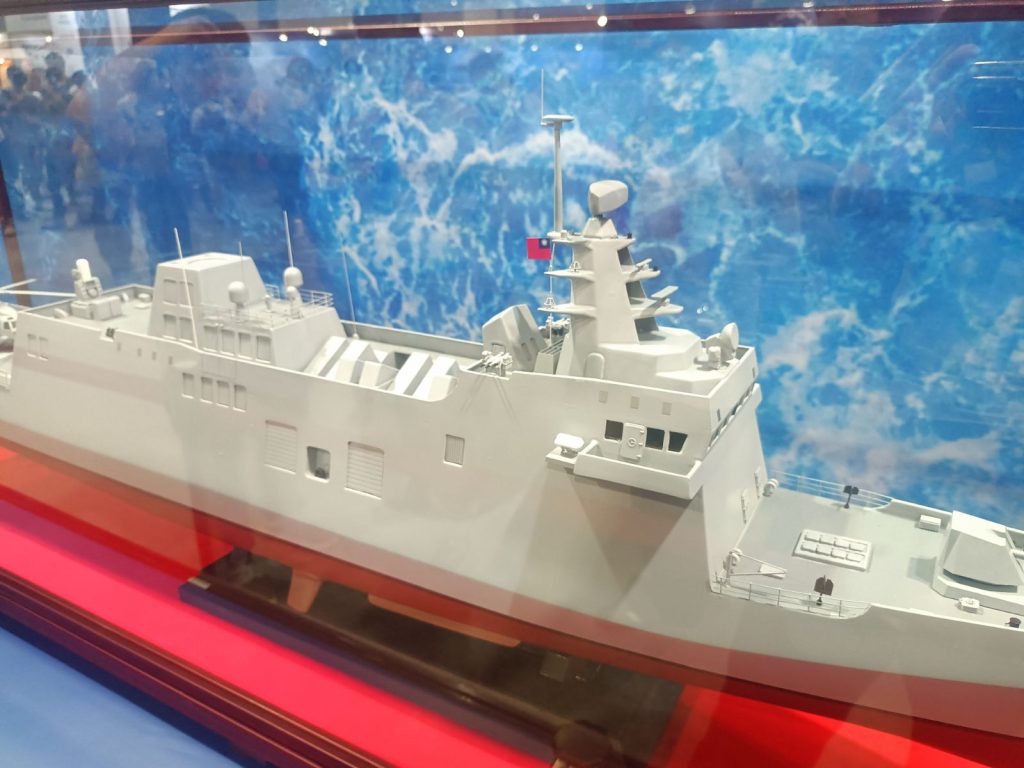
Two models of Taiwan’s next-generation light frigate are on display in the defense ministry area. It was announced last year that there are two variants, an anti-submarine warfare version and an air defense version. One of each is currently under construction — 12 will be built in total.
The light frigate has a displacement of approximately 2,500 tons. It was reported last year that both variants will be armed with Hsiung Feng II (雄風二型) and Hsiung Feng III (雄風三型) anti-ship missiles and Sky Sword II (天劍二) surface-to-air missiles. The air defense variant was intended to have less anti-ship missiles, and more surface-to-air missiles, including a vertical launch system, or VLS, module. The anti-submarine warfare variant was intended to have torpedo launchers as well as anti-submarine rocket, or ASROC, missiles that put torpedoes in the water 10 kilometers from the ship.
What the model at TADTE reveals, confirmed by naval officers present, is that the anti-submarine warfare variant will not have surface-to-air missiles, nor ASROC missiles, at least initially. The specific difference is that there is no longer a plan to mount the surface-to-air missiles in fixed-angle launchers as well as vertically. Both variants still have a Phalanx gun for close range air defense.
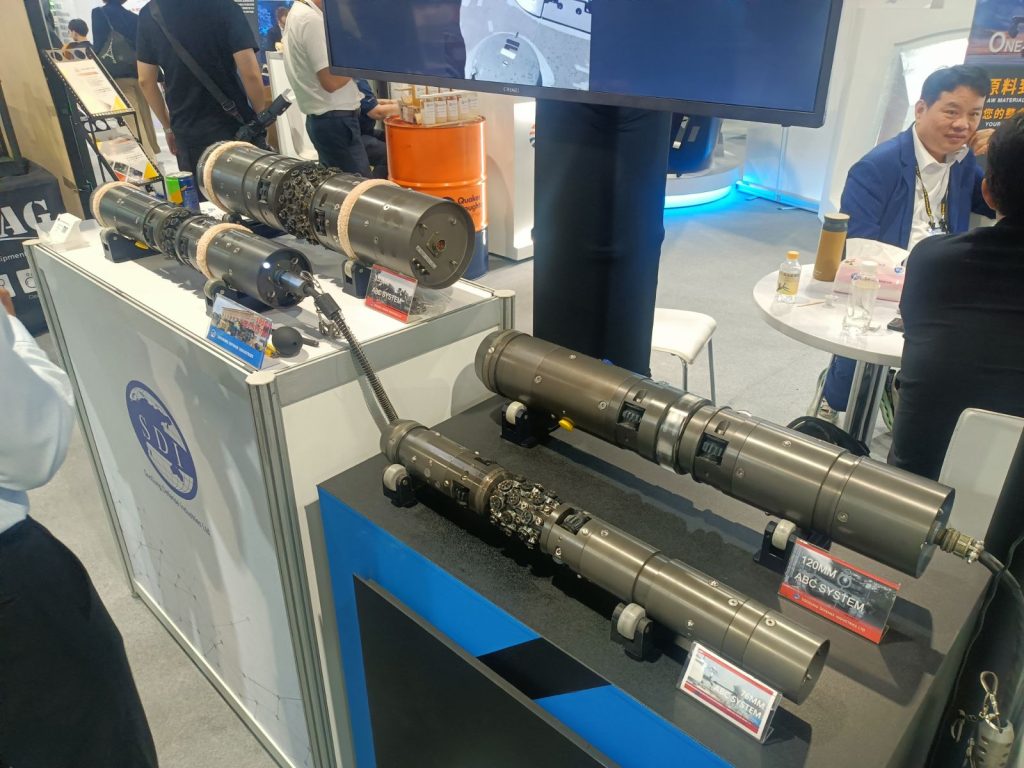
Korea’s Barrel-Cleaning Mole
Something a little different: SooSung Defense Industries was showing off a robot that crawls down the barrel of a large caliber gun and cleans it semi-autonomously. The mole uses metal brushes to clean the interior and can apply oil. General Manager Chae Gyu Hun told Domino Theory that the robot needs a human to put it in and take it out, but that instead of eight soldiers swabbing the barrel manually, one soldier can operate three robots simultaneously.
SooSung’s Taiwanese agent Simon Fu (傅旭昇) explained that automating systems can help alleviate the loss of manpower in the Korean and Taiwanese militaries. SooSung has sold its product to eight countries, including South Korea, where it is in widespread use.
The robot is available in different sizes, for tanks, artillery, and naval guns.
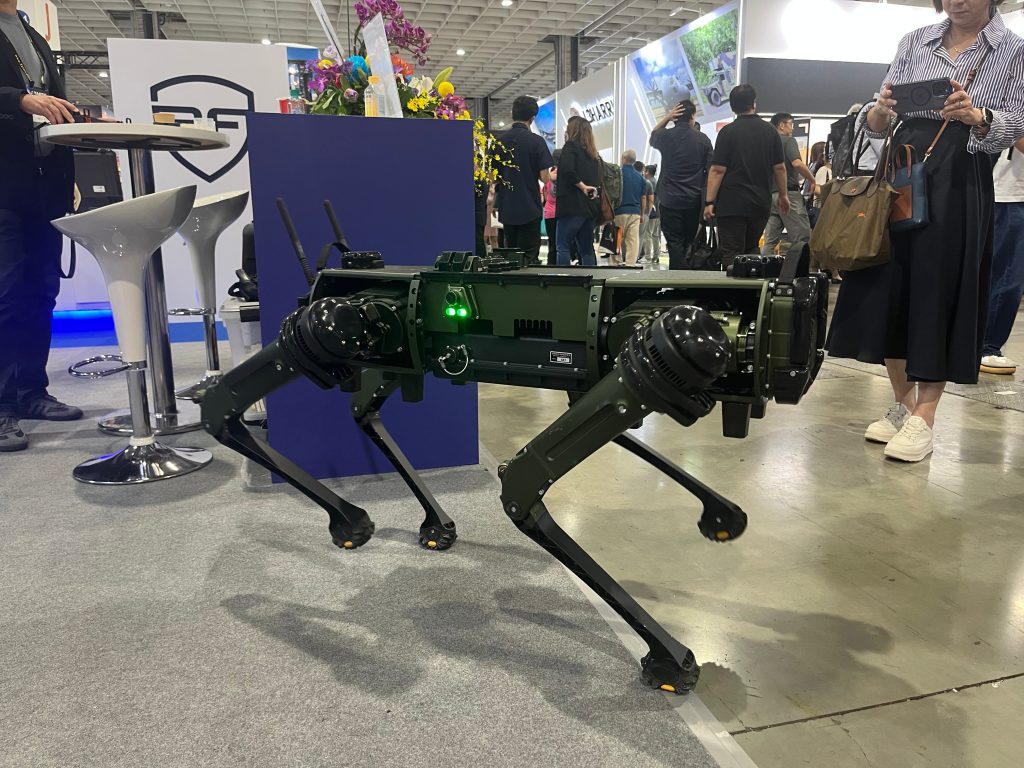
A Drone Ready to be Unleashed
Ghost Robotics’ Vision 60 should technically be referred to as a quadrupedal uncrewed ground vehicle, or QUGV. But watching it prance around TADTE, it’s easy to see why the device has been such a hit: The Vision 60 looks like a dog drone.
QUGVs’ main advantage over other land drones lies in their ability to navigate varied terrain. The top of the vehicle can be rigged with reconnaissance sensors or a fire extinguisher. But it’s important not to overstate what these things can do, Ghost’s vice president for Global Business Development John Laviolette explains. There still has to be a human in charge.
Lavoilette has been traveling all over the Indo-Pacific, with stops in Indonesia, Singapore and South Korea. He feels most at home in Taipei. Selling robots is easier in a tech-obsessed society like Taiwan, Laviolette explains. Rather than sell directly to the Taiwanese government, Ghost is partnering with a local intermediary firm.
Laviolette controls the Vision 60 from a table on the table next to him. As we speak, it’s been lying on the ground in front of their booth. But now he reaches over and clicks a button. The vehicle springs to life, and laughter from the modest crowd around the booth resumes.
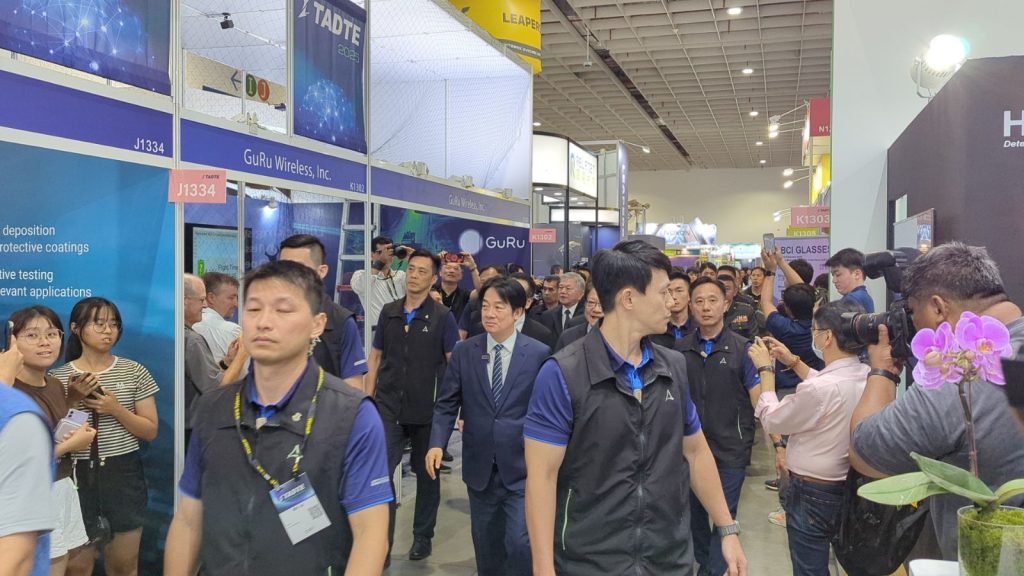
President Lai Visits the Expo
The crowd is 10 deep as President Lai Ching-te (賴清德) arrives. Despite heightened security and the gaggle of broadcast journalists trailing behind him, he’s moving through the hall more quickly than Vice President Hsiao Bi-khim (蕭美琴) did. His route included more picture-posing and fewer equipment explanations.
He shakes hands with representatives from Lockhood Martin, whose F-16 fighter jets form the backbone of Taiwan’s Air Force. Then he poses for pictures with a row of top Taiwanese military and civilians officials, including Deputy Air Force Commander General Cheng Jung-feng (鄭榮豐) and Defense Minister Wellington Koo (顧立雄).
On Friday morning, The Washington Post reported that President Donald Trump had declined to approve $400 million in military aid to Taiwan earlier this summer. Trump has shown a reluctance to give away American arms for free. But defense cooperation between the U.S. and Taiwan appears to be alive and well at this year’s TADTE. Lockheed Martin and Northrop Grumman had two of the largest booths in the entire hall, probably dwarfed only by the Taiwan defense ministry itself.
At a White House meeting this past February, Ukrainian President Volodymyr Zelenskyy got into hot water with the Trump administration for what they deemed to be his insufficient gratitude for U.S. military aid. On Friday, in response to The Washington Post’s report, representatives from President Lai’s office said: “Taiwan expresses gratitude for the long-standing U.S. support in strengthening its defense capabilities. Both sides will continue to deepen their partnership across various fields, contributing to global prosperity and stability.”
Thunder Tiger Unveils the Tiger Road
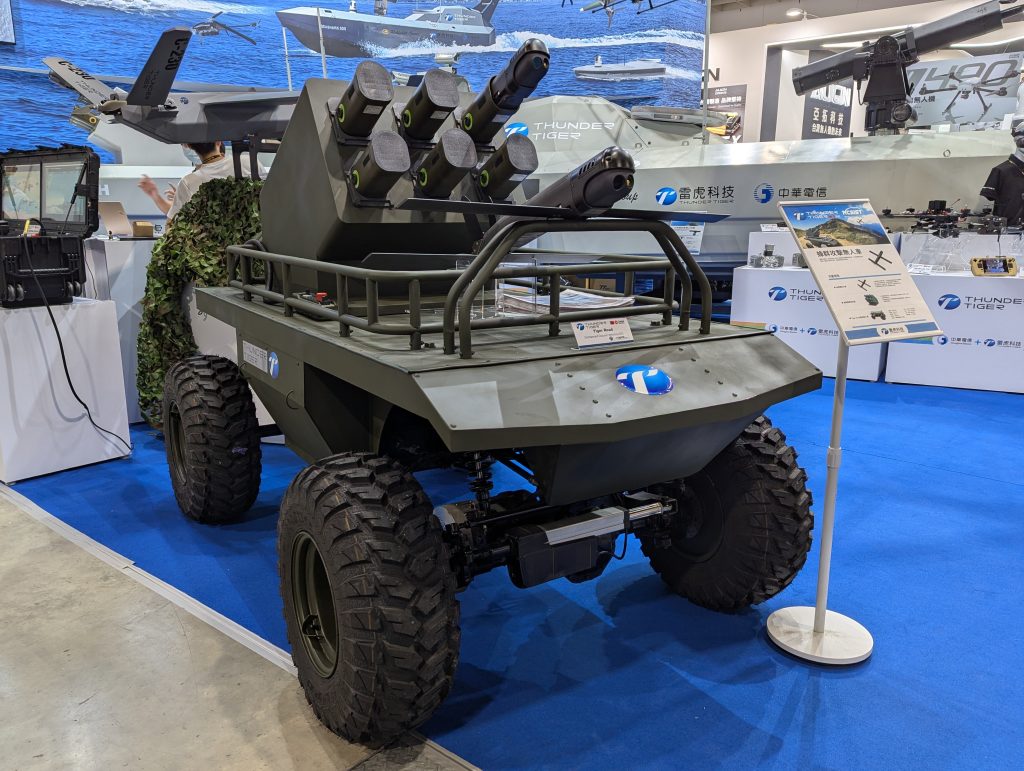
Thunder Tiger, a household name for remote-controlled toys in Taiwan, unveiled an unscrewed ground vehicle the Tiger Road.
Sales specialist Allan Chi (紀文軒) told Domino Theory that the Tiger Road is a swarm attack drone developed with National Chung-Shan Institute of Science and Technology.
Tiger Road, according to Chi, is customizable and “avoids [a] certain supply chain.”
Although the drone’s lenses are from Israel, France and the U.S. due to Taiwan’s limited lens manufacturing, the land drone currently carries NCSIST’s Switchblade.
As for sourcing, Chi said, “Our products don’t require rare earth materials,” ensuring flexibility without reliance on suppliers from China.
Convention of Conscripts
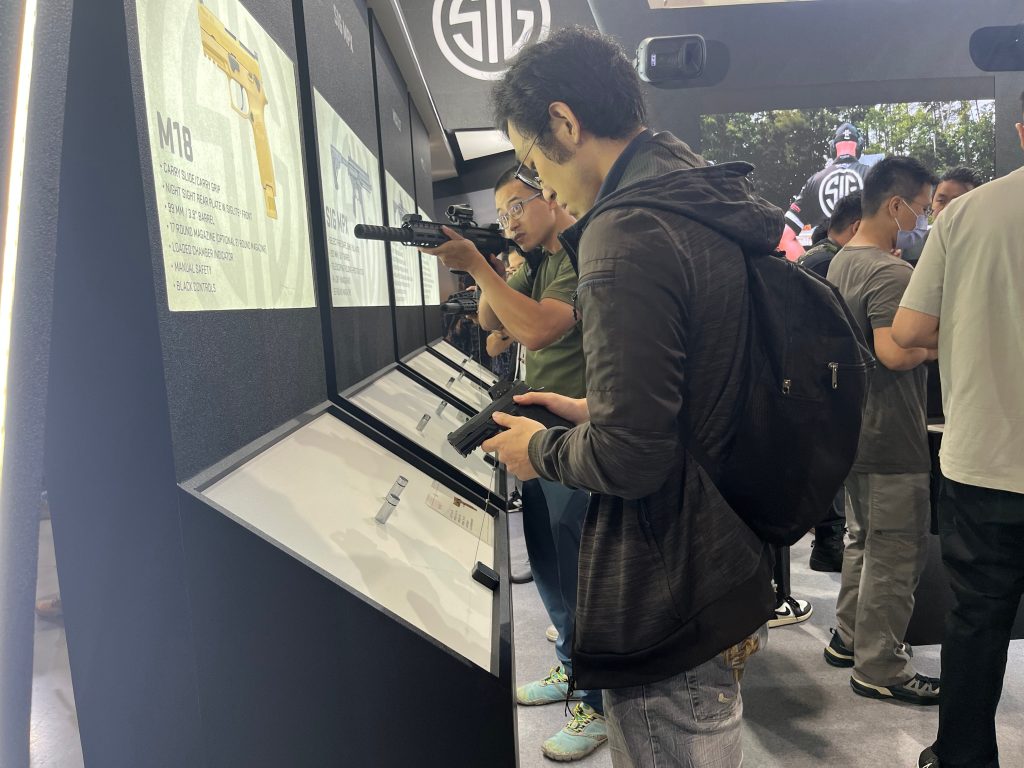
Day three of TADTE, now open to the public, has seen a conspicuous increase in one demographic: young men. The longest line Domino Theory has seen is outside the booth of Sig Sauer, an American gunmaker that is displaying a range of rifles and pistols for visitors to try. (Without ammunition, of course.)
A 26-year-old from Taipei who introduced himself as Wego (鄭詹緯) is training to become a police officer. In the military, he practiced with rifles and grenades, but never touched the sort of cutting-edge equipment on display at this year’s expo. “It was pretty boring,” Wego said.
Taiwan has mandatory military service for all men between the ages of 18 and 36. Back when William Chen (陳威霖), 22, served, the requirement was just four months, but in 2022, Tsai Ing-wen’s (蔡英文) administration announced their intention to extend it to a year. That change went into effect this past January. Domino Theory asked Chen whether the expo has given him confidence in Taiwan’s ability to protect itself. “Right now, we are very divided,” he said. “But if something were to happen, I think Taiwan would unite.”
Correction: In the Strong Bow update, the phrase “it uses small rocket motors to maneuver in its terminal phase” has been replaced by “it uses its rocket motor to maneuver in its terminal phase. The Chiang Kung does not have attitude control motors.” This was due to a miscommunication at the booth on September 18.




Leave a Reply