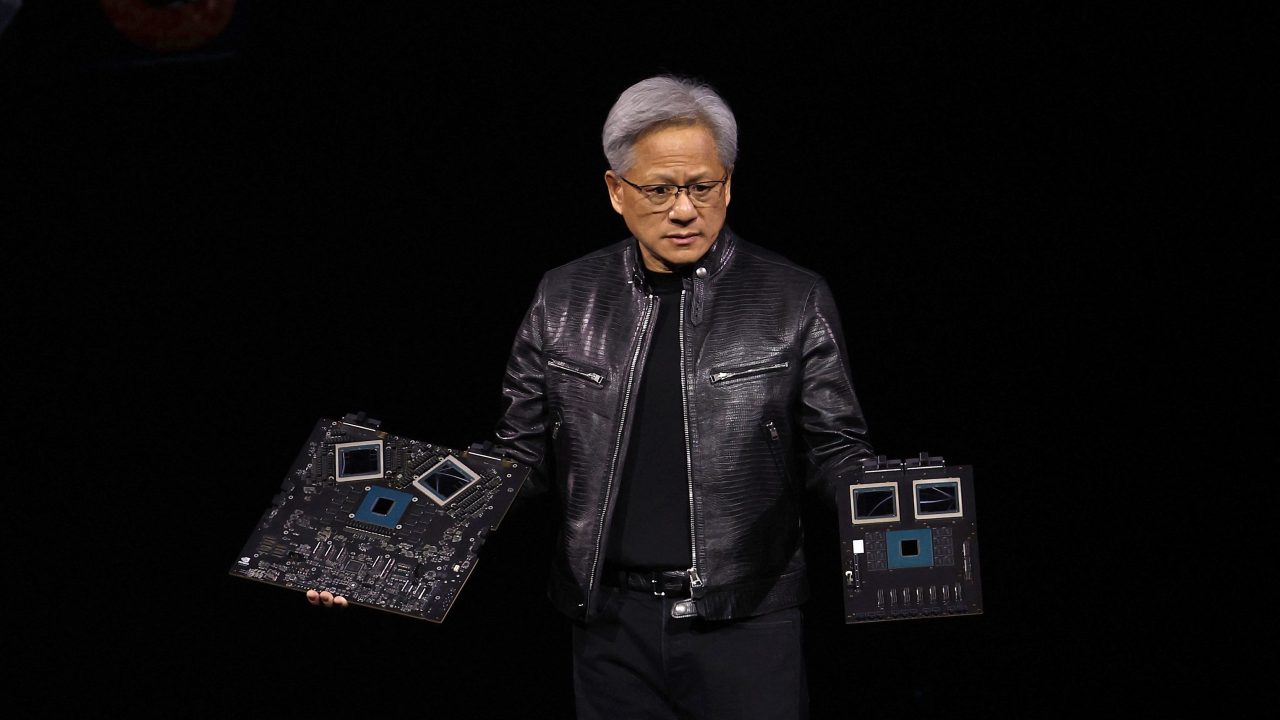
Last week, China’s State Administration for Market Regulation announced that it would be launching an investigation into Nvidia, the American chip company at the center of the AI revolution. In one respect, this investigation is unsurprising. Nvidia generates significant revenue in the Chinese market, which means its extraterritorial business conduct — in this case, its acquisition of the Israeli firm Mellanox Technologies — is subject to China’s Anti-Monopoly Law. The U.S. and France initiated their own antitrust investigations into Nvidia this year.
China’s probe centers on Nvidia’s acquisition of Mellanox in 2020. Simply put, Mellanox provides interconnect technology, allowing chips, servers, and other components to efficiently transfer data between each other. This enables data centers to process large-scale AI workloads at greater speed and cost-effectiveness. “We were a GPU company and then we became a GPU systems company,” Huang said about the acquisition. Months after the U.S. and the EU gave their approval, China finally greenlit the deal, but with several conditions. Two of these conditions are secret, and the remaining include stipulations that prevent Nvidia from bundling Mellanox with its own GPUs to the exclusion of third-party interconnect products. China is investigating Nvidia for violating one of these terms, although it did not specify which one.
The investigation is raising eyebrows among industry watchers for a couple reasons. First, it comes a week after the administration of President Joe Biden imposed its latest round of semiconductor export controls on China. This implies a political motivation. Second, due to several years of U.S. chip controls, Nvidia’s business in China is on the decline. Historically, China has imposed politically motivated antitrust requirements on American companies to support the growth of its domestic firms. Why would China punish a company whose market dominance is already decreasing?
China might be wanting to inflict some hurt amidst tit-for-tat technology competition with the U.S. Given centralized state control over politics and policy, China’s regulatory process can move much more quickly than the U.S.’s and be shaped to fit political priorities. While efficiency is still a consideration for China’s sprawling bureaucracy, it recently streamlined the oversight of antitrust enforcement under the State Administration for Market Regulation. The body has significant power and discretion to investigate and adjudicate antitrust cases, amplifying concerns among foreign companies that it’s a black box, leading to decisions that conform to the state’s agenda, regardless of whether they cause inconsistency in enforcement.
China has used regulatory tools to punish American technology companies before. In 2015, Qualcomm was fined $975 million following a 14-month antitrust investigation. At the time, half of Qualcomm’s revenue came from China. Last year, Micron was banned from the Chinese market following a cybersecurity review. The U.S. Commerce Department responded that it “firmly opposes restrictions that have no basis in fact,” adding that this decision was a part of Beijing’s “raid” against American firms. In contrast, the U.S. government waffled on TikTok for more than four years before Biden signed into law a bill that will require ByteDance to divest its U.S. operations of the app. Yet TikTok’s fate in the U.S. remains unclear.
In Nvidia’s case, China might be seeking to punish the U.S. for further restricting chip exports to China or deter the U.S. (or more specifically, Trump) from imposing additional restrictions. Nvidia could face a fine of up to 10% of its previous year’s revenue if it is found to have committed an antitrust violation. But it could also face a market ban, as China has not been shy about shutting out American companies in the past.
The 2.6% drop in Nvidia’s stocks signaled that the investigation has created some perceived risk to Nvidia’s economic outlook. A substantial fine, and certainly a market ban, would pose significant short-term costs. The Chinese market contributes about 15% to Nvidia’s global sales ($5.4 billion), which means that it could be fined up to hundreds of millions of dollars. Nvidia is clearly eager to grow in China, as it’s adding hundreds of staff to its self-driving research team. Given rumblings among investors that it’s at risk of plateauing, Nvidia might be particularly concerned about securing this market.
But Nvidia’s overarching resilience puts the effectiveness of China’s probe as a punishment or deterrent into question. Although U.S. chip controls have shrunk Nvidia’s business in China by a significant margin, the company has maintained enormous growth. Nvidia is entering markets that are chasing the AI wave, including India, Saudi Arabia and the United Arab Emirates. Jensen Huang, Nvidia’s CEO, is also making a concerted effort to create new markets for Nvidia by campaigning for “sovereign AI.” Huang is appealing to nationalist sentiment to convince governments around the world that they should be constructing their own AI from scratch — using Nvidia’s chips, of course.
Another component of Nvidia’s resilience is its importance to China’s technological ambitions. It seems unlikely that China would impose the harshest punishment — a market ban — on Nvidia, as this would hinder China’s semiconductor catch-up and in turn, its ability to compete with the U.S. in artificial intelligence. China’s major semiconductor companies, Huawei and Semiconductor Manufacturing International Corporation, or SMIC, are currently several years behind their competitors. China has not yet been able to crack the code for reliable, advanced semiconductor production, so Chinese companies are stockpiling Nvidia’s less advanced chips and accessing restricted chips through back channel distributors to keep pace.
Just as China can strategically scale up regulatory punishments, it can also scale them down. For example, China can choose to use the announcement of the investigation — and perhaps an ultimately negligible fine — to convey messages to domestic and international audiences.
To the domestic audience, this investigation signals that Nvidia has fallen out of favor with the Chinese government. China seeks self-sufficiency in semiconductor production to reduce its vulnerability vis-a-vis the U.S. and it has reportedly been increasing pressure on domestic companies to buy chips locally where possible. In China, a regulatory probe carries more symbolic weight than it does in the U.S., as it is considered to be more so a directive to comply with national objectives than a procedural issue. Relatedly, the Nvidia probe is likely meant to signal self-sufficiency, and in turn, strength. This message was evidently received by some X users.
Chinese state media is using this probe to signal to international audiences that it can provide a comparatively favorable business environment. The U.S. pursues “strong arm tactics in trade and technology, which have caused many to seek alternatives … China is the safest alternative to the U.S.,” said one (professional and self-proclaimed) Chinese propagandist about the investigation on X. This aligns with the overarching Chinese narrative that the U.S. provokes and disrupts, while China is a responsible international actor, capable of exercising strategic restraint. In fact, for the credibility of this message to hold, antitrust can only be narrowly applied as a trade weapon. China needs to signal its reasonableness to attract foreign investors — it is probably confident that this investigation will be interpreted as such because the U.S. and France initiated similar ones.
An advantage of China’s centrally controlled regulatory regime is that investigations like this one can be scaled to fit the particular context. In this case, Nvidia’s resilience to potential regulatory punishments means that the probe is likely more effective as a messaging tool than as a deterrent. China will likely rely on other levers, like cutting off the U.S.’s supply of critical minerals, to inflict real pain.






Leave a Reply