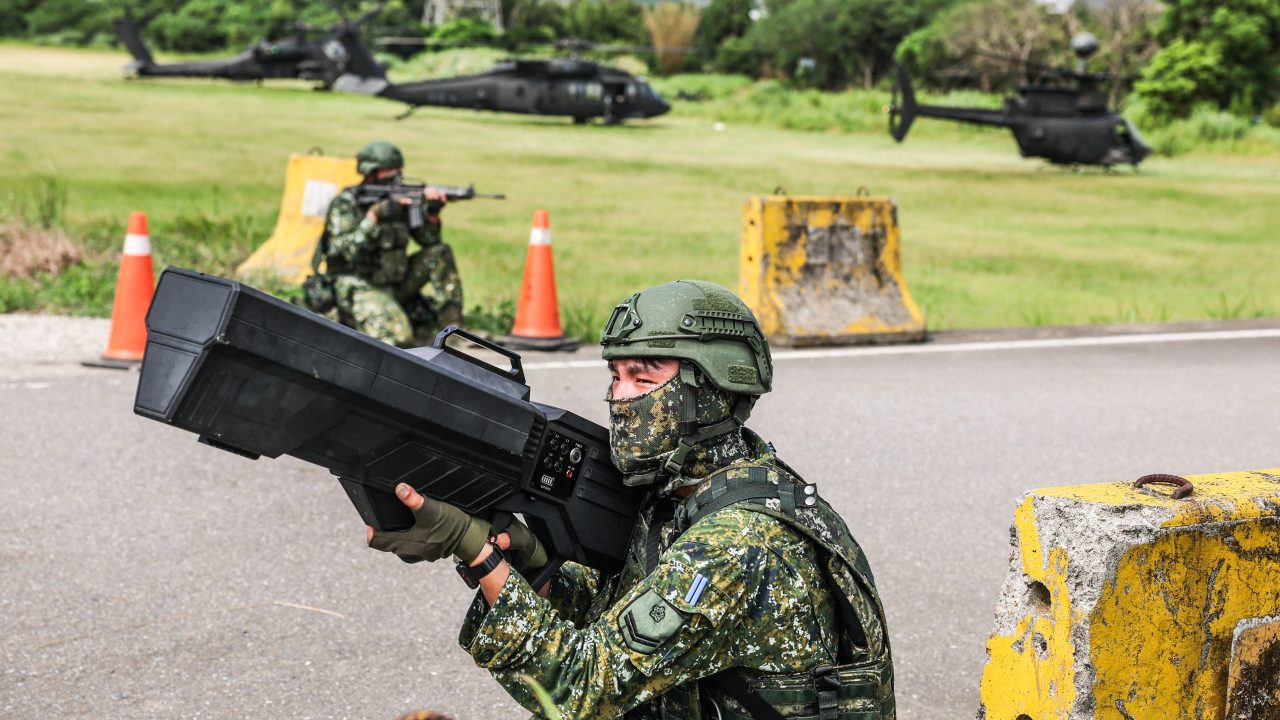
In a lengthy investigative report published on Wednesday, Domino Theory revealed how Taiwan spent four years trying to acquire a counter-drone system to address Chinese harassment of its frontline islands, and why it came up empty.
The story began in August 2022, when China started using drones to harass military bases in Kinmen, a Taiwanese island just off China’s coast. But this wasn’t a military operation. The drones were cheap, off-the-shelf models, and the pilots were Chinese civilians in the nearby city of Xiamen, who appeared to delight in capturing video of hapless Taiwanese soldiers and posting them online.
The viral embarrassment of that moment spurred Taiwan’s Ministry of National Defense to launch a project to install counter-drone systems on both Kinmen and Matsu, the country’s other main outlying island. From the beginning, it looked like Tron Future, a Taiwanese defense startup just then beginning to break into the counter-drone sector, would be an attractive candidate to provide the systems.
But four years, one research project, at least 22 million New Taiwan dollars (roughly $690,000) in public funding, one whistleblower complaint, two rounds of failed bidding, three rounds of failed acceptance tests, and one legislative hearing later, Taiwan’s Defense Ministry announced in July that its efforts to purchase a counter-drone system from Tron had failed.
Here are five key takeaways from Domino Theory’s investigation:
- When Taiwan’s government began consulting with local suppliers on counter-drone equipment in early 2023, it had already missed the deadline to include the project in that year’s normal annual budget. So the Defense Ministry resorted to drawing NTD 60 million in funds from the National Defense Industry Development Foundation, or NDIDF, an endowment whose remit was traditionally confined to research and development projects. An investigation by the Control Yuan, a branch of Taiwan’s government that acts as a watchdog, later concluded that the Defense Ministry had violated the spirit of the NDIDF’s charter, effectively transforming the foundation into its “slush fund.”
- In July 2023, the Defense Ministry awarded Tron the NTD 60 million in counter-drone funding. It did so with the understanding that Tron would work with another local firm, iWavenology, to integrate multiple types of radar into a comprehensive defense system. As it turned out, that understanding was based not on a written agreement between Tron and iWavenology, but on verbal assurances from Tron. When the Defense Ministry later discovered that Tron and iWavenology had not, in fact, found a way to collaborate, it terminated Tron’s contract, leaving the government out at least NTD 22 million with nothing to show for it.
- The Defense Ministry then launched another effort to procure counter-drone systems, this time a batch of 26 for its frontline islands. And despite the NDIDF research debacle, which had drawn the ministry a public censure from the Control Yuan, it awarded this contract as well to Tron in January 2025. That turned out to be a mistake. Over the next 18 months, Tron delivered its equipment to the military three times, each time failing the acceptance tests. In July, the Defense Ministry moved to terminate the contract and announced that it would consider blacklisting Tron as a military supplier.
- Based on our conversations with industry experts in Taiwan, Europe and the United States, as well as Domino Theory’s analysis of Taiwanese defense procurement data, we concluded that two main factors explain Taiwan’s failure to acquire the counter-drone system. The first factor is not Taiwan’s fault. Counter-drone technology is in its infancy. The number of people in the world with practical experience with these systems is vanishingly small, and most of them live in Ukraine and Russia. This makes it hard for Taiwan’s government to set reasonable specification targets for counter-drone systems, and even harder to find civilians to impartially assess different vendor options.
- The second factor is more problematic. Taiwan’s democratic system has guardrails and transparency mechanisms in place to guard against corruption and incompetence in its procurement system. In the case we examined for this article, those mechanisms failed. The Control Yuan did good work to uncover the Defense Ministry’s misconduct during the first procurement effort in 2023. But when required to follow up on those findings in early 2025, it pliantly accepted that the issues it had censured the ministry for had been rectified. Another means of oversight that fell short: civilian participation on selection committees. The Defense Ministry invited four working civilian experts — all of whom hold prominent academic positions at respected universities in Taiwan — to serve on the procurement committee for the counter-drone project. But when that committee held a meeting to decide whether to award Tron the contract, none of the four showed up. When Domino Theory contacted these experts, they professed ignorance of the very technology they were tapped by the military to assess.
To understand how all this played out in much greater detail, we encourage you to read the original investigation, here.






Leave a Reply