When conflict broke out between India and Pakistan earlier this month, Pakistan relied on Chinese missiles and air defence systems. And while the Chinese government called for “restraint” from both sides in the days beforehand, China’s foreign minister Wang Yi (王毅) also notably expressed support for Beijing’s “all-weather” friend Pakistan “firmly implementing counter-terror actions.”
In other words, at the sharp end of international relations, China leaned away from India.
And yet, the relationship between China and India remains defined by contradictions. The two countries have huge areas of convergence, on top of notable areas of divergence.
And India refuses to act as the straightforward bulwark against China that the U.S. would ideally like it to be.
“Both countries are vying for influence and leadership in an emerging multipolar world and yet despite the importance of this bilateral relationship I think it’s very poorly understood outside the two countries and within China and India it’s often seen from a very one-sided perspective,” Chietigj Bajpaee, senior research fellow for South Asia at Chatham House’s Asia-Pacific Programme, said at one of their recent online events.
The balance sheet for the relationship has major pluses and minuses on either side, as a new report from Bajpaee and co-author Yu Jie (喻潔), senior research fellow on China at Chatham House, has set out.
One area of tension is an almost $100 billion trade deficit in China’s favor. India has launched more anti-dumping investigations against China than any other country. Another key issue is that India has opposed China’s Belt and Road Initiative because of concerns it can impact sovereignty claims in disputed territories. And yet another is that China has refused to endorse India joining the permanent members of the U.N. Security Council.
The ongoing border dispute remains, of course, a definitive pressure point, too. After 2020’s Galwan Clashes, in which at least 24 soldiers died, visa restrictions were put in place and direct passenger flights between the two were suspended. Those moves were only reversed earlier this year.
At the same time, there are significant areas of overlapping interests, too. India’s trade deficit may be a source of frustration for Indian politicians, but it also marks out a reality of economic interdependence between the two sides. Both countries are also explicitly committed to forms of multipolarity —though India speaks of both a “multipolar Asia” and a “multipolar world” while China only uses the latter. And both sides’ rhetoric speaks of an aspiration to lead the Global South and create a more equitable distribution of resources across the international system.
In practice, these overlapping viewpoints have actually tended to take precedence over the areas of tension in key forums like the U.N.
“[T]hroughout 2023, if you look into the votes within the U.N. General Assembly … around 81% of all the votes … China and Indian vot[ed] around the same pattern, whereas … the U.S. and India aligned only around 36% [of the time],” Yu Jie pointed out at the same Chatham House event.
Both China and India have consistently voted for the right to development to take precedence over climate concerns, Bajpaee said. They both take a similar position on freedom of navigation, with both countries broadly opposed to the passage of military vessels through their exclusive economic zone without prior consent. Both are also cautious on issues of humanitarian intervention and are comfortable maintaining relations with non-democratic or weak-democratic regimes such as Iran, Russia or Myanmar.
However, these overlapping positions do not entail a large degree of direct cooperation. “[P]ursuing overlapping positions … they are in parallel rather than in convergence,” Bajpaee added.
The effect is that they can vote together out of shared convenience, but they aren’t working together on shared infrastructure projects or military operations. Hence the warmest words Indian Prime Minister Narendra Modi has offered about China this year was the idea of the two countries competing in a “healthy way.”
And this calculation has not been changed by a tactical thawing of relations around the border, either. “The only credible metric would be a serious dialogue on the border issue and India relaxing constraints on Chinese investments in some critical sectors! Otherwise everything is tactical,” Harsh Pant, foreign policy head at the Observer Research Foundation think tank, told Domino Theory earlier this year.
Translated into the broader context of great power competition between the U.S. and China, then, what this continues to mean is that India refuses to enter either camp, and is determined to look after its own interests on a case by case basis.
“The general impression may be that India is under pressure to align more closely with Washington but … I think that the sense you’ll get if you speak to Delhi is that strategic autonomy isn’t up for negotiation,” Nirupama Menon Rao, former Indian foreign secretary, said at the Chatham House event.
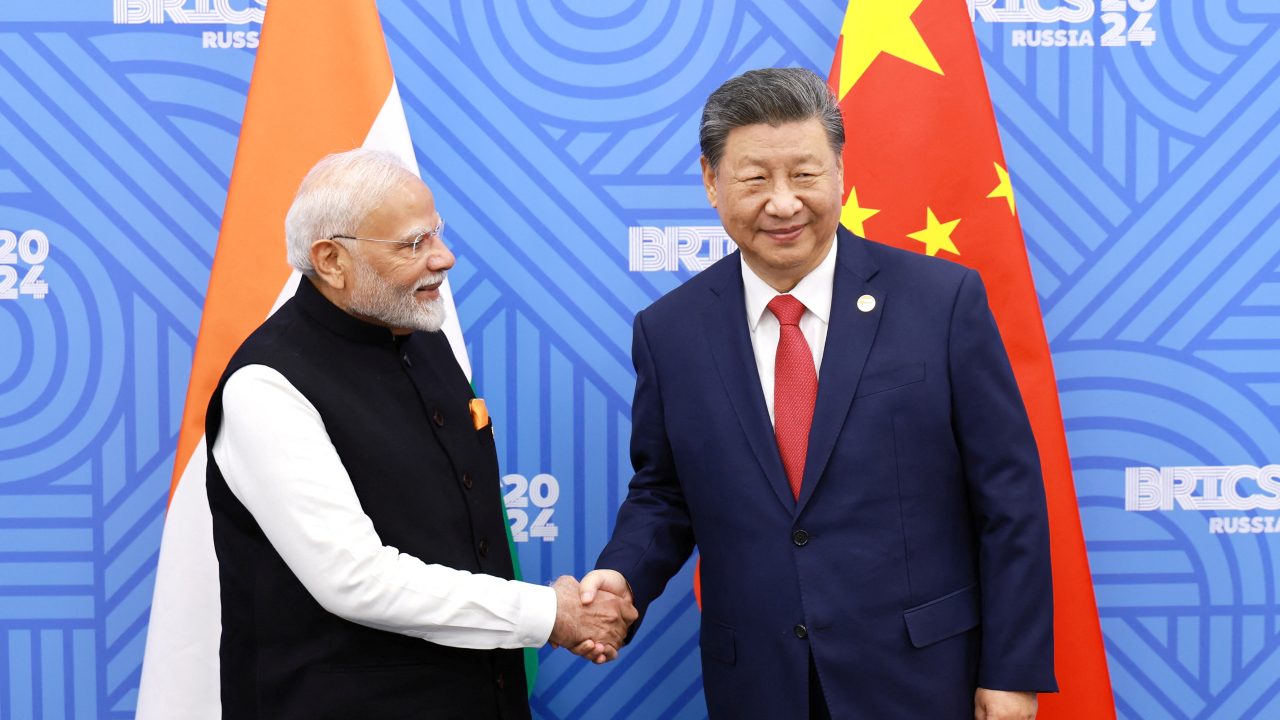
The slightly jarring outcome: While India might be happy to, for instance, challenge China in parts of the Indian Ocean one day, and China might back Pakistan in an armed conflict the next, the two will also continue to be willing to sit in BRICS meetings discussing issues with dollar dominance on another.
“Duality is the doctrine” for India, as Nirupama Menon Rao put it. That might well suit China too.


Leave a Reply