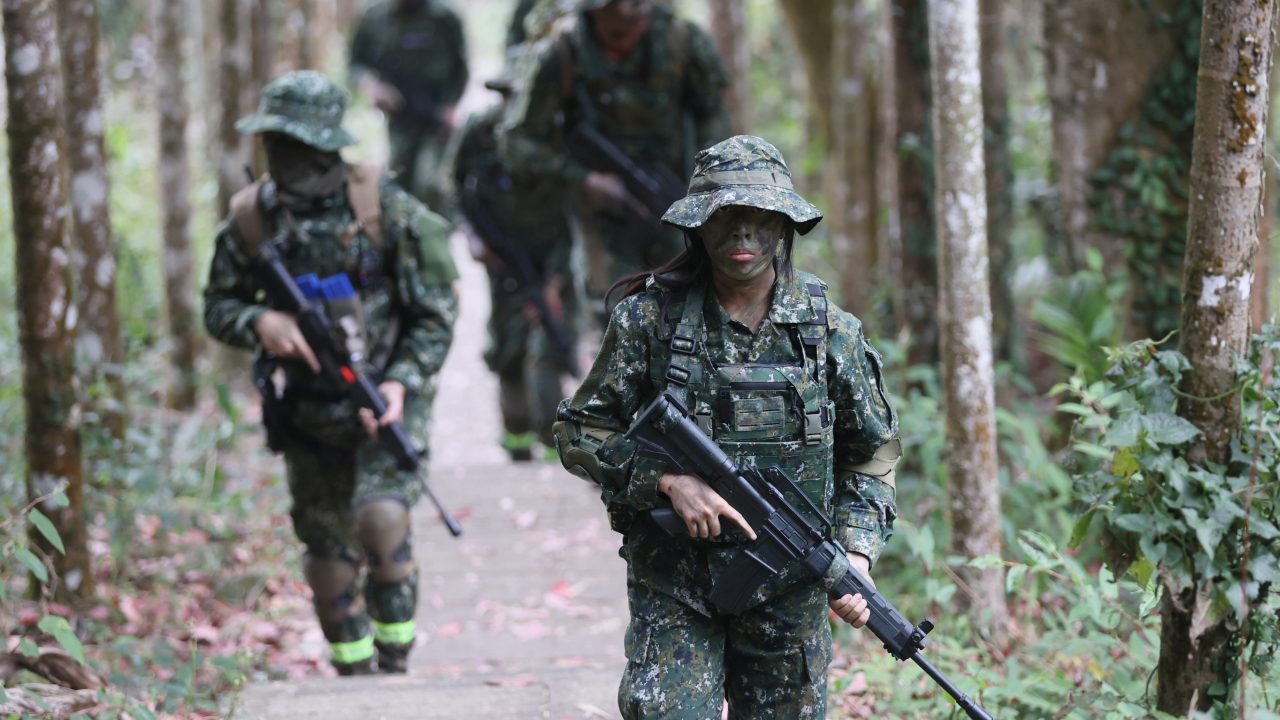
It is increasingly the political norm in the United States to understand Taiwan in the context of a realist “new Cold War” framework. But the assumptions of this framework — including that China poses an existential threat to Taiwan and that Taiwan should ready itself for war by expanding its defense budget — should not be taken for granted as representative of the political sentiment in Taiwan.
Contested perspectives on national identity, security and defense readiness in Taiwan can be broadly understood through the tension between the Chinese Nationalist Party (KMT) and the Democratic Progressive Party (DPP). One issue emblematic of this tension is civil defense, which is an effort to enhance the resiliency and preparedness of civilian populations for disaster or conflict. Last week, several KMT legislators proposed draft amendments to Taiwan’s civil defense acts that would restrict the ability of school youth to train with civil defense teams. These amendments come off the heels of a recent attempt by KMT legislator Hsu Chiao-hsin (徐巧芯) to prevent civil defense forces from participating in military tasks.
DPP officials and legislators say the KMT is seeking to “demonize” civil defense and “undermine” Taiwan’s national security by making these changes. In contrast, the DPP has made several attempts to bolster Taiwan’s civil defense in the last few years — this includes the formation of the All-Out Defense Mobilization Agency in 2022 and Taiwanese President Lai Ching-te’s (賴清德) task force on “whole of society resilience” this fall. KMT officials involved in the proposals did not respond to Domino Theory’s request for comment.
These improvements are much needed, as Taiwan’s civil defense readiness is widely considered to fall far short of what one might expect of a contested territory. As Leo Lin (林少凡), a Senior Lecturer in policing studies at Charles Sturt University explained, “low morale in Taiwan’s civil defense stems from historical underprioritisation by the government, leaving it underfunded and undervalued. Limited public discussion and awareness, combined with insufficient training, have created a perception of civil defense as ineffective and irrelevant.”
Since 1973, civil defense has been under the purview of the Ministry of the Interior’s National Police Agency, which means that local police branches are responsible for training civil defense volunteers. As of 2022, there are about 420,000 civil defense volunteers in Taiwan, which constitutes 1.8% of Taiwan’s population. Civil defense volunteers tend to be over the age of 50 because state-sponsored civil defense units offer “limited training opportunities and a lack of incentives” for busy young people, among other reasons, according to Lin. There are also budget issues. Of the approximately $800,000 that was allocated to civil defense units in Taiwan annually from 2020 to 2022, only 4% of that budget went to training volunteers, while the rest went to funding social activities.
The reasons for Taiwan’s lackluster civil defense are largely political. First is a historical distrust between the civilian population and the military in Taiwan. The military was a crucial instrument of the KMT’s rule during the White Terror. In particular, it was the job of the military police to suppress the dang wai (黨外), which translates to “people outside of the party.” This experience of state-sponsored suppression has left a lasting impact, according to Calvin Chu (朱晏辰), a former research associate at the DPP mission in the U.S. Even people who support Taiwanese independence — a position commonly associated with the DPP — are wary of participating in defense, and he believes this is in part a vestige of historical distrust of the KMT’s military. One study found that the most salient explanatory factor for public ambivalence toward defense reform in Taiwan is not economic interdependence or personal identification with China, but rather mistrust of Taiwan’s military.
Chu argues that historical civil-military division has led many Taiwanese people to think that war is solely the responsibility of the military and to disengage from defense issues. In reality, during conflict, the civilian population would not only need to protect infrastructure and provide food, water and other resources to the front lines, but they would also need to be able to take care of themselves to allow the government to expend finite resources on the front lines. There needs to be greater clarity among individual civilians about what their specific role would be during wartime, Chu added.
Another way in which political tension manifests is in the KMT’s claim that preparing for war with China makes conflict more likely. Yi-Suo Tzeng (曾怡碩), a research fellow at the Institute for National Defense and Security Research, wrote in his PhD thesis that, “many security professionals in both the blue and green camps [the KMT and the DPP] have no doubt that China is a security threat to Taiwan; the difference between them is how to tackle such a threat.” Research on war attitudes and political affiliation in Taiwan has found that KMT members are significantly less willing to fight than DPP members.
According to Chu, the DPP has difficulty communicating to the public about civil defense because the party worries that highlighting the threat of war with China won’t galvanize voters, but rather make them fear that voting for the DPP would instigate a war with China. The DPP doesn’t want to lose votes to the KMT and other opposition parties, said Chu.
For example, in an effort to be politically neutral, the DPP government produced a civil defense handbook with serious flaws. It provides instructions on basic survival skills, but not unequivocal statements from the government that it would not surrender if attacked. This messaging is included in similar handbooks published by Sweden, Lithuania, and Latvia to counter potential disinformation during wartime.
Another complicating political factor is that civil defense is largely a local issue. This is both a function of Taiwan’s civil defense law and also a practical reality that if Taiwan were to fight an asymmetric war against China, localities would need to be independently mobilized. While the DPP has won the presidency for the last three elections, the KMT predominates at the local level. In fact, during Taiwan’s last round of local elections in 2022, known as Nine-in-One Elections (九合一選舉), the KMT won 13 out of 22 top local leadership positions across Taiwan, while the DPP only won five. Wen Liu (劉文), a Taiwanese scholar conducting fieldwork on the rise of grassroots civil defense mobilization in Taiwan, said that since civil defense has become so politicized, it is difficult to convince both local KMT and DPP leaders to take it seriously — KMT leaders because it is against the party line and DPP leaders because they don’t want to lose their next election to the KMT.
Liu says that the Covid-19 pandemic and Russia’s invasion of Ukraine both contributed to a turning point for Taiwan in its focus on civil defense. The Taiwanese government’s response to Covid-19 gave citizens an idea of what war mobilization would look like, while the Ukraine invasion awakened “a lot of civilians who didn’t want to think about war,” said Liu. Increased interest in defense was initially harnessed by Taiwan’s civil society. Prominent Taiwanese civil defense organizations such as Kuma Academy and Forward Alliance were founded shortly after the pandemic and saw a surge in interest in their workshops following Russia’s invasion of Ukraine.
Despite being inherently more flexible and innovative than the government, civil defense organizations are similarly constrained — at least to some extent — by politics and public attitudes about war and defense. According to Tobie Openshaw, a civil defense expert in Taiwan, “most of the self-training groups specifically focus only on non-lethal, non-firearms, non-weaponry things, in order to not scare the people, in order to not invite unintentional government scrutiny, and to avoid accidentally training up some people who are actually … anti-Taiwan.”
Without a doubt, there remains an important role for the national government to play in spotlighting civil defense, strategizing and providing resources like communications equipment to localities. “Taiwan needs to really get its priorities straight and understand that there’s sacrifices to be made in order to preserve the things that you don’t want to lose,” said Openshaw.
Although political tension surrounding the issue of civil defense evidently persists, Openshaw thinks that there’s a shift occurring at the presidential level. In contrast to his predecessor Tsai Ing-wen (蔡英文), “Lai is definitely not shy to talk about the possibility of war and civil resilience,” Openshaw said.
In fact, at an event hosted by Academia Formosana — a religious civil defense organization — in September, Lai was unusually explicit on the topic: “I would like to assure everyone that Taiwan will absolutely not sign a peace accord … We must rely on our own strength to achieve peace. Peace based on a piece of paper is not reliable.”



Leave a Reply