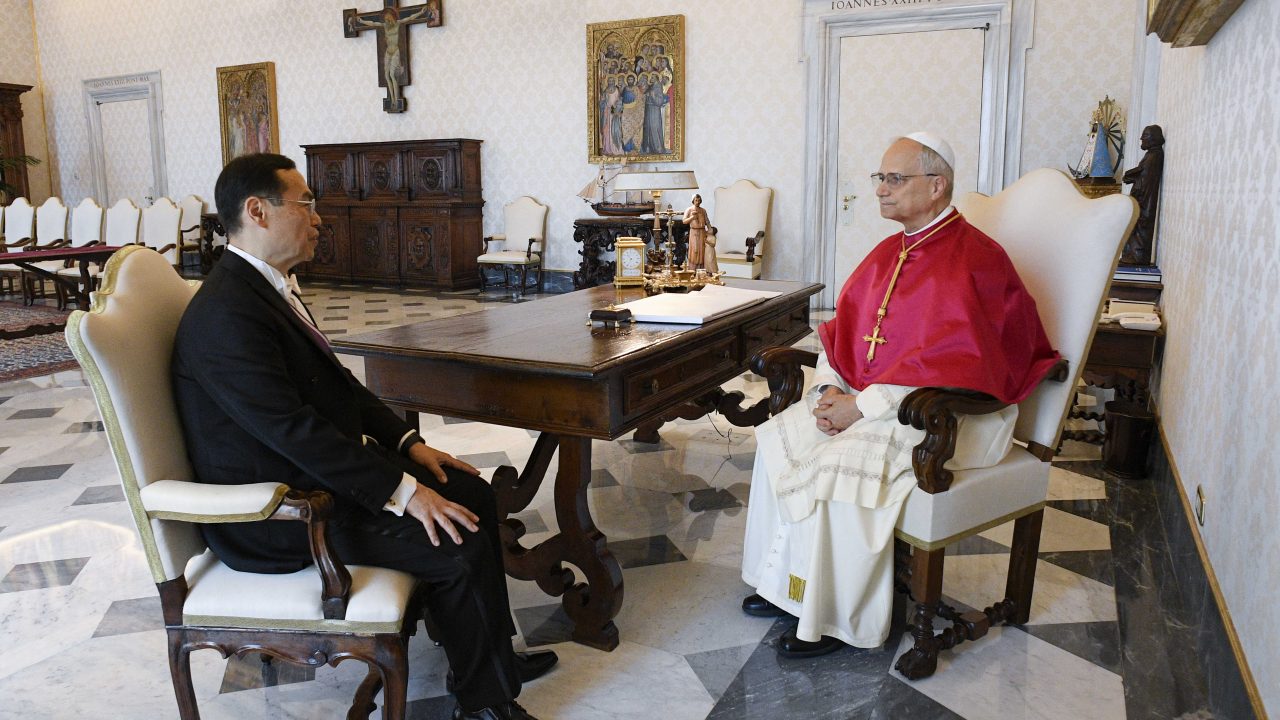
Pope Leo XIV appeared to speak to the brewing cross-strait crisis earlier this month in his first address to the Vatican diplomatic corps since he became pope. Less than two weeks prior, China had launched large-scale military exercises around Taiwan as a warning against “separatist forces.”
“We cannot fail to mention the intensifying signs of tension in East Asia, and to express hope that all parties involved will adopt a peaceful and dialogue-based approach to the contentious issues that are a source of potential conflict,” Leo said. His predecessor, Pope Francis, never mentioned East Asia, let alone rising tensions in the region, during his annual addresses to the diplomatic corps.
Without a military or an economy of its own, the Vatican is not the most consequential third party in cross-strait relations. But it is perhaps the most unique. Not only is the Vatican a singular moral authority on issues of war and peace, it is also one of only 12 countries that maintain formal diplomatic relations with Taiwan. In fact, the Vatican is Taiwan’s only formal diplomatic ally in the West.
The Vatican manages a delicate balance between Taiwan and China. In 1971, the same year that U.N. recognition passed from the Republic of China to the People’s Republic of China, the Vatican downgraded its relationship with Taiwan. Despite maintaining formal diplomatic relations with Taiwan, the Vatican has not sent a nuncio, or an ambassador-level representative, to staff its embassy in Taipei since then.
China expelled its papal representative, Archbishop Antonio Riberi, in 1951. While the Vatican has never had formal diplomatic relations with the People’s Republic of China, China is home to more than 10 million Catholics. During the period of reform and opening up in the early 1980s, the Communist Party allowed a limited expansion of Catholic practice under state supervision. A network of “underground churches” that recognize the Vatican, not the Communist Party, as their religious authority formed in parallel. These unofficial churches regularly face persecution from the state.
China has maintained that establishing official ties with the Vatican would require the Holy See to sever relations with Taiwan and avoid interfering in China’s internal affairs, including its religious decisions. One flashpoint has been the central role that the Vatican plays in bishop selection, as bishops derive their authority through a succession system that flows from the pope. China has taken issue with this system, as no other authority, political, religious or otherwise, can supersede the totalizing role of the Communist Party.
However, in 2018, the Vatican and China came to an unprecedented agreement that allows China to nominate bishops for the Vatican’s final approval. The Vatican’s secretary of state, Cardinal Pietro Parolin, was the architect of the agreement. Francis, who was pope at the time of the agreement, and Parolin consistently defended this new approach to China. When China unilaterally appointed bishops in 2022 and 2023, in violation of the 2018 agreement, Francis approved these appointments ex post de facto. “I now think that Cardinal Parolin cares less about the Church than about diplomatic success,” said Cardinal Joseph Zen (陳日君), a prominent Hong Kong cardinal, in an op-ed in The New York Times. “His ultimate goal is the restoration of formal relations between the Vatican and Beijing.”
Leo provisionally confirmed Parolin as secretary of state at the beginning of his pontificate, but whether he will remain in the position is unclear. Since Parolin’s tenure has lasted 13 years, it’s an open question as to whether a reshuffle of this position would merely be part of the normal process, or whether it would also be “very subtle condemnation of the role he played before, more specifically on this case in China,” said François Mabille, director of the Geopolitical Observatory of Religion at the Institute for International and Strategic Affairs.
“I think that there is a great difference between Pope Francis and Pope Leo. And this difference could have some implications for China and for Taiwan,” Mabille said. One major difference is that Francis was a Jesuit, while Leo belongs to the Augustinian order. In the Jesuit tradition, China represents “the utopia of mission and also the willingness to convert Chinese people to Christianism.”
In Mabille’s view, “[Leo] is also someone more moderate in his approach, someone who I think doesn’t integrate risk, as Pope Francis used to do.” The 2018 agreement was indeed a risky attempt to pave a new path for relations with China. While Mabille doesn’t think that Leo will try to condemn or reconstruct the agreement, he might be more interested than Francis in making sure that the terms of the agreement are respected. Leo has demonstrated a particularly strong commitment to upholding legal frameworks in the first months of his pontificate.
Leo also received Cardinal Zen for a 30-minute private audience during Zen’s trip to the Vatican to attend the convening of the Extraordinary Consistory of Cardinals earlier this month. Zen, who was highly critical of Francis’ China policy, was repeatedly rejected by Francis in his requests for a private meeting.
At the consistory, Zen also gave a short intervention regarding the synodal process. Mabille interpreted his remarks as a “more global condemnation of what occurred during Pope Francis’ pontificate, integrating, of course, what he did with mainland China.”
Overall, though, Mabille expects Leo’s approach to China to be one of “continuity, rather than rupture.” Dialogue with Beijing is likely to be maintained, as it remains the only available channel through which the Holy See can exert influence over the situation of Catholic communities in China. Still, there might be a recalibration of method and language, such as placing a greater emphasis on the protection of minorities and vulnerable communities in China.
Moreover, if China were to invade Taiwan, Mabille thinks the Holy See would embrace its long-standing diplomacy of compromise, which is partially a consequence of the Holy See’s lack of military or economic leverage vis-a-vis other countries. The Vatican would likely issue a condemnation followed by specific demands for preserving the local organization of the Catholic church in Taiwan.
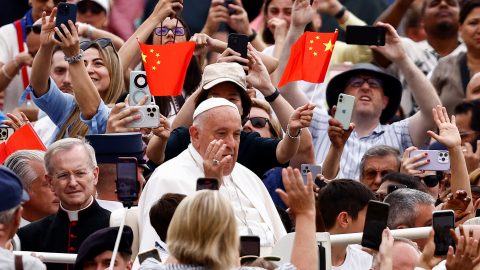
In terms of the global impact of the Vatican’s moral guidance, Scott Appleby, a professor of global affairs at the University of Notre Dame and an expert in religion’s relationship to peace and conflict, thinks that while the Vatican’s influence is not decisive, it is still an important voice. The pope “is the head of a hierarchical, somewhat centralized church” who speaks for 1.2 billion Catholics. “That’s not insignificant itself, but there are a lot of people in the world who listen to the pope just because they’re looking for someone to speak truth to madness.”
The question of how much influence any one leader can have, when constrained by structural factors and historical trajectories, is a perennial one in international relations. “Taiwan must stay focused on continuing to find creative ways to keep the Vatican close, while understanding that the Vatican is under pressure, and the Vatican is being courted by China,” said Zsuzsa Anna Ferenczy, a visiting fellow on EU-Southeast Asia relations at the Martens Centre Brussels.
Thomas Ching-wei Tu (凃京威), a doctoral fellow at National Chengchi University’s College of International Affairs, is optimistic about how Taiwan’s relationship with the Vatican seems to be evolving. Tu noted how Leo specifically mentioned Taiwan in a public address at St. Peter’s Square following Typhoon Ragasa last September. Tu thinks this was unusual, noting that Francis might have instead said that the typhoon hit “Southeast Asia.”
Tu has also noticed “a lot of interaction” between the pope and Taiwan’s new ambassador to the Holy See, Anthony C.Y. Ho (賀忠義), in recent months. Tu attributes this to the fact that Ho, unlike the previous ambassador, is Catholic himself, creating more ceremonial access to the pope.
Being at the Vatican also allows Taiwan’s diplomats to talk to the representatives of other countries, said Tu. Taiwan may only have 12 diplomatic allies, but its relationship with the Vatican opens up the ability to convene with several dozen more. Over 90 countries send diplomatic representatives to Rome to work solely on Vatican-related diplomacy. Foreign Minister Lin Chia-lung (林佳龍) visited Taiwan’s embassy to the Holy See last year.
There is also an enduring symbolic weight to having Taiwan’s flag flying in Rome. “We have a national flag there,” said Tu. “So how can people say that the Republic of China already died? No, never. We have a flag there.”



Leave a Reply