New U.S. Defense Secretary Pete Hegseth has asked the Pentagon to prepare plans to redistribute 8% of the U.S. defense budget next year. Where and how that money is spent could be crucial for Taiwan’s security. But who will decide?
In a statement on the Department of Defense website, acting Deputy Secretary of Defense Robert Salesses said, “Secretary Hegseth has directed a review to identify offsets from the Biden Administration’s FY26 budget that could be realigned from low-impact and low-priority Biden-legacy programs to align with President Donald Trump’s America First priorities for our national defense.”
He went on to say, “Through our budgets, the Department of Defense will once again resource warfighting and cease unnecessary spending that set our military back under the previous administration, including through so-called ‘climate change’ and other woke programs, as well as excessive bureaucracy.”
I encourage readers to view the statement in full. There was much confusion in the media initially that Hegseth intends to simply cut spending by 8%. A holistic reading of what Salasses actually said all but precludes this. It is clear that the money should be redirected towards other national security priorities. What is perhaps missing is clarity that the 8% would be kept “in-house” at the Department of Defense, or spent by other departments such as Homeland Security which also have a claim to the national defense mantle.
Given that Trump has separately called for the U.S. to halve its military budget, it is of course possible that what Sallases said will later be shown to have been irrelevant or superseded by the unpredictable actions of the executive branch above him. We will just note that this is the case and move on, since it is instructive for the question of Taiwanese security to consider the 8% proposal seriously.
Most military thinkers agree that the American military could be better prepared for a possible war with China in the defense of Taiwan. Indeed, I cannot think of a single instance of a prominent voice saying that the U.S. is in a comfortable military position in relation to the strait. The Pentagon’s own analysis acknowledges this.
However, what are the necessary improvements or even reforms to make is a fascinating topic, and I would like to direct readers’ attention to an interesting divide between two camps that is not completely obvious on the surface, since they appear to be somewhat aligned.
We can call these two schools of thought the “Boiling Moat” school and the “Hellscape” school, and, yes, I have deliberately chosen names that heighten rather than alleviate the confusion to make my point.
Both groups take the defense of Taiwan seriously. Both think that the U.S. needs to spend a lot of money on weapons, for deterrence or for war if deterrence fails. Both, I think, believe that the U.S. is in serious danger of being unable to prosecute a war over Taiwan due to inadequate supplies of weapons, although this can be hard for some proponents from either side to articulate due to the roles they occupy.
Team Hellscape takes its name from a quote by Admiral Samuel Paparo, the head of U.S. Indo-Pacific Command, who told The Washington Post in an interview last year, “I want to turn the Taiwan Strait into an unmanned hellscape using a number of classified capabilities.”
The key identifying feature of Hellscapers is that they believe in a new primacy of uncrewed systems, and that the U.S. should prioritize the acquisition of these new weapons types so that it can fight and win the next war, not the last one. These new uncrewed systems would include UAVs, USVs and UUVs, as well as their close cousins the loitering munition and the smart naval mine.
Team Boiling Moat draws from their seminal text The Boiling Moat, edited by former deputy national security advisor Matt Pottinger, but written by many. In this book the “boiling moat” itself is an old Chinese metaphor for a well-marshalled defense.
In Matt Pottinger’s own introductory words: “[We] call for marshaling technologies and weapons systems that, for the most part, already exist in the arsenals of the United States and its partners or have been developed and tested and are eligible for production and procurement.”
Moaters believe that the U.S. should not in the main commit to developing new systems, but rather should focus on building up stockpiles of existing weapons and acquiring more of existing capabilities. They believe that this is enough to win in this decade, and implicitly or explicitly fear that the time needed to develop new systems would leave the U.S. dangerously exposed in the very short-term.
Importantly, the Moaters are not anti-drone. They call for learning the lessons of Ukraine and for Taiwan in particular to acquire uncrewed capabilities as part of an asymmetric warfare strategy. In this sense they overlap with the Hellscapers. They just don’t want to throw the current capabilities baby out with the outdated weapons bathwater.
I am not so sure that the Hellscapers return the favor. Admiral Paparo would no doubt never say that the current U.S. Pacific Fleet is obsolete, but a true-believing Hellscaper might. For better or for worse, this topic has attracted the multi-faceted attention of Elon Musk, who believes that building manned fighter jets like the F-35 is idiotic. Musk recently said that “American weapons programs need to be completely redone.”
One of the great military minds of our generation Musk may not be, but he is the head of the Department of Government Efficiency, a body that is currently tearing through government budgets. Reportedly, Trump has directed Musk to review defense spending and waste at the Pentagon.
This is where the intersection with Hegseth’s 8% “cuts” comes crashing back into the picture. The Washington Post reported on a memo that detailed various categories that should be exempted from the cuts, including one-way attack drones, but also some legacy systems and “munitions.”
In theory then, there is something there for Hellscapers and Moaters alike, even if Hegseth himself is avowedly in favor of uncrewed systems. He made this clear in his confirmation hearing, but it does not preclude a belief in the importance of existing weapons.
The greater issue for Moaters is that if one of the architects of the overall attempted reduction in government spending, Musk, is firmly in the other camp, you can see which way the wind might blow with the defense budget. And here, too, is where the largest elephant in the room raises its trunk, because unlike most of the contributors to this debate, it is not obvious that Musk takes the defense of Taiwan seriously at all.
If there is a serious debate within the Pentagon between the two camps, the Moaters are up for the fight. One of the authors of “The Boiling Moat,” Rear Admiral Mark Montgomery (retired), wrote an article in the New York Post on the weekend calling for the part of the redistributed 8% to be spent on “transport aircraft, refueling aircraft, conventional munitions and, most importantly, as many B-21s [bombers] as we can get our hands on.”

There is also some evidence that the Moaters have the ear of Taiwanese leadership. Both Montgomery and Matt Pottinger met with President Lai Ching-te (賴清德) during a visit to Taipei last week. Both are either openly or quietly here several times a year. Lai just announced a plan to increase Taiwanese defense spending to 3%, which may be difficult in the face of domestic political trouble.
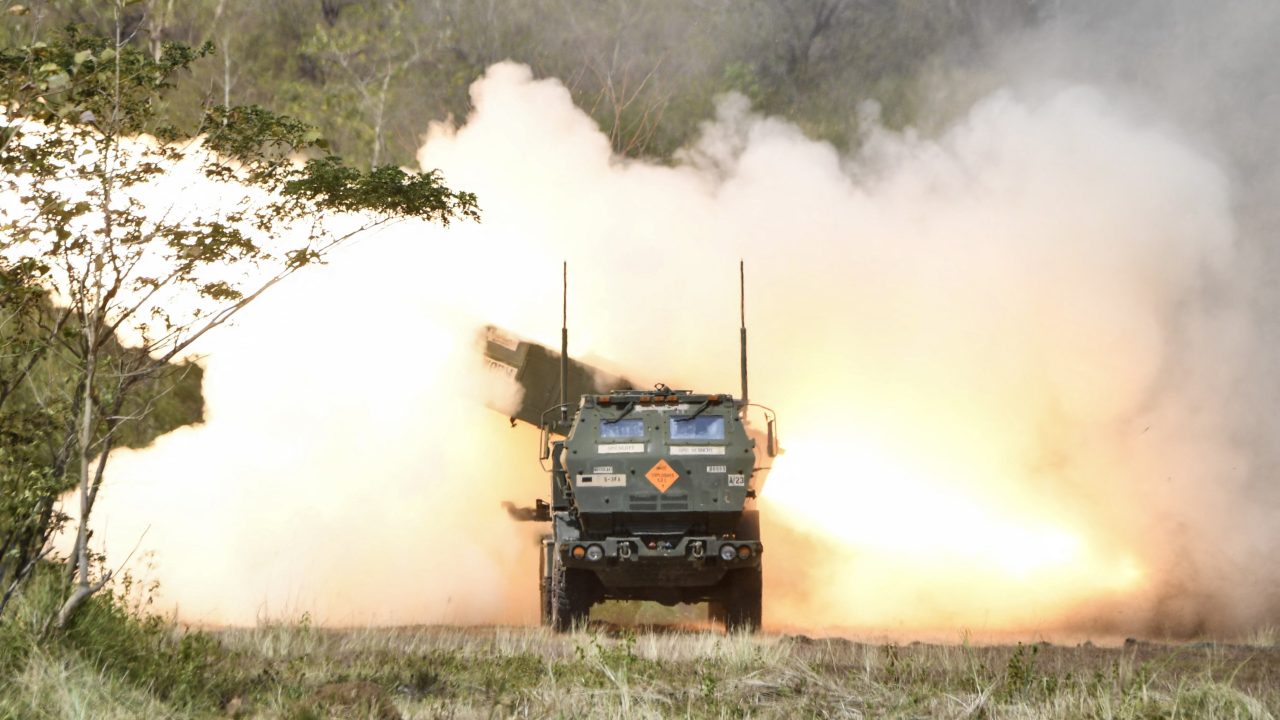
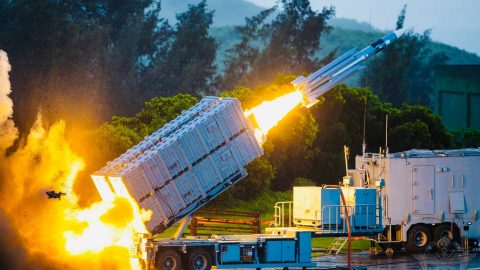
Almost simultaneously Reuters reported that Taiwan is considering a multi-billion dollar arms buy from the U.S, which could include coastal defense missiles and HIMARS rockets. These are conventional munitions for systems that Taiwan already has, and they also happen to be on a list of weapons Taiwan should prioritize in a chapter of “The Boiling Moat.” That chapter, five, was written by Ivan Kanapathy, who is now the Senior Director for Asia at the U.S. National Security Council.
It will be very interesting to see what weapons Taiwan ends up attempting to purchase, and what areas Hegseth’s Pentagon prioritizes in the 2026 defense budget. Then we may truly know whether the Hellscapers or the Moaters are in the ascendency.







Leave a Reply